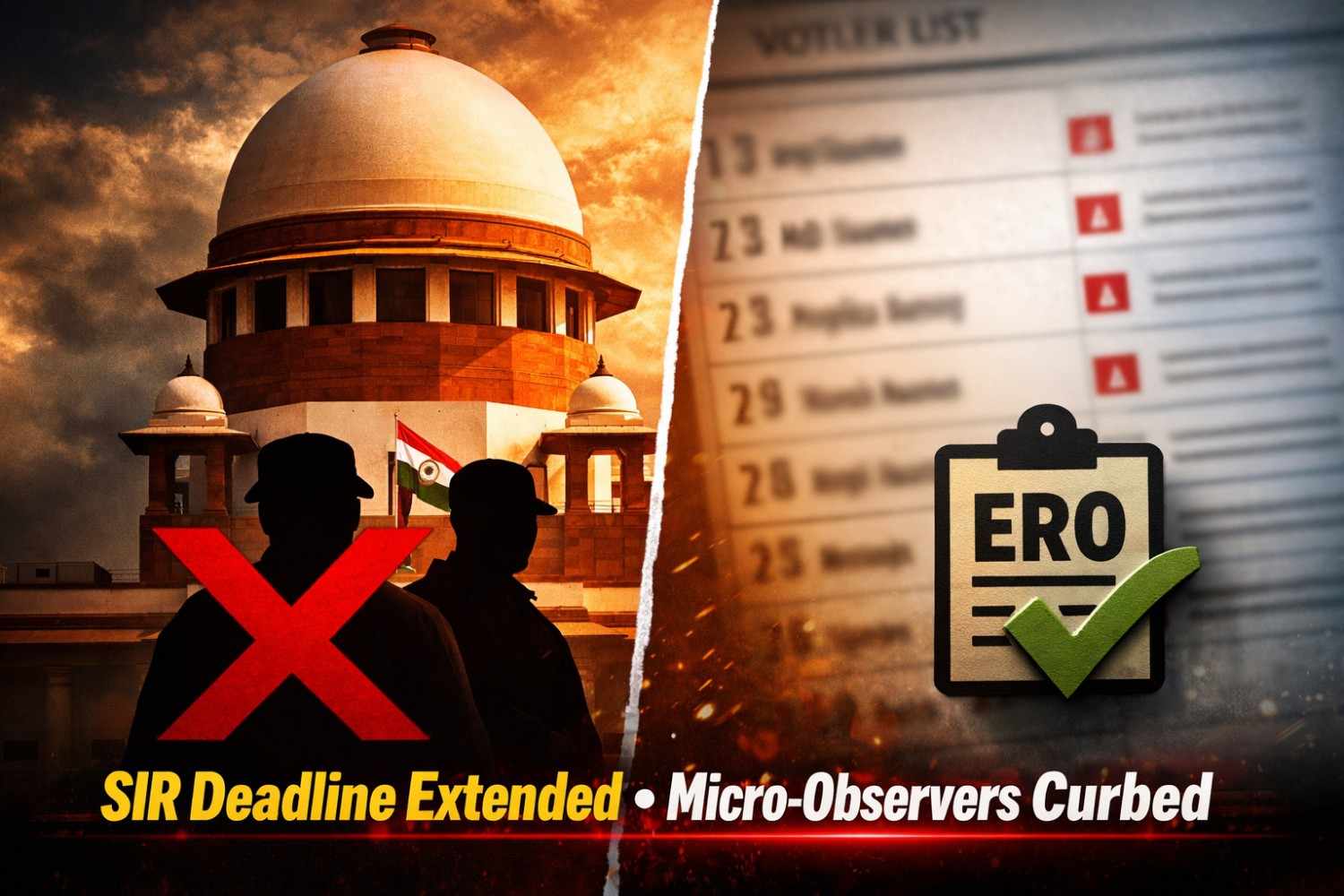
In a decisive intervention in the ongoing electoral roll revision exercise in West Bengal, the Supreme Court of India on Monday issued a slew of key directions aimed at resolving procedural ambiguities and safeguarding voters’ rights. The Bench granted an extension of the deadline for the Special Intensive Revision (SIR), while critically recalibrating the role of micro-observers in the quasi-judicial process.
Supreme Court’s Directions: Extension & Clarification
A Constitution Bench led by Chief Justice of India Surya Kant, along with Justice Joymalya Bagchi and Justice NV Anjaria, extended the existing deadline for completing the scrutiny of objections and documents in West Bengal’s SIR exercise. The final list of electoral rolls was originally due by February 14; the Court has now granted at least a one-week extension to accommodate thorough verification.
The Bench also issued a crucial clarification on the role of micro-observers — personnel drafted by the Election Commission of India (ECI) to assist in the SIR process due to a reported shortage of state officers. The Court stressed that micro-observers cannot themselves pass final orders on claims or objections — that authority remains exclusively with the Electoral Registration Officers (EROs).
“The responsibility already assigned to micro-observers shall be only to assist the DEO/EROs. The final decision will be taken by the EROs only.”
— Supreme Court Order
The Court also directed that Group B officers from the State, whose details were recently furnished, should report for SIR duties and may be trained briefly to assist in the process, thus reducing reliance on centrally appointed micro-observers.
Addressing Violence & State Cooperation
In a stern move, the Supreme Court issued a show-cause notice to the Director General of Police, West Bengal, ordering him to file a personal affidavit in response to serious allegations by the ECI. The poll body had submitted that officials engaged in the SIR exercise faced intimidation, threats and violence in several districts — yet alleged a lack of adequate FIRs or police action.
The Bench underscored its earlier order requiring maintenance of law and order and indicated that failure to ensure the safety of SIR officials could not be tolerated.
Context: The Political and Legal Friction
The SIR exercise has become the epicenter of a high-stakes legal and political battle. The West Bengal Government, led by Chief Minister Mamata Banerjee, challenged the SIR process in the Supreme Court, contending that it has led to mass exclusions rather than inclusions, especially in the so-called “logical discrepancy list.” Critics have alleged that minor mismatches in names — especially due to transliteration from Bengali to English — have triggered notices to voters.
On the other side, the ECI defended its deployment of micro-observers as constitutionally permissible, saying the state failed to provide sufficient Class B officers earlier requested from the government.
Why This Matters
The Supreme Court’s directions have far-reaching implications:
- They reaffirm that quasi-judicial authority lies with statutory officers (EROs) and cannot be delegated to auxiliary personnel.
- The extension ensures that electoral roll revision, a foundational aspect of free and fair elections, proceeds without procedural haste.
- The Court’s insistence on law and order reflects its role in protecting the sanctity of democratic processes, especially in heated political climates.
This judgment serves as a crucial legal yardstick for future electoral revisions and underscores the judiciary’s role in balancing administrative efficiency with constitutional safeguards.