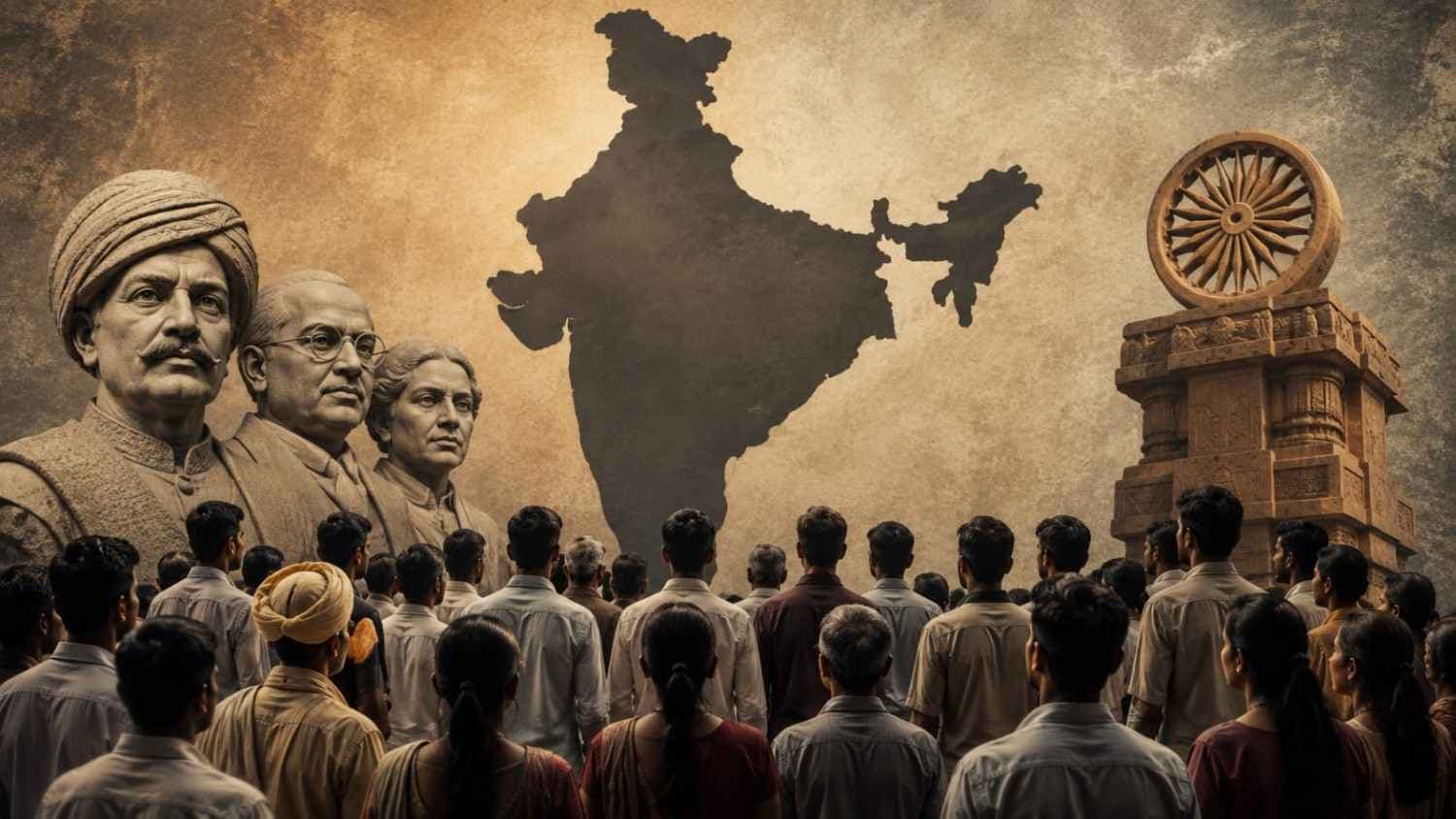
Introduction: The Premise of Affirmative Action in India
Reservation in India represents one of the world’s most extensive affirmative action frameworks. While frequently discussed in contemporary political discourse as a modern legislative tool, its foundations were laid long before the drafting of the Indian Constitution in 1950.
The policy of reservation emerged out of systematic social exclusion, anti-caste reform movements, colonial administrative policies, and intense ideological debates during the freedom struggle. To understand the constitutional validity and social necessity of affirmative action, one must first engage with its core jurisprudence: the distinction between formal equality (treating everyone identically regardless of background) and substantive equality (acknowledging structural disadvantages and providing differential state support to achieve genuine equity).
This article examines the complete trajectory of reservation in India—tracing its pre-independence historical roots, its constitutional crystallization under Dr. B.R. Ambedkar, pivotal judicial interventions such as the Indra Sawhney judgment, and the recent introduction of economic quotas.
Pre-Independence Foundations: Social Reform and Princely State Policies
The intellectual and administrative precedents for reservation developed throughout the late 19th and early 20th centuries across various regions of colonial India.
Jyotirao Phule and the Struggle for Institutional Access (1882)
Social reformer Jyotirao Govindrao Phule and Savitribai Phule pioneered early demands for educational equity in Western India. Phule recognized that social hierarchy was maintained primarily through the denial of literacy and knowledge to marginalized communities.
In 1882, testifying before the Indian Education Commission (headed by Sir William Hunter), Phule urged the British administration to prioritize primary education and offer state-funded assistance to socially depressed castes. Phule’s central thesis was foundational to modern affirmative action: declaring equal rights under the law remains ineffective if historical barriers prevent marginalized sections from accessing public infrastructure.
The Kolhapur Model of Executive Reservation (1902)
The earliest formal administrative policy guaranteeing reserved quota in government employment occurred in the princely state of Kolhapur. In July 1902, Chhatrapati Shahu Maharaj issued a historic royal decree reserving 50% of administrative positions in his state for non-Brahmin and backward classes.
Shahu Maharaj identified a structural imbalance in state administration, where public offices were monopolized by a few privileged communities. The Kolhapur policy established that government employment was not merely a revenue-earning opportunity, but a instrument of state power that required broad-based social participation.
The Madras Presidency Communal G.O. (1921)
In Southern India, the non-Brahmin movement led by the Justice Party contested the disproportionate representation of elite castes in government offices and educational institutions under the British administration.
This mobilization led to the passage of the landmark Communal Government Order (G.O. No. 613) in 1921 in the Madras Presidency. The Communal G.O. established a quota system dividing government appointments among specified community categories, including Non-Brahmins, Brahmins, Muslims, Anglo-Indians/Christians, and Depressed Classes. This legislative action proved that affirmative action policies were active mechanisms in Indian administration decades prior to independence.
Political Representation and the Poona Pact of 1932
As India moved toward constitutional reforms under British rule, the focus of affirmative action expanded from educational and employment preferences to political representation.
HISTORICAL TRAJECTORY OF POLITICAL & EXECUTIVE SAFEGUARDS

Caste-Based Exclusion
  └── Jyotirao Phule (Hunter Commission Testimony, 1882)
        └── Kolhapur Decree (Shahu Maharaj, 1902)
              └── Communal G.O. (Madras Presidency, 1921)
                    └── Communal Award & Poona Pact (1932)
                          └── Drafting of the Constitution (1950)
The Ramsay MacDonald Communal Award (1932)
Dr. B.R. Ambedkar advocated strongly for statutory political safeguards for the "Depressed Classes" (the term then utilized for communities later designated as Scheduled Castes). Ambedkar maintained that social reform alone, lacking institutional power, could not protect marginalized populations from systemic oppression.
In August 1932, British Prime Minister Ramsay MacDonald announced the Communal Award, which granted separate electorates to the Depressed Classes, alongside other minority communities. Under a separate electorate system, members of a specific community vote exclusively for candidates from their own group.
The Gandhi-Ambedkar Ideological Conflict
Mahatma Gandhi vehemently opposed separate electorates for the Depressed Classes, arguing that institutionalizing separate voter rolls would permanently divide Hindu society and isolate the Depressed Classes from the social fold. Gandhi began a fast unto death at Yerwada Central Jail in Pune to demand the withdrawal of separate electorates for marginalized castes.
Ambedkar contended that without exclusive political leverage, representatives from marginalized communities would remain subordinated to dominant electoral majorities within joint voter rolls.
The Terms of the Poona Pact (September 24, 1932)
Recognizing the imminent threat to Gandhi’s life and seeking an institutional compromise, Ambedkar and other leaders signed the Poona Pact on September 24, 1932.
The compromise altered the political framework in two primary ways:
Abandonment of Separate Electorates: The proposal for separate voter rolls for the Depressed Classes was relinquished.
Expansion of Reserved Seats within Joint Electorates: In return, the number of legislative seats reserved for the Depressed Classes within the joint electorate was increased significantly—from 71 seats under the Communal Award to 148 seats across provincial legislatures.
The Poona Pact established the operational model for political reservation in post-independence India: reserving specific constituencies for marginalized groups while keeping the voting population unified across community lines.
The Constitutional Scheme: Constructing the Framework for Equality
When the Constituent Assembly drafted the Constitution of India between 1946 and 1949 under the leadership of Dr. B.R. Ambedkar as Chairman of the Drafting Committee, social justice was embedded directly into the foundational legal architecture.
Key Constitutional Provisions
Article 14 (Equality Before Law): Guarantees equality before the law and equal protection of the laws within the territory of India.
Article 15 (Prohibition of Discrimination): Prohibits the State from discriminating against any citizen on grounds only of religion, race, caste, sex, or place of birth.
Article 15(4) [Added by 1st Amendment, 1951]: Empowers the State to make special provisions for the advancement of any socially and educationally backward classes of citizens, or for the Scheduled Castes and the Scheduled Tribes.
Article 16 (Equality of Opportunity in Public Employment): Guarantees equality of opportunity for all citizens in matters relating to employment or appointment to any office under the State.
Article 16(4): Explicitly allows the State to make provisions for the reservation of appointments or posts in favor of any backward class of citizens which, in the opinion of the State, is not adequately represented in the services under the State.
Article 17 (Abolition of Untouchability): Abolishes "Untouchability" and forbids its practice in any form, making its enforcement a punishable offense.
Article 46 (Directive Principles): Mandates that the State shall promote with special care the educational and economic interests of the weaker sections of the people, and in particular, of the Scheduled Castes and the Scheduled Tribes.
Legal Clarification: The "Ten-Year Expiry" Myth
A persistent misunderstanding in public discourse is that Dr. Ambedkar intended all forms of reservation to end after ten years.
From a constitutional standpoint, this assumption is legally inaccurate:
The ten-year time limitation inserted under Article 334 applied exclusively to political reservations (reserved seats in the Lok Sabha and State Legislative Assemblies for SCs and STs). Parliament has consistently extended this period through constitutional amendments (most recently via the 104th Constitutional Amendment Act, 2019).
Reservation in educational institutions and public employment under Articles 15(4) and 16(4) contained no statutory sunset clause or time limit. These provisions were enacted as standing enabling measures tied to the social reality of backwardness and inadequate representation.
Post-Independence Expansion: The Mandal Commission and OBC Reservation
While the post-1950 constitutional structure immediately catered to Scheduled Castes (SCs) and Scheduled Tribes (STs), affirmative action for Other Backward Classes (OBCs) developed over subsequent decades.
Article 340 and the Commissions for Backward Classes
Article 340 of the Constitution empowers the President to appoint a Commission to investigate the conditions of socially and educationally backward classes.
The Kalelkar Commission (1953): The First Backward Classes Commission, headed by Kaka Kalelkar, submitted its report in 1955. However, its recommendations were not implemented due to disagreements over the criteria for identifying backwardness.
The Mandal Commission (1979): The Prime Minister Morarji Desai-led government appointed the Second Backward Classes Commission under the chairmanship of B.P. Mandal.
Findings and Recommendations of the Mandal Report
Submitted in December 1980, the Mandal Commission applied social, educational, and economic indicators to identify backward communities. The Commission concluded that OBCs comprised approximately 52% of the Indian population and recommended a 27% reservation in central government jobs and educational institutions for OBC candidates.
In August 1990, the V.P. Singh-led Union Government announced the implementation of the Mandal Commission's recommendations, sparking nationwide protests, litigation, and political realignment.
Landmark Supreme Court Jurisprudence
The Indian judiciary has played a defining role in shaping, limiting, and validating the reservation system through constitutional interpretation.
KEY SUPREME COURT LANDMARKS

State of Madras v. Champakam Dorairajan (1951)
  └── Triggered 1st Constitutional Amendment (Enacted Article 15(4))
        │
Indra Sawhney v. Union of India (1992)
  └── Established 50% Ceiling, Creamy Layer Exclusion, & Adequacy of Representation
        │
Janhit Abhiyan v. Union of India (2022)
  └── Upheld 103rd Amendment (EWS Quota based purely on economic criteria)
State of Madras v. Champakam Dorairajan (1951)
Context: The Supreme Court struck down communal quotas in medical and engineering colleges in Madras, holding that communal reservations violated Article 29(2) of the Constitution.
Impact: Parliament responded immediately by enacting the First Constitutional Amendment Act, 1951, adding Clause (4) to Article 15. This amendment formally authorized state affirmative action in educational admissions.
Indra Sawhney v. Union of India (1992) — The Mandal Case
A landmark nine-judge Constitution Bench evaluated the constitutional validity of the 27% OBC quota. The Court upheld the reservation framework while laying down structural parameters:
Social and Educational Basis: Backwardness under Article 16(4) must be social and educational. Caste can be used as a primary criterion to identify backwardness, but economic status alone cannot define a "backward class" under Article 16(4).
The 50% Rule Ceiling: Reservations should not exceed 50% of total available seats, preserving a balance between affirmative action and open competition, except under extraordinary regional circumstances.
The Creamy Layer Doctrine: The economically advanced individuals within OBC communities ("creamy layer") must be excluded from reservation benefits so that aid reaches the genuinely disadvantaged.
No Reservation in Promotions: Reservation under Article 16(4) was restricted to initial appointments, not promotions (though subsequent constitutional amendments, including Articles 16(4A) and 16(4B), were enacted by Parliament to enable promotion quotas and backlog vacancy carry-forwards for SCs and STs).
The Shift to Financial Status: The EWS Reservation Framework
The fundamental premise that affirmative action must be rooted primarily in social and educational backwardness was restructured in 2019.
The 103rd Constitutional Amendment Act (2019)
Parliament passed the 103rd Amendment, introducing Articles 15(6) and 16(6) to the Constitution. This amendment empowered the State to provide up to 10% reservation for Economically Weaker Sections (EWS) among citizens who are not covered under existing SC, ST, or OBC reservation categories.
Unlike previous reservation schemes, EWS eligibility is defined strictly by financial criteria (household income and asset ownership) rather than caste identity or social backwardness.
Janhit Abhiyan v. Union of India (2022)
A five-judge Constitution Bench of the Supreme Court evaluated the constitutional validity of the EWS quota. By a 3:2 majority, the Court upheld the 103rd Amendment, establishing major precedents:
Economic Criteria as a Standalone Head: The majority held that economic disadvantage alone can serve as a valid basis for affirmative action under the Constitution.
Exclusion of SC/ST/OBC Categories: The exclusion of existing reserved categories from EWS benefits was ruled constitutionally permissible, as those groups already access targeted affirmative action under Articles 15(4) and 16(4).
Flexibility of the 50% Rule: The majority ruled that the 50% ceiling established in Indra Sawhney applied specifically to social and educational reservations and was not an inflexible limit for new categories created by constitutional amendments.
Contemporary Debates: Equity, Efficiency, and Governance
As the reservation framework expands, modern constitutional and administrative debates center on several key issues:
Sub-Classification within SCs/STs: Questions over whether state governments possess the legislative power to create sub-categories within Scheduled Castes to ensure equitable distribution of benefits among the most marginalized sub-groups.
Demand for a Comprehensive Caste Census: Proponents argue that updated socio-economic caste data is legally necessary to fulfill the "inadequate representation" requirement under Article 16(4). Opponents express concern over potential social fragmentation.
Merit vs. Substantive Equality: Critics argue that quotas compromise administrative efficiency (referencing Article 335). Conversely, constitutional jurisprudence—notably reaffirmed in BK Pavitra II (2019)—maintains that true merit cannot be reduced to examination scores alone when candidates start from unequal socio-economic background positions.
Conclusion
Reservation in India is not a static policy, nor was it constructed as an overnight concession in 1950. It represents a evolving constitutional response to historical exclusion, institutional inequality, and systemic under-representation.
From the early educational demands of Jyotirao Phule and Shahu Maharaj’s executive orders to the legal compromises of the Poona Pact, the constitutional architecture built by Dr. B.R. Ambedkar, and modern Supreme Court rulings on the creamy layer and EWS quotas, affirmative action reflects an ongoing effort to balance individual merit with constitutional equity.
Understanding this complex history is indispensable for engaging with the present legal debates surrounding social justice and governance in India.