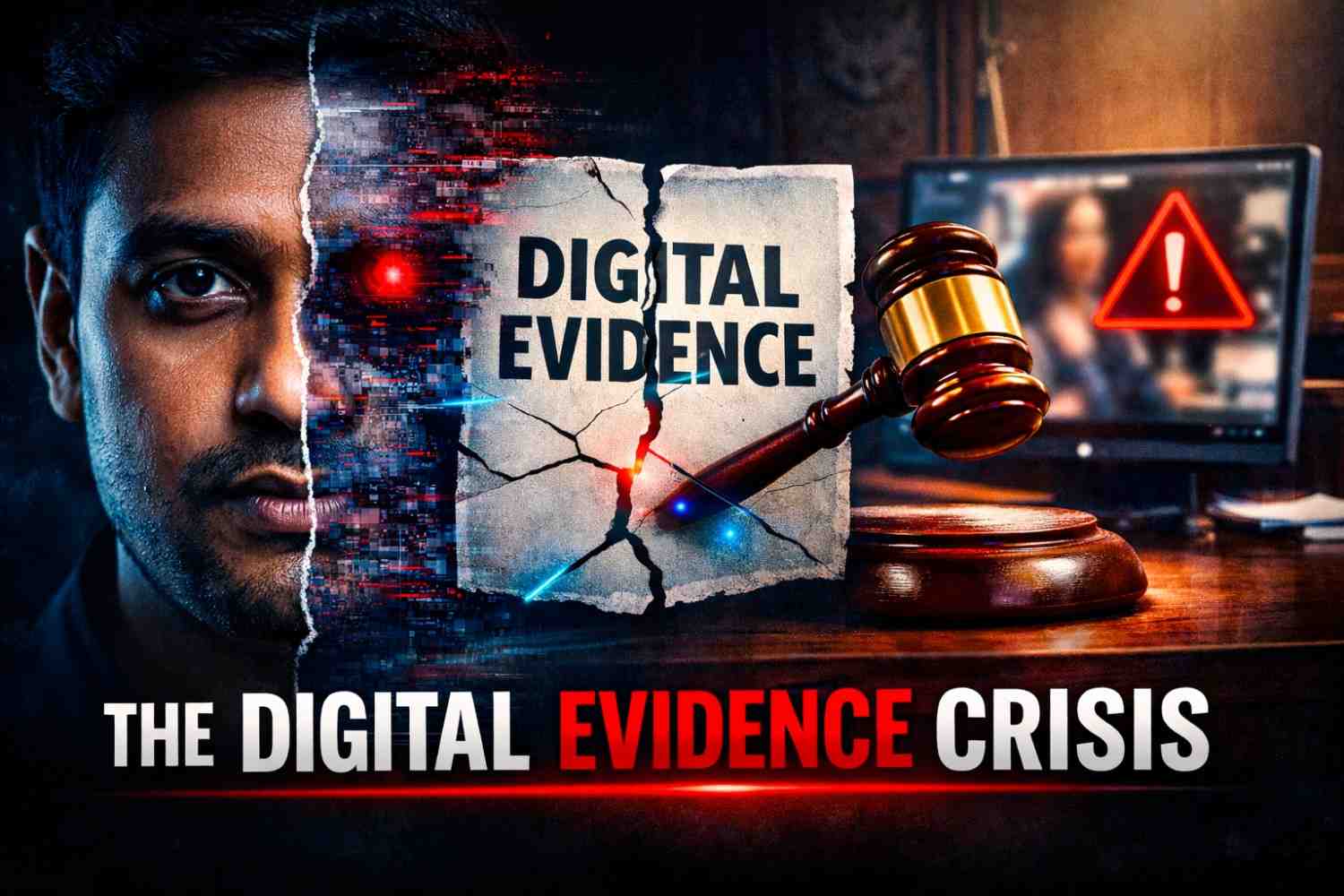
The Indian judicial system operates on a foundational epistemological assumption: that a photograph, a video recording, or an audio clip is a reflection of reality, captured by a device acting as a neutral observer. For decades, the evidentiary battleground has been strictly procedural—proving that the device was working, that the storage media was uncorrupted, and that the chain of custody remained intact.
We are now witnessing the silent collapse of this framework. The proliferation of Generative Adversarial Networks (GANs) and sophisticated deepfake technology has severed the tether between "digital record" and "physical reality." Today, high-fidelity synthetic media can be generated not by capturing an event, but by computing it.
This presents a systemic crisis for Indian criminal and civil justice. As courts transition to the Bharatiya Sakshya Adhiniyam, 2023 (BSA), they largely inherit the logic of Section 65B of the Indian Evidence Act, 1872 (IEA)—a provision designed for mainframe computers and physical servers, not for an era where AI can manufacture a confession, fabricate a bribery sting, or simulate a riot. The danger is not merely that fake evidence will be admitted, but that the legal standards for distinguishing truth from simulation are structurally inadequate. We are entering an era of "epistemic anarchy" in the courtroom, where the provenance of digital evidence is presumed rather than proven.
The Evolution of Digital Evidence
To diagnose the breakdown, one must analyze the trajectory of electronic evidence in India. The legislative intent, historically, was to facilitate the admissibility of computer outputs, acknowledging that modern commerce and governance rely on paperless records.
The judicial journey from State (NCT of Delhi) v. Navjot Sandhu (2005) to the landmark Anvar P.V. v. P.K. Basheer (2014) represented a shift from lax admissibility to strict procedural compliance. Anvar correctly overruled Navjot Sandhu, establishing that electronic records generally require certification to be admissible. This was further cemented by Arjun Panditrao Khotkar v. Kailash Kushanrao Gorantyal (2020), which clarified the mandatory nature of certification under Section 65B(4) of the IEA (mirrored in Section 63(4) of the BSA).
However, these judgments addressed a specific 20th-century problem: reliability of the device. The judicial anxiety was focused on whether a computer was operating properly or if a file had been corrupted during transfer. The courts assumed that if the device was working and the file was not tampered with after creation, the content was a reliable record of an event.
This logic is obsolete. In the context of AI, a perfectly functioning computer can generate a perfectly fabricated video. The "integrity of the source" is no longer synonymous with the "integrity of the device." The Indian evidentiary framework has spent twenty years perfecting the lock on the door (admissibility procedure) while the walls of the house (authenticity) are dissolving.
Deepfakes and Synthetic Media
Deepfakes represent a fundamental shift in the ontology of evidence. Traditional digital forgery (such as Photoshop or crude splicing) leaves digital artifacts—pixel inconsistencies, metadata clashes, or lighting irregularities—that forensic analysts can often detect.
AI-generated synthetic media is different. It does not just manipulate pixels; it regenerates them. A deepfake audio clip of a CEO admitting to fraud, or a politician inciting violence, is constructed using training data to mimic biometric markers—voice timbre, cadence, and micro-expressions.
The threat to Indian law is twofold:
- The Weaponization of Fabrication: In a political and legal landscape heavily reliant on WhatsApp forwards and leaked "sting" videos, the barrier to creating incriminating evidence has lowered to near-zero. A malicious actor no longer needs a sophisticated studio; they need a subscription to a commercially available generative AI tool.
- The "Liar’s Dividend": This is the converse threat, identified by legal scholars Chesney and Citron. As deepfakes become common, genuine evidence will be dismissed as "fake." A guilty defendant caught on genuine CCTV can plausibly argue, "That is an AI-generated fabrication," and the prosecution may struggle to prove the negative without expensive, probabilistic forensic analysis that Indian trial courts are currently ill-equipped to evaluate.
Section 65B and the Procedural Safeguards
The central doctrinal failure lies in the certification requirement, formerly Section 65B of the IEA and now Section 63 of the BSA.
The certificate requires a responsible person to attest that:
- The computer output was produced by a computer used regularly to store or process information.
- The computer was operating properly during the relevant period.
Why this fails in the AI Age: Consider a scenario where a bad actor uses a standard laptop to generate a deepfake video of a crime. They then transfer this video to a USB drive.
- Was the computer working properly? Yes.
- Was the data processed in the ordinary course of use? Yes.
- Is the content a truthful representation of reality? No.
A Section 65B/BSA certificate attests to the health of the hardware, not the veracity of the data. It acts as a chain-of-custody document, not an authenticity verification. In the era of cloud computing and AI, where data is often processed by "black box" algorithms on distributed servers, the certifier (often a nodal officer or IT manager) rarely has personal knowledge of the content's genesis. They are certifying the container, oblivious to the fact that the contents are synthetic.
The law demands a certificate of admissibility, but the crisis requires a certificate of provenance. The current statute provides no mechanism to distinguish between a file created by a camera sensor (photon capture) and a file created by a neural network (pixel prediction).
Indian courts generally display a high degree of reliance on electronic evidence once the procedural hurdles of Arjun Panditrao are cleared. There is a "presumption of reality" attached to audio-visual material.
In recent criminal trials, courts have begun to grapple with "hash values" and forensic cloning to ensure data hasn't been altered post-seizure. However, the judicial reasoning consistently misses the pre-seizure synthesis.
For instance, in cases involving defamatory social media posts or cyber-stalking, courts often rely on the IP address and the device recovery. If the device contains the file, the link is established. But if the file itself is a deepfake planted or generated to frame the accused, the current forensic standard operating procedures (SOPs) often stop at "file integrity" (does the hash match?) rather than "content authenticity" (is this a recording of a real human?).
We are seeing the early signs of this breakdown in family law and matrimonial disputes, where manipulated audio recordings are increasingly submitted. Family courts, often less stringent on technical forensics than criminal courts, are at high risk of basing custody or alimony decisions on synthetic fabrications. The judiciary is applying analog logic to digital deception.
Comparative Perspectives
Globally, jurisdictions are scrambling to patch this evidentiary gap.
The United States: The US approach, governed by Federal Rules of Evidence (Rule 901), focuses on authentication. Recent amendments and scholarship suggest a move toward "distinctive characteristics" testing. US courts are increasingly open to "forensic detection algorithms" that analyze metadata and compression artifacts to detect AI generation. However, this creates an "arms race" between deepfake generators and detectors.
The European Union: The EU’s AI Act takes a regulatory approach, mandating watermarking and transparency for AI-generated content. While this helps in the commercial sphere, it does little for criminal justice where bad actors will simply bypass watermarking protocols.
China: China has introduced "Deep Synthesis" provisions, explicitly regulating the use of technologies that alter biometric data. They require platform-level authentication.
Lesson for India: India cannot rely solely on the EU's "watermarking" (which criminals will ignore) or the US's "adversarial expert witness" model (which is too expensive for the average Indian litigant). India needs a doctrinal shift that places the burden of proving authenticity on the party introducing the digital evidence, specifically when the nature of the evidence is challenged on the grounds of synthetic manipulation.
Consequences for Justice
If the Indian Evidence framework remains static, the consequences will be severe and multifaceted:
- Wrongful Convictions: We face the terrifying prospect of individuals being incarcerated based on fabricated voice notes or videos that pass the Section 65B/BSA procedural check.
- The Death of Open Source Intelligence (OSINT): Investigative journalism and public interest litigation often rely on whistleblower videos. If courts adopt a blanket skepticism of all video due to deepfakes (the Liar's Dividend), genuine human rights violations recorded by citizens will be dismissed as "potentially AI."
- Investigative Paralysis: Law enforcement agencies may find their own evidence—CCTV footage, intercepted calls—constantly bogged down in "authenticity hearings," stalling trials that are already famously delayed.
The Need for Doctrinal Reform
The transition from the Indian Evidence Act to the Bharatiya Sakshya Adhiniyam was a missed opportunity to explicitly address synthetic media. Merely retaining the certification requirement of Section 65B (now Section 63) is akin to using a padlock to secure a cloud server.
Judicial caution is no longer enough. We need:
- Mandatory Forensic Metadata Analysis: Courts must mandate that for contested electronic evidence, a "hash value" match is insufficient. Forensic reports must explicitly analyze the file for signs of synthesis (GAN artifacts, unnatural compression).
- A Rebuttable Presumption of Manipulation: In cases where a party provides a prima facie technical challenge to the authenticity of a video/audio, the burden should shift to the submitter to prove the recording's provenance—not just its storage history.
- Legislative Amendment: The BSA requires a specific provision for "Synthetic and AI-Generated Evidence," distinguishing it from standard "Electronic Records."
The silent breakdown of our evidence framework is already underway. Unless we acknowledge that "seeing is no longer believing," the Indian courtroom risks becoming a theater of high-tech fiction, rather than a sanctuary of truth.