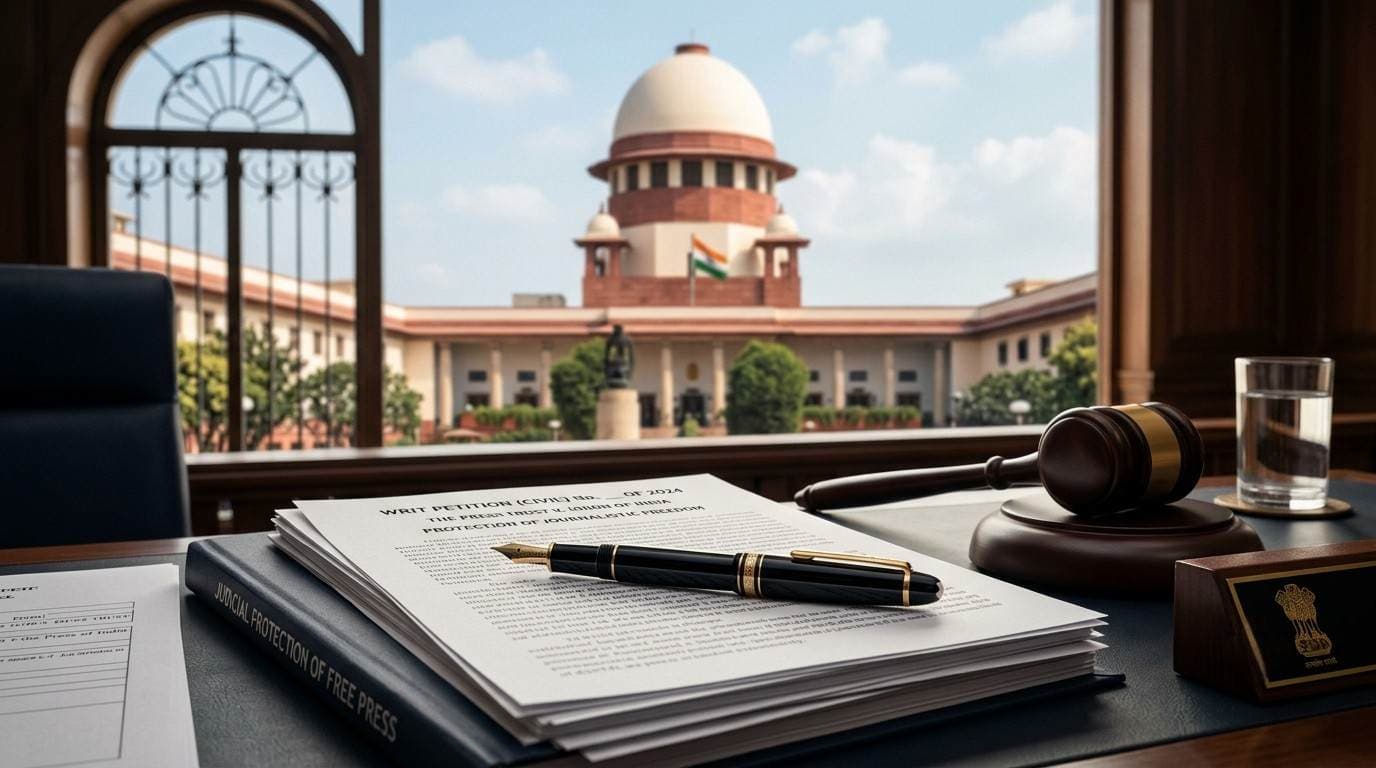
The Supreme Court of India has agreed to hear an urgent petition filed by investigative journalist Abhishek Upadhyay, who is seeking the quashing of a police case registered against him. The journalist, known for breaking reports on alleged financial irregularities in Ram Mandir donations and corruption in state administration, contends that the criminal case filed against him is a staged retaliation intended to intimidate and silence his reportage.
The matter was mentioned for urgent listing before a bench comprising Chief Justice of India Surya Kant, Justice Joymalya Bagchi, and Justice V. Mohana. Following submissions by his legal counsel detailing repeated police visits to his residence and the urgency of the situation, the top court agreed to list the matter for a hearing.
At the core of the dispute is a First Information Report (FIR) registered on August 18 following an alleged road rage altercation. The complainant accused Upadhyay of hitting a two-wheeler from behind, followed by verbal abuse and intimidation, leading to charges under sections of the Bharatiya Nyaya Sanhita alongside stringent provisions of the Scheduled Castes and Scheduled Tribes (Prevention of Atrocities) Act.
In his writ petition before the top court, the journalist categorically denied the allegations, describing the incident as an entirely fabricated setup. According to the petition, Upadhyay was returning home after picking up his minor daughter from school when a motorcyclist pulled alongside his vehicle and attempted to create a disturbance. He stated that he deliberately avoided any confrontation to protect his daughter and that no physical collision or verbal argument took place.
The plea further contends that the timing and nature of the criminal case point to targeted harassment by authorities. Prior to the incident, Upadhyay had published investigative exposés concerning alleged embezzlement of donations related to the Ram Mandir Trust, as well as a high-value land acquisition report involving a senior bureaucratic officer.
According to the petition, independent inquiries made by the journalist's colleagues revealed inconsistencies in the prosecution's claims. The plea highlights discrepancies regarding the two-wheeler mentioned in the complaint, asserting that its registration details, model type, and ownership records do not match the particulars recorded in the official FIR.
Additionally, the petition claims that efforts to retrieve local CCTV footage from commercial establishments near the alleged scene of occurrence were obstructed, alleging that surveillance records had been pressured into non-disclosure.
With the Supreme Court scheduled to examine the maintainability of the petition and the prayer for interim protection, the case highlights the ongoing legal battle surrounding press freedom, journalistic accountability, and the threshold required for judicial intervention in criminal investigations.