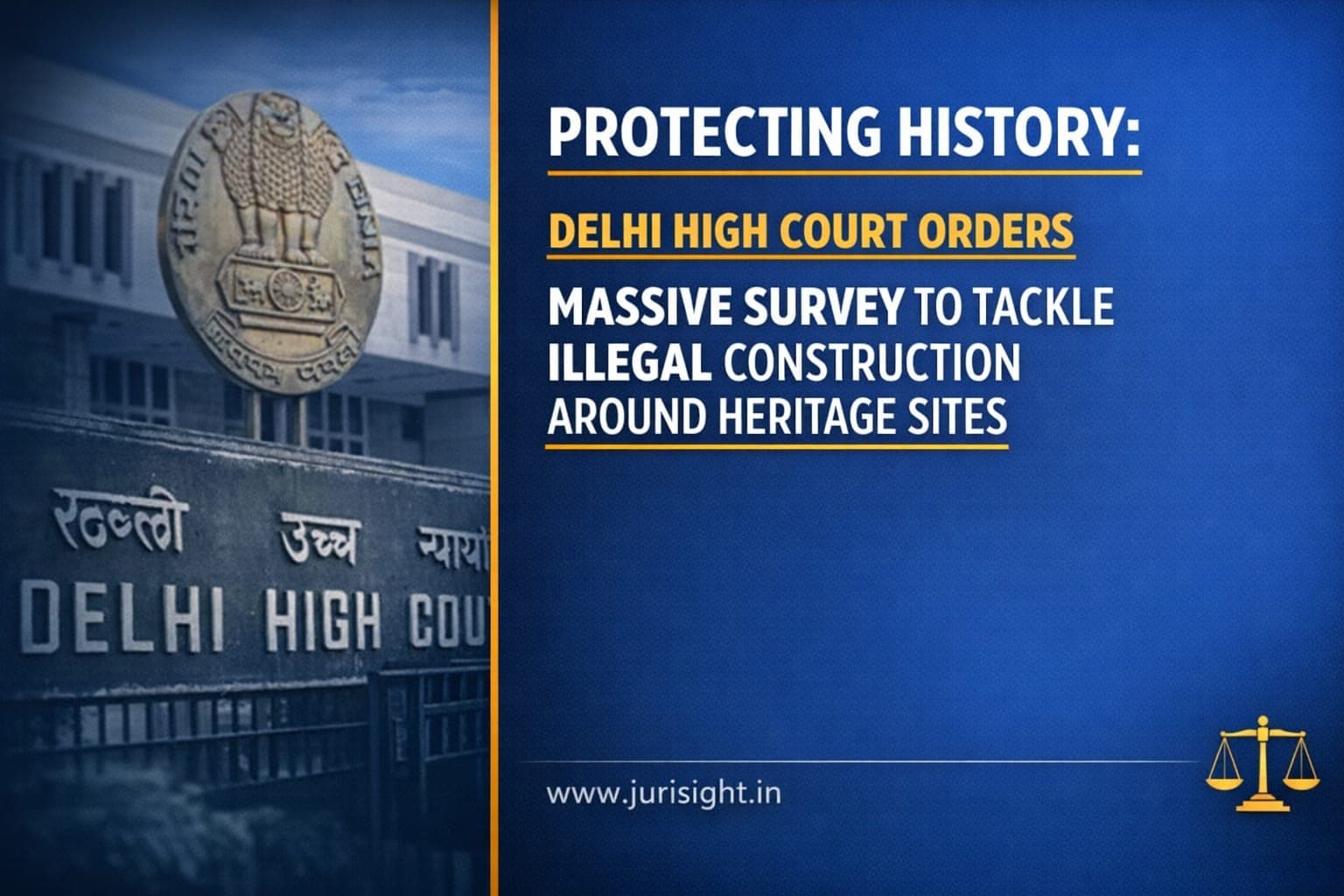
In a significant move to protect the historical character of the national capital, the Delhi High Court has directed the Municipal Corporation of Delhi (MCD) to conduct a comprehensive survey of all buildings located near notified heritage properties. The court's primary objective is to identify and curb illegal constructions that threaten to deface or alter the unique identity of Delhi's heritage.
A Division Bench comprising Chief Justice Devendra Kumar Upadhyaya and Justice Tejas Karia issued these directions while hearing a batch of petitions. These pleas, including the lead matter Kusum Sehgal v. Heritage Conservation Committee & Ors, raised serious grievances regarding widespread violations of building bye-laws in heritage zones.
The petitioners approached the court with a alarming concern: unauthorized constructions in the vicinity of national heritage sites are not just legal violations, but are actively "altering and defacing" the character of these structures.
It was argued that many of these constructions—some ongoing and others already completed—tend to change the very essence of heritage properties. The petitioners highlighted that:
- Occupiers often deviate significantly from sanctioned building plans.
- The MCD has, in several instances, allegedly ignored building bye-laws while approving plans.
- Crucial advice from the Heritage Conservation Committee (HCC) has frequently been overlooked by municipal authorities.
The court took serious note of these submissions, recognizing that heritage buildings are not just old structures but a vital part of the city’s cultural fabric that requires strict protection.
To address these issues, the High Court has laid down a strict roadmap for the authorities. The Bench directed the MCD to constitute a specialized survey team. To ensure expert oversight, the court mandated that the team must include at least one officer from the Heritage Conservation Committee, to be nominated by its Chairperson.
Key highlights of the Court's Order:
- Comprehensive Scope: The survey will cover all buildings situated in the vicinity of the heritage properties listed in the petitions.
- Verifying Compliance: The team must ascertain whether the constructions are in accordance with established norms and the officially sanctioned building plans.
- Individual Accountability: A separate report must be filed for each heritage property mentioned in the petitions.
- Transparency: Copies of these reports must be served to the petitioners' counsel, allowing them to file responses or objections before the next hearing.
"In the survey, it shall appropriately be ascertained as to whether the constructions raised in such buildings... are in accordance with the norms and the approved sanctioned building plan," the Bench observed.
Understanding the urgency of the matter, the High Court has set a firm deadline. The MCD and the HCC must complete this massive survey and submit their findings within three months.
This order is seen as a major victory for heritage activists who have long complained about the "builder mafia" and administrative apathy in Old Delhi and other heritage-rich areas like Mehrauli and Shahjahanabad.
For years, Delhi’s heritage has been under threat from rapid, unplanned urbanization. Illegal extensions, additional floors, and modern facade changes in the "buffer zones" around protected monuments often ruin the visual integrity of the site. By involving the Heritage Conservation Committee directly in the survey, the High Court has ensured that "conservation" is prioritized over "regularization."
The court has clarified that the term "heritage property" refers to all buildings and structures enlisted in relevant government notifications.
The court has scheduled the next hearing for May 15, 2026, by which time the MCD is expected to have a clear picture of the scale of unauthorized construction surrounding Delhi's history.
For the residents and property owners in these areas, the message from the Bench is clear: adherence to sanctioned plans is no longer optional, and the protection of heritage is a collective legal responsibility.
- Case Title: Kusum Sehgal v. Heritage Conservation Committee & Ors & Other Connected Matters
- Bench: Chief Justice Devendra Kumar Upadhyaya and Justice Tejas Karia
- Date of Order: January 28, 2026