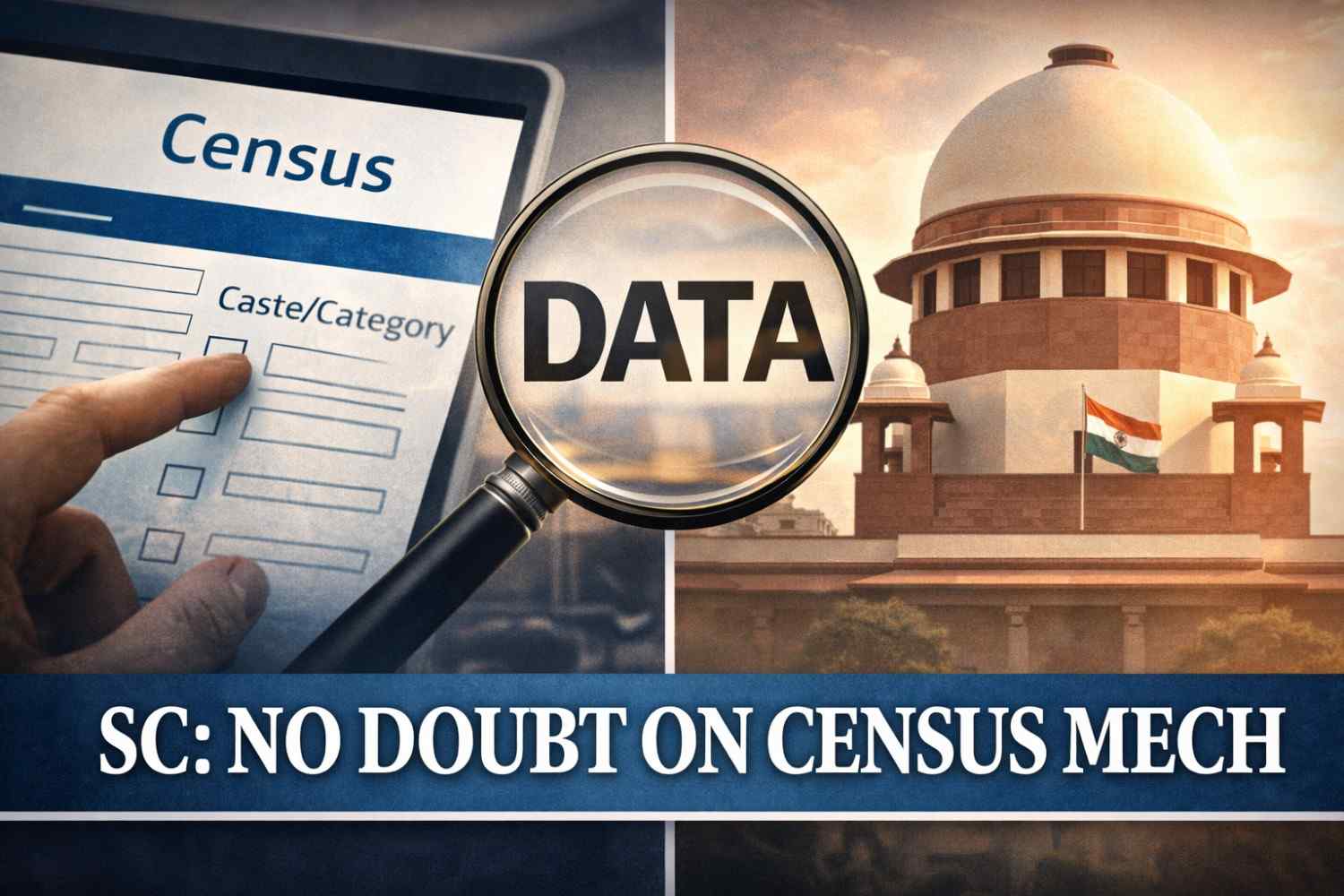
The Supreme Court of India has refused to entertain a Public Interest Litigation (PIL) that sought to micromanage the procedure for the upcoming Census 2027, specifically regarding the collection and verification of caste data. Emphasizing judicial restraint in policy matters, the Apex Court observed that it has "no reason to doubt" that the government has evolved a robust mechanism for the exercise, which is set to be India's first comprehensive caste enumeration since 1931.
The PIL, filed by academician Aakash Goel, raised concerns about the lack of a "pre-determined data" set or a transparent questionnaire for recording caste identities. Represented by Senior Advocate Mukta Gupta, the petitioner argued that without a clear disclosure of criteria, the classification of caste data—especially now that it extends beyond just Scheduled Castes (SCs) and Scheduled Tribes (STs)—could be prone to massive errors and ambiguity.
The matter was heard by a bench comprising Chief Justice of India Surya Kant and Justice Joymalya Bagchi. The Bench made it clear that the Census is a highly specialized administrative exercise governed by the Census Act, 1948 and Census Rules, 1990, which empower the authorities to determine the "particulars and manner" of the operation.
Dismissing the need for judicial oversight at this stage, the Court noted:
"We have no reason to doubt that the respondent authorities, with the aid and assistance of domain experts, have evolved a robust mechanism to rule out errors as apprehended by the petitioner."
While the Court declined to issue binding directions, it did not dismiss the petitioner's concerns entirely. The Bench acknowledged that some "relevant issues" had been raised and disposed of the petition by requesting the Registrar General and Census Commissioner of India to consider the suggestions made by the petitioner in his legal notice.
The 2027 Census is poised to be a historic and politically sensitive exercise, as it transitions to a fully digital format and includes a broader caste count. By adopting a "hands-off" approach, the Supreme Court has reaffirmed the principle that the judiciary should not step into the shoes of the executive in complex data-collection exercises. However, by asking the Centre to "consider" the suggestions, it has kept a window open for administrative accountability without stalling the massive logistical machinery of the Census.