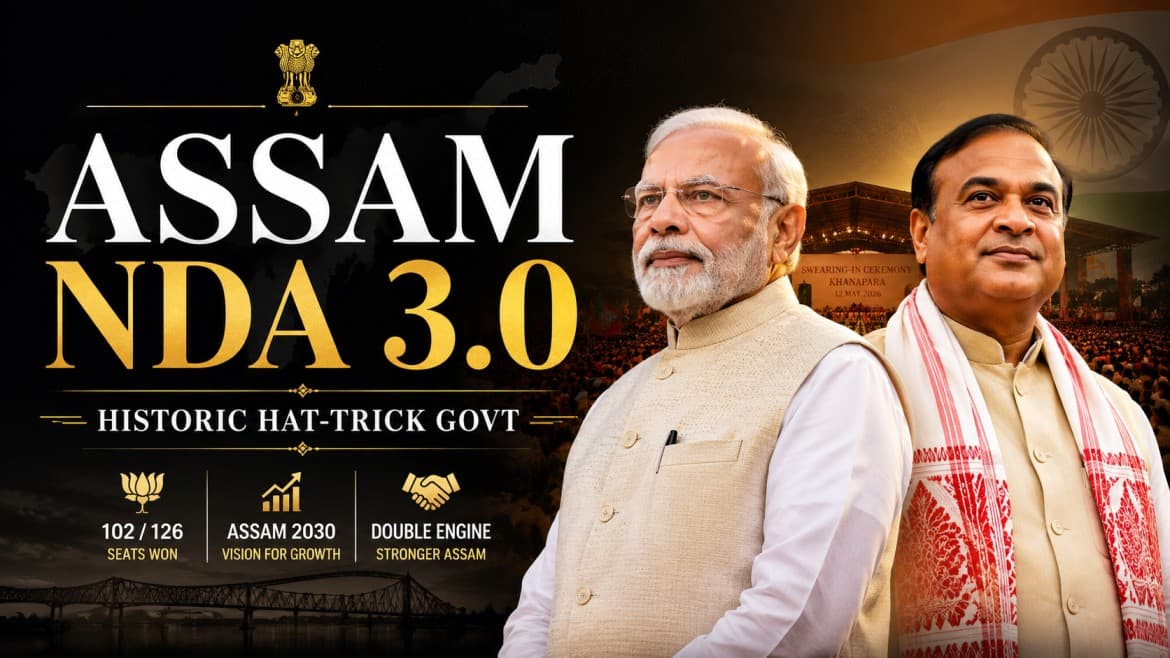
Guwahati’s Khanapara Veterinary College Ground was transformed into a sea of saffron and green on May 12, 2026, as Prime Minister Narendra Modi arrived to witness the swearing-in of the third consecutive NDA government in Assam. The air was thick with celebration as the state’s political landscape reached a new milestone, marking the first time a non-Congress alliance has secured a hat-trick of terms in the northeastern powerhouse.
The centerpiece of the ceremony was Dr. Himanta Biswa Sarma, who took the oath of office for his second consecutive term as Chief Minister. Under his leadership, the BJP-led alliance secured a resounding mandate in the 2026 Assembly elections, winning 102 out of 126 seats. The BJP alone emerged as a dominant force with 82 seats, while allies Asom Gana Parishad (AGP) and Bodoland People's Front (BPF) contributed 10 seats each to the "double engine" victory.
The presence of Prime Minister Modi, alongside Home Minister Amit Shah and Defense Minister Rajnath Singh, underscored the strategic importance of Assam in the NDA’s national vision. Dignitaries from across the country, including Chief Ministers of several BJP-ruled states, filled the stage to signal unity and strength. For the thousands of supporters gathered at the venue, the Prime Minister’s presence was a validation of the state's rapid development trajectory over the last decade.
Alongside the Chief Minister, four key cabinet ministers also took their oaths: Rameswar Teli and Ajanta Neog from the BJP, Atul Bora from the AGP, and Charan Boro representing the BPF. This initial cabinet lineup reflects a balanced coalition approach, rewarding both veteran leaders and regional allies who helped bridge the gap between various ethnic and cultural blocs within the state.
The 2026 election results have been described by political analysts as a mandate for continuity and security. The NDA’s campaign focused heavily on infrastructure projects, the completion of major bridges over the Brahmaputra, and administrative reforms that have streamlined governance. With this third term, the government is expected to pivot toward "Assam 2030," a vision document aiming to make the state a major industrial hub for Southeast Asia.
Addressing the crowd, the newly sworn-in Chief Minister emphasized that this term would focus on "saturation of schemes," ensuring that every eligible citizen receives the benefits of state and central welfare. The sentiment of the day was one of gratitude and resolve, as the leadership promised to work with "greater dedication and humility" to live up to the massive two-thirds majority handed to them by the voters.
As the ceremony concluded with the national anthem, the departure of the Prime Minister and other dignitaries marked the end of the celebratory phase and the beginning of the hard work ahead. The eyes of the nation are now on Guwahati, as the third NDA government begins its journey with a clear mandate to accelerate the transformation of Assam.
In conclusion, the May 12 ceremony was more than just a formal transition of power; it was a demonstration of the NDA's deep-rooted political dominance in the North East. With the "Look East" policy evolving into "Act East," the next five years under this administration will likely define Assam's role as the gateway to a more integrated and prosperous regional economy.