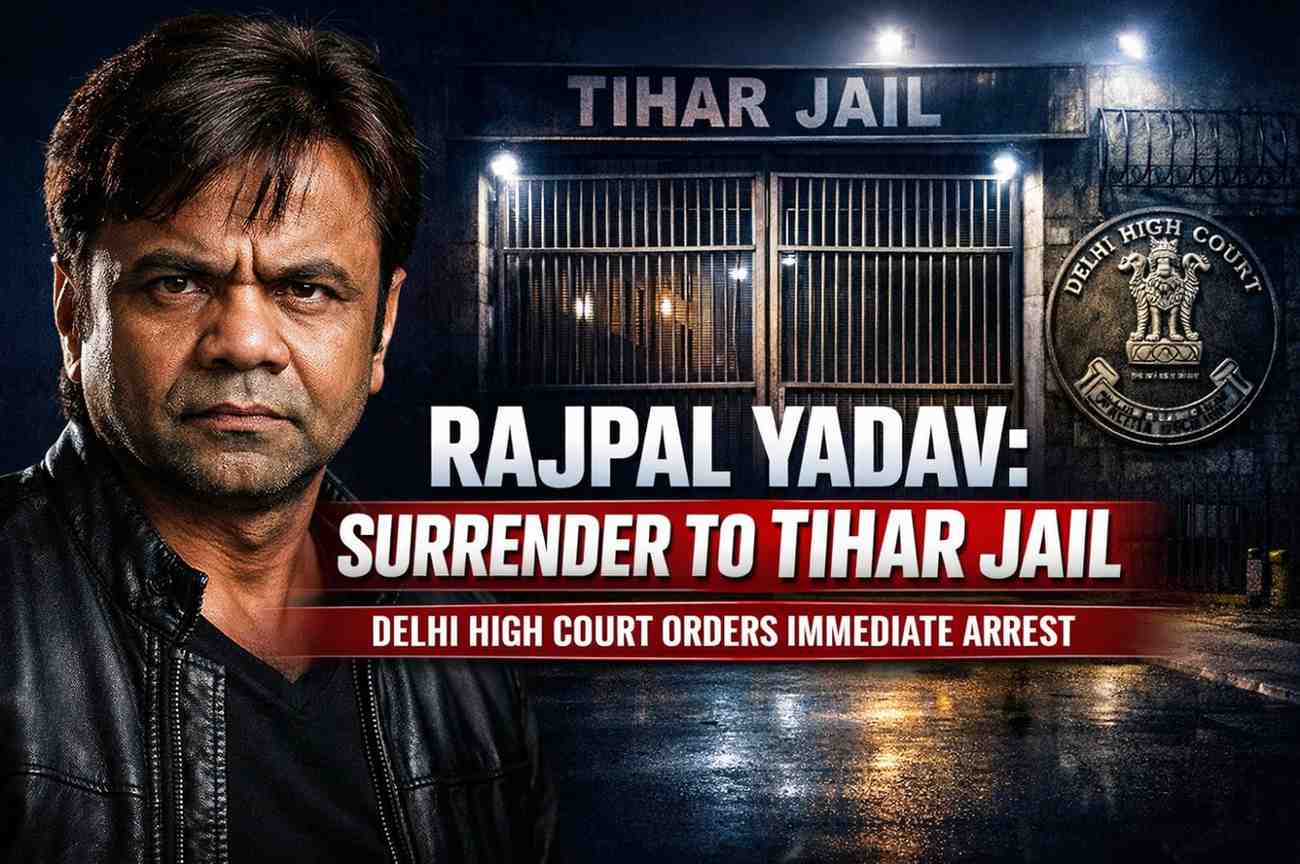
New Delhi: The Delhi High Court has sent a stern message to the film fraternity and the public at large: the law does not look at a person’s celebrity status; it only looks at their conduct. In a significant development, the Court has directed Bollywood actor Rajpal Naurang Yadav to surrender immediately before the Superintendent of Tihar Jail following his continued failure to comply with settlement terms in a long-standing cheque dishonour case.
The order, passed by Justice Swarana Kanta Sharma, highlights the judiciary's growing impatience with litigants who use their social standing to seek endless leniency while disregarding legal undertakings.
The legal troubles for Rajpal Yadav date back to 2010. The actor and his wife, Radha Yadav, had reportedly taken a loan of ₹5 crores from a Delhi-based businessman, M/s Murli Projects Pvt. Ltd., to fund his directorial debut film, Ata Pata Laapata.
When the actor failed to repay the amount, the matter reached the courts under Section 138 of the Negotiable Instruments Act (Cheque Bouncing). Over the years, the case saw multiple rounds of litigation, settlement agreements, and repeated breaches of those agreements. In 2018, Yadav had even served a brief stint in Tihar Jail for misleading the court, but the financial dispute remained unresolved.
On Thursday, the Delhi High Court was hearing a plea by the actor seeking to recall an earlier order that directed his surrender. His counsel argued that the actor was making every effort to arrange the funds and requested the court to treat the application as a "mercy plea."
However, Justice Swarana Kanta Sharma was not inclined to grant further relief. The Court noted that on February 2, it had already given the actor a clear deadline to surrender by February 5. Instead of complying, the actor reached Delhi late and approached the court for more time.
“The law rewards its compliance, not its contempt,” Justice Sharma remarked. She emphasized that extending continuous leniency to a person who disregards the law sends a dangerous message to society—that court directions can be ignored without consequences.
One of the most powerful observations made by the Court was regarding the actor’s professional background. Justice Sharma stated that the judiciary cannot create "special circumstances" for any individual simply because they belong to a specific industry or have a high social profile.
The Court noted:
“A Court of law looks through only from the prism of equality as per law. While this Court, in the present case, has shown sufficient leniency towards the petitioner, it cannot lose sight of the plight of the complainant. The interests of justice require this Court to walk a careful line between compassion and discipline.”
This observation reinforces the principle of Aequitas (equity), reminding citizens that while the court is compassionate toward genuine struggles, it will not be a silent spectator to the "cat and mouse game" of non-payment.
While celebrities often garner headlines, the Court turned the spotlight on the victim—the complainant company. Justice Sharma pointed out that the complainant had been waiting for their dues for years. The court observed that leniency cannot be extended endlessly, especially when it is met with "continued non-compliance."
The actor’s counsel had stated that Yadav was in the process of arranging money and had arrived in Delhi at 5 PM on the day he was supposed to surrender, which prevented him from turning himself in by the 4 PM deadline. The Court, however, found this excuse insufficient, noting that nothing had physically prevented the actor from following the judicial mandate.
The High Court's refusal to recall the surrender order means Rajpal Yadav must now serve the remainder of the sentence or stay in custody as directed in the underlying conviction. The matter is set for a compliance report on February 7, where the jail authorities or the actor’s legal team will have to confirm his surrender.
In legal circles, this case is being viewed as a landmark example of how "undertakings" given to a court are sacred. In many commercial disputes, parties often give "solemn undertakings" to pay back money to avoid immediate arrest. If these undertakings are breached, it is treated as "Civil Contempt" in addition to the original criminal liability under the Negotiable Instruments Act.
The Rajpal Yadav case serves as a cautionary tale for all litigants. The Delhi High Court has made it clear that "stardom" is no shield against the law. For a legal system to remain credible, its orders must be respected by the powerful and the commoner alike.
As the actor heads back to Tihar Jail, the focus remains on whether the dues will finally be settled or if this decade-long saga will continue to find its way through the corridors of the Delhi High Court.
- Case Title: Sh. Rajpal Naurang Yadav & Anr v. M/S. Murli Projects Pvt. Ltd & Anr
- Bench: Justice Swarana Kanta Sharma
- Date of Order: February 5, 2026