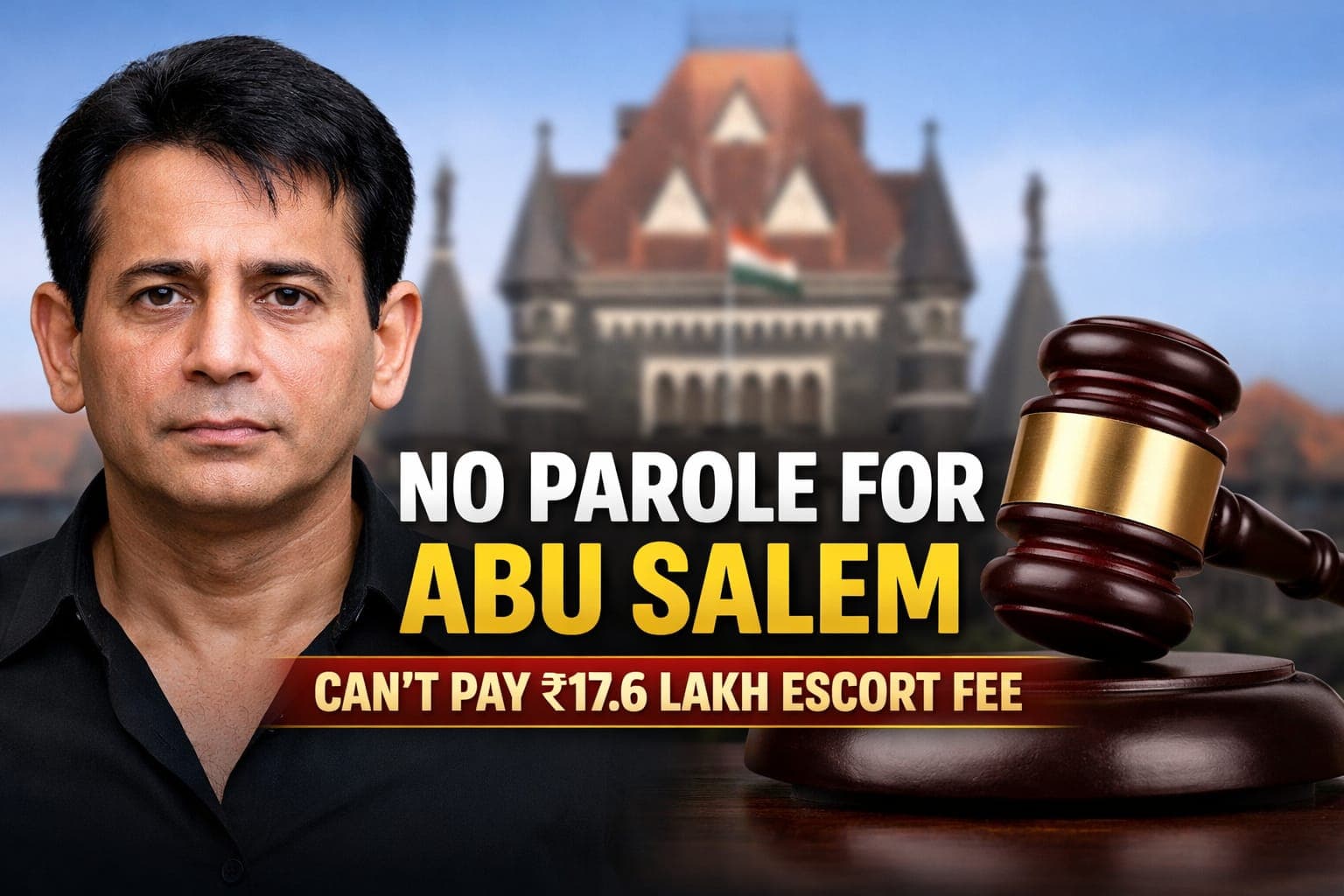
The Bombay High Court has recently dismissed a plea filed by 1993 Mumbai serial blasts convict and underworld gangster Abu Salem, seeking emergency parole to visit his hometown in Azamgarh, Uttar Pradesh. The court’s decision came after Salem expressed his inability to pay the hefty police escort charges amounting to ₹17.60 lakh, which were a prerequisite for his temporary release.
Abu Salem, who is currently serving a life sentence at the Nashik Central Jail, approached the court following the death of his brother, Abu Hakim Ansari. He sought "emergency parole" for a period of 15 days to attend the funeral rites and mourn with his family in Azamgarh.
Under the Maharashtra Prison (Prisons and Parole) Rules, convicts are often allowed temporary release for specific reasons like the death of a close family member. However, for "high-risk" prisoners like Salem, this permission often comes with strict conditions, including a 24/7 high-security police escort at the prisoner's own expense.
The primary hurdle in Salem’s request was the cost of security. The jail authorities and the Appellate Authority had granted him permission to travel, but only on the condition that he deposit ₹17.60 lakh to cover the expenses of the police team required to escort him to Uttar Pradesh and back.
During the hearing before a division bench of Justices Ajay Gadkari and Shyam Chandak, Salem’s counsel, Advocate Farhana Shah, argued that her client had been in prison for nearly 24 years and did not have the financial means to pay such a massive sum. She stated that Salem could only manage to gather ₹1 lakh through a third-party loan and urged the court to lower the charges on humanitarian grounds.
The State of Maharashtra, represented by Additional Public Prosecutor Ashish Satpute, strongly opposed any reduction in the charges or the security detail. The prosecution highlighted several critical points:
- High-Risk Category: Salem is a prime convict in the 1993 Mumbai Bomb Blasts and has a history of fleeing the country (extradited from Portugal in 2005).
- Communal Sensitivity: Local police reports from Azamgarh’s Saraymir area suggested that the region is "communally sensitive." There were concerns that the presence of a high-profile gangster like Salem could lead to law and order issues or public celebrations by his supporters.
- Mandatory Rules: The state argued that the escort charges are calculated based on a set formula for security personnel and cannot be waived or arbitrarily reduced for individual convicts.
Advocate Shah countered the state's "celebration" concerns by clarifying that Salem was visiting for a funeral, not a festival. She reminded the bench that Salem had been granted parole twice in the past—following the deaths of his mother and foster mother—and had returned to jail without any security incidents.
She further argued that characterising Salem as an "international gangster" was an exaggeration in this context, as his extradition cases were concluded and he was merely seeking to perform his religious and familial duties.
After hearing both sides, the Bombay High Court upheld the decision of the Appellate Authority. The bench observed that the condition to pay escort charges is a mandatory requirement for prisoners of Salem’s profile. Since the convict refused to comply with the financial conditions set by the state, the court found no reason to interfere with the denial of parole.
The court emphasized that while emergency parole is a provision for mourning, the security of the state and the rules governing high-risk convicts take precedence.