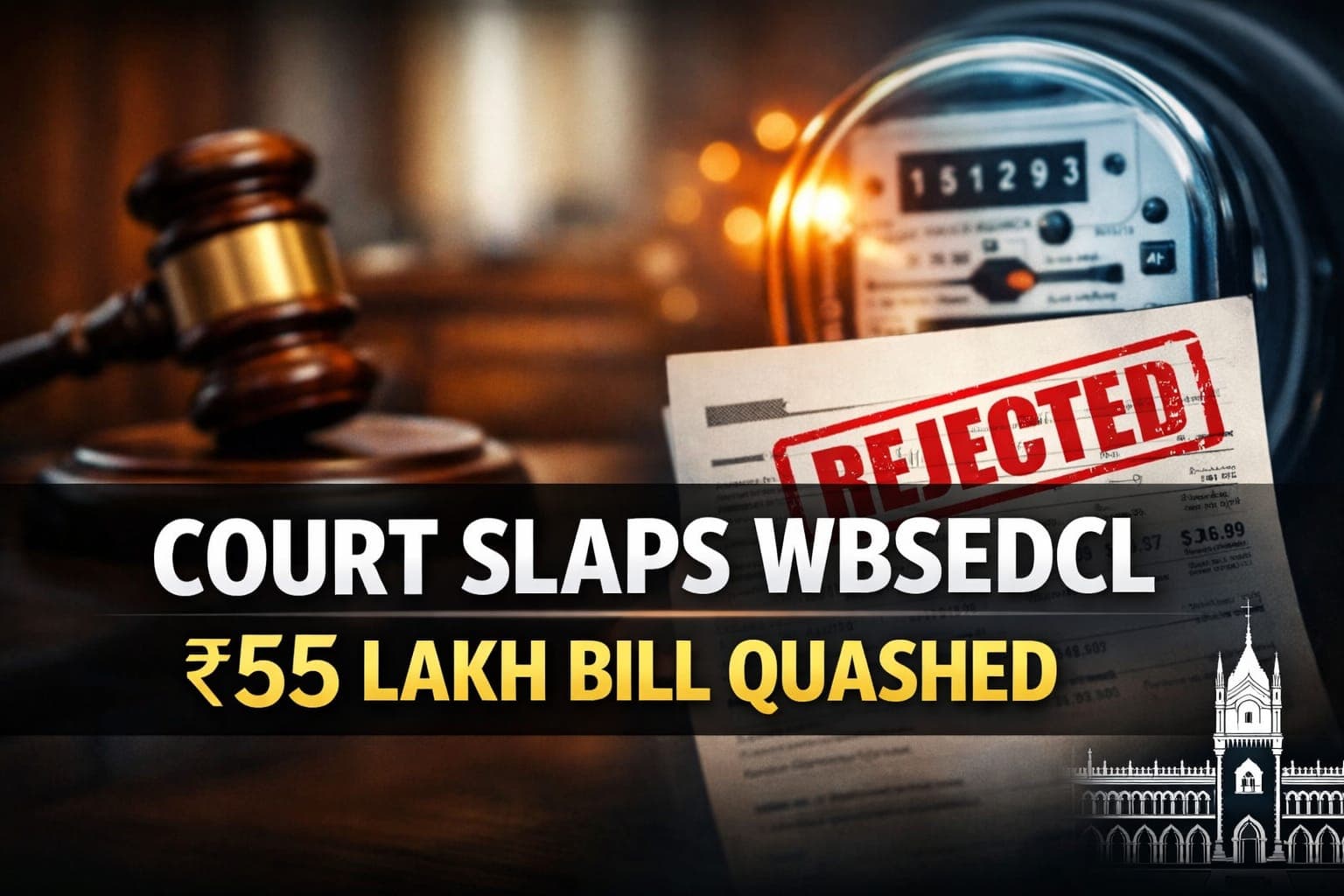
In a landmark judgment that reinforces the accountability of public utility providers, the Calcutta High Court has quashed a supplemental electricity bill of ₹55.8 lakh issued by the West Bengal State Electricity Distribution Company Limited (WBSEDCL) against a local rice mill. The Court observed that the relationship between a public utility provider and a consumer is one of "fiduciary trust" and cannot be governed by "administrative high-handedness."
The Division Bench, comprising Justice Rajarshi Bharadwaj and Justice Uday Kumar, set aside the demand raised against Jyotish Chandra Rice Mill, emphasizing that state-run corporations cannot issue speculative bills without concrete evidentiary support.
The case dates back to July 2019, when WBSEDCL replaced a transformer at the premises of Jyotish Chandra Rice Mill. For the following four months, the mill operated as usual, and WBSEDCL issued monthly bills based on actual meter readings. The consumer diligently paid these bills, which were accepted by the electricity department without any objection.
However, in November 2019, the situation took a drastic turn. WBSEDCL unilaterally refunded the payments already made by the mill and issued a fresh, consolidated "supplemental bill" amounting to a staggering ₹55,80,000.
The department claimed that the meter had been "under-recording" energy consumption due to a technical defect—specifically a "polarity reversal"—in the newly installed transformer. To make matters worse for the consumer, WBSEDCL also imposed a Late Payment Surcharge (LPSC) of ₹32.72 lakh, bringing the total financial burden to nearly ₹90 lakh.
The rice mill initially challenged this demand before the Electricity Ombudsman. However, the Ombudsman upheld the bill, leading the consumer to approach the High Court.
Upon review, the High Court found that the Ombudsman’s order was "patently perverse." The Court noted a glaring contradiction: while the Ombudsman acknowledged that the department failed to prove exactly when the defect started or when it was fixed, it still declared the consumer liable to pay the massive amount based on "average billing."
The High Court's judgment centered on three primary legal pillars:
1. The Presumption of a "Correct Meter"
Under the West Bengal Electricity Regulatory Commission (WBERC) Regulations, specifically Regulations 3.3.1 and 3.6.1, there is a statutory presumption that a meter is correct unless proven otherwise. The Potential Transformer (PT), which WBSEDCL claimed was defective, is considered part of the metering circuit.
The Court held that since WBSEDCL could not provide documented proof of the exact date the defect occurred or the exact date it was rectified, they had no legal authority to ignore the actual meter readings and switch to "average billing."
2. Fiduciary Trust vs. Administrative Power
Perhaps the most significant observation in the judgment was the Court's definition of the role of a utility provider. The Bench stated:
"The provision of a public utility is a matter of fiduciary trust and not administrative high-handedness. A state-run corporation must act with transparency and fairness, especially when dealing with the financial liabilities of citizens."
The Court remarked that WBSEDCL acted arbitrarily by first accepting payments and then suddenly reversing them to slap a speculative bill on the consumer.
3. Orders cannot be "Improved" later
WBSEDCL attempted to justify the bill by filing fresh affidavits during the court proceedings, adding details that were not in the original order. The High Court rejected this, citing established legal precedents that a statutory order must "stand or fall" on the grounds mentioned when it was first issued. You cannot fix a bad legal order by adding new excuses later in court.
The High Court provided complete relief to the rice mill by:
- Quashing the Demand: The supplemental bill of ₹47,06,213 was declared null and void.
- Waiving Surcharges: The Late Payment Surcharge of ₹32.72 lakh was entirely waived.
- Refund/Adjustment: The Court ordered that the ₹11,70,855 already deposited by the mill "under protest" must be adjusted against their future electricity bills.
- Stopping Disconnection: All disconnection notices issued by WBSEDCL were quashed, ensuring the mill could continue its operations.
This judgment serves as a stern warning to electricity distribution companies and other public utilities across India. It establishes that technical "assumptions" are not enough to penalize a consumer. If a utility company claims a meter is wrong, the burden of proof lies heavily on them to show the "how, when, and where" of the defect.
For the common man and small business owners, the ruling is a victory for fairness. it reaffirms that the "Rule of Law" protects them from the arbitrary whims of powerful state machinery.
Case Details:
- Case Title: THE WEST BENGAL STATE ELECTRICITY DISTRIBUTION COMPANY LIMITED & ORS. VS JYOTISH CHANDRA RICE MILL & ORS.
- Case No: FMA 179 OF 2023
- Court: Calcutta High Court (Division Bench)
- Date of Judgment: February 5, 2026