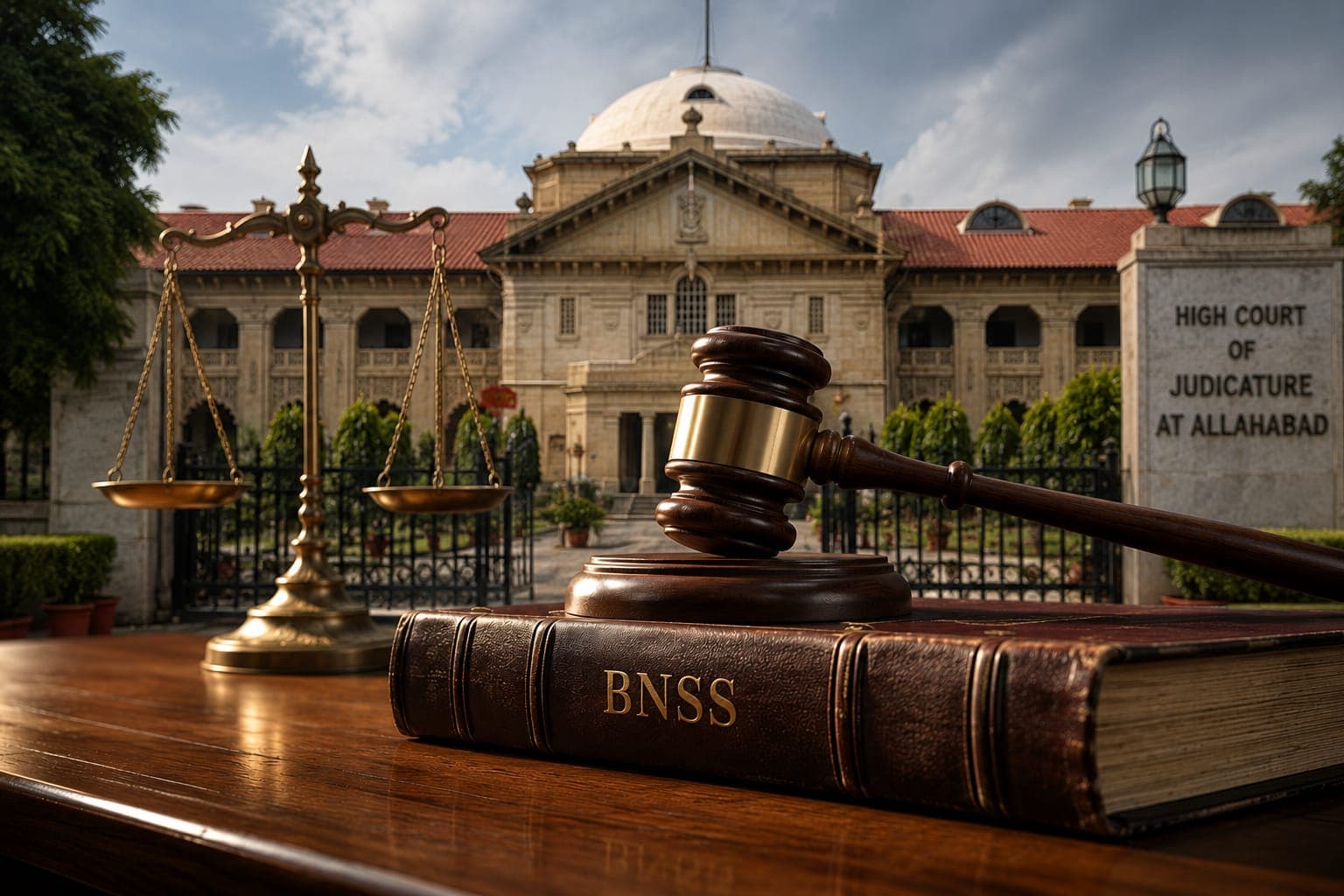
In a significant move to protect personal liberty and ensure police accountability, the Uttar Pradesh government has assured the Allahabad High Court that no arrests will be made in the state without providing the accused with clear "reasons and grounds" for their detention.
The State’s assurance comes as a major relief for citizens and reinforces the strict safeguards introduced under the Bharatiya Nagarik Suraksha Sanhita (BNSS), 2023, which recently replaced the British-era Code of Criminal Procedure (CrPC).
The matter reached the court through a Habeas Corpus petition filed by one Santosh Gupta. The petitioner challenged her arrest and subsequent remand in a case involving allegations of cheating and forgery in Balrampur district.
The petitioner’s counsel, Senior Advocate Purnendu Chakravarty, argued that the arrest was unconstitutional and illegal because the police failed to follow the mandatory legal procedure of informing the accused about the specific reasons for the arrest at the time of the action.
During the hearing before a division bench comprising Justice Abdul Moin and Justice Pramod Kumar Srivastava, Additional Advocate General (AAG) Vinod Kumar Shahi represented the State.
The AAG informed the Court that the Uttar Pradesh government is committed to upholding the rule of law. He stated that following the landmark Supreme Court judgment in the case of Mihir Rajesh Shah vs State of Maharashtra (2026), the State has already issued directives to the Additional Chief Secretary (Home) and the Director General of Police (DGP).
These directives mandate that every police officer in Uttar Pradesh must strictly comply with the BNSS provisions, ensuring that the "grounds of arrest" are communicated to the individual in writing.
After hearing both sides, the High Court noted that the arrest of Santosh Gupta did not meet the legal standards. Relying on its own previous precedents and the Supreme Court’s guidelines, the bench declared the arrest "illegal."
The Court further set aside the remand order passed by the Chief Judicial Magistrate, Balrampur, noting that if an arrest itself is unlawful, any subsequent custody or remand order cannot be sustained in the eyes of the law. The petitioner was ordered to be released immediately.
This development is a cornerstone for civil liberties in Uttar Pradesh. The Court recorded the State’s assurance that:
- Written Grounds are Mandatory: Arresting officers must provide a written document explaining why the person is being taken into custody.
- BNSS Compliance: All procedures must align with the new criminal laws (BNSS, 2023).
- Accountability: The presence of the Additional Director General (Crime) in court signaled that the top brass of the police department is now under direct judicial scrutiny regarding arrest protocols.
The Allahabad High Court’s decision serves as a stern reminder to the law enforcement agencies that "power of arrest" is not a tool for harassment. By recording the State’s solemn assurance, the Court has created a shield for the common man against arbitrary police action. Moving forward, any officer failing to provide the grounds of arrest could face serious legal consequences for contempt and procedural lapse.