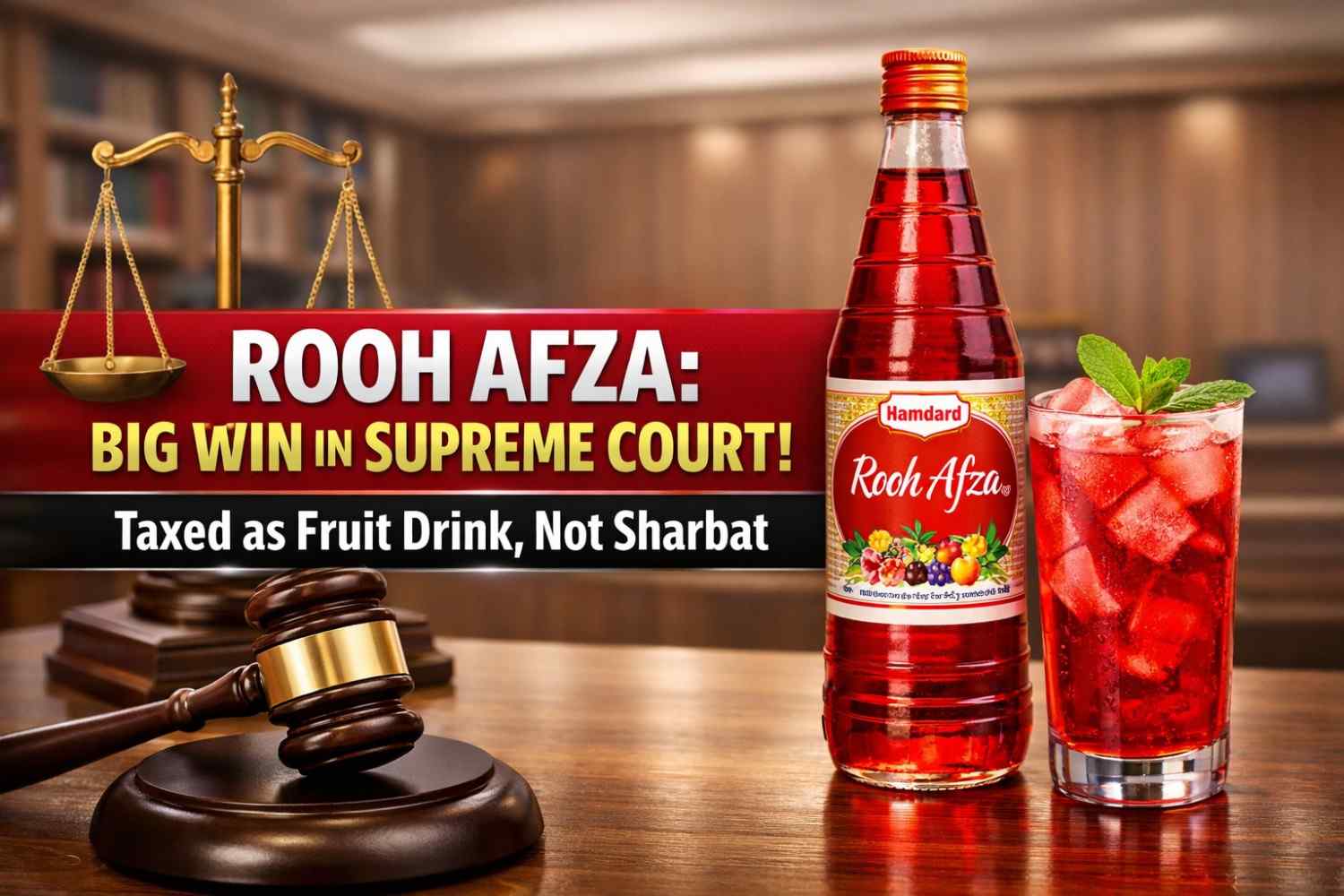
In a significant judgment that brings clarity to how products are taxed in India, the Supreme Court has ruled that 'Rooh Afza'—the iconic summer cooler—should be classified as a "fruit drink" rather than an unclassified "residuary" item. This decision means the product attracts a much lower tax rate of 4% instead of the 12.5% previously claimed by tax authorities in Uttar Pradesh.
The ruling, delivered by a bench comprising Justice BV Nagarathna and Justice R Mahadevan, highlights a crucial legal principle: the way a company markets its product or the labels it uses for food safety licenses cannot dictate how that product is taxed.
The legal battle began over the classification of Rooh Afza under the Uttar Pradesh Value Added Tax (UPVAT) Act.
Hamdard Laboratories (the makers of Rooh Afza) argued that since their product contains 10% fruit juice along with herbal distillates, it should fall under Entry 103, which covers "fruit drinks" and "processed fruit products." In UP, these items enjoyed a concessional VAT rate of 4%.
On the other hand, the Commercial Tax Department of Uttar Pradesh insisted that Rooh Afza was a "Sharbat" or a "Non-fruit syrup." They pointed to the fact that Hamdard had obtained licenses for the product under the description of a "non-fruit syrup" under food safety regulations. Because "Sharbat" was not specifically mentioned in the tax categories, the government wanted to put it in the "residuary entry"—a catch-all category for items not listed elsewhere—which attracts the highest tax rate of 12.5%.
The Allahabad High Court had previously ruled in favor of the tax department, leading Hamdard to appeal to the Supreme Court.
One of the most important takeaways from this judgment is the Court's stance on "nomenclature" (the names used for things).
The Supreme Court observed that tax authorities often rely too heavily on what a product is called in a license or how it is described on a marketing banner. However, the Bench clarified that for the purposes of a taxing statute (the law that determines tax rates), the "true nature" of the product is what matters.
The Court noted:
"The nomenclature adopted by the parties, or the description of the product as a 'non-fruit syrup' under the licensing statute, is not determinative for the purposes of classification under a taxing statute."
In simple terms, just because a company calls its product a "sharbat" to sound traditional or uses a specific label to satisfy food safety officers, it doesn't mean the tax department can ignore what is actually inside the bottle.
How do we decide what a product "really" is? The Supreme Court applied what is known as the Essential Character Test.
The tax department had argued that Rooh Afza is mostly sugar. Indeed, about 80% of the volume of the concentrate is sugar syrup. They argued that because sugar is the dominant ingredient, it cannot be called a fruit drink.
However, Justice Mahadevan, writing the judgment, rejected this "mechanical" way of looking at ingredients. The Court explained that sugar syrup in Rooh Afza acts as a "carrier" and a "preservative." It provides the base, but it is not what gives the product its identity.
The Court held that the flavor, aroma, and the very reason people buy Rooh Afza come from the 10% fruit juice and the herbal distillates. These ingredients give the drink its "essential character." Therefore, even though sugar is higher in volume, the fruit component is what defines the product's identity in the eyes of the consumer.
Another key legal tool used by the Court was the "Common Parlance Test." This test asks: how would a regular person in the market understand this product?
The Court found that in common understanding, Rooh Afza is a fruit-based beverage preparation intended to be diluted with water or milk and consumed as a refreshing drink. Since it fits the description of a "fruit drink" in the minds of the public, it should be taxed as such.
Interestingly, the Court also looked at how other states in India were taxing Rooh Afza. It was found that states like Delhi, West Bengal, Gujarat, Madhya Pradesh, and Andhra Pradesh were already treating Rooh Afza as a fruit-based beverage.
The Supreme Court emphasized that when similar tax entries exist across different states, there should be a level of uniformity. If most of the country views it as a fruit drink, it would be unfair for one state to treat it as an "unclassified" luxury item just to collect more tax.
This judgment is a major victory for the food and beverage industry. It sends a clear message to tax departments: you cannot simply dump a product into the highest tax bracket (the residuary category) if it reasonably fits into a specific, lower-taxed category.
For the average consumer, such rulings are important because higher taxes on manufacturers often lead to higher prices on the shelf. By ensuring that products are taxed correctly based on their ingredients and nature, the Court protects both the business and the end-user from "tax overreach."
The Supreme Court’s decision to classify Rooh Afza as a fruit drink is a blend of common sense and legal logic. By prioritizing the "essential character" of the product over its "marketing label," the Court has ensured that the spirit of the law is upheld.
Rooh Afza remains, as it has been for decades, a beloved fruit and herbal preparation. And now, thanks to the Apex Court, it carries a tax label that finally matches its recipe.
Case Details:
- Case Title: M/S Hamdard (Wakf) Laboratories vs. Commissioner, Commercial Tax, U.P.
- Bench: Justice BV Nagarathna and Justice R Mahadevan
- Key Law: UPVAT Act, Entry 103 (Schedule II)