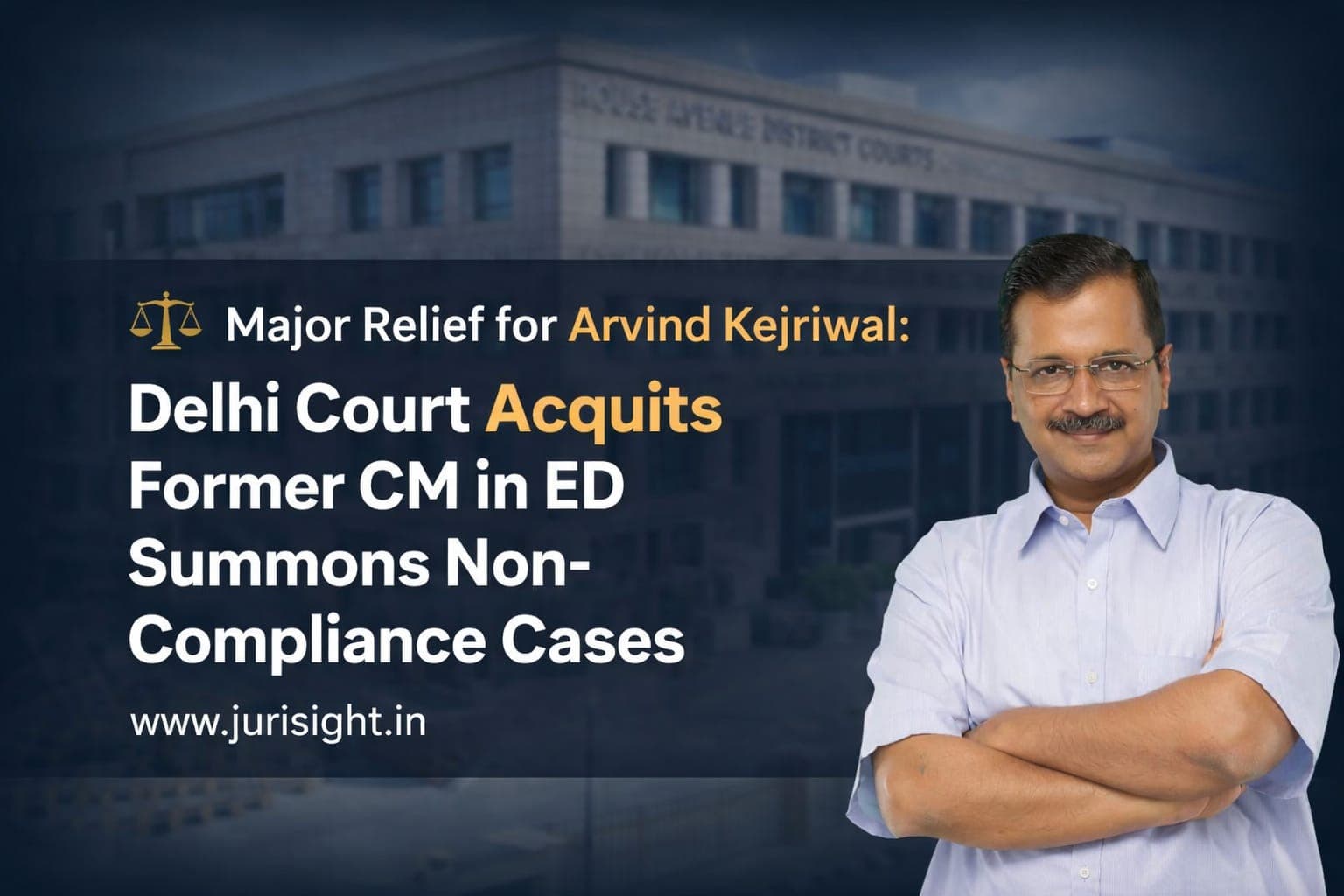
NEW DELHI: In a development that carries heavy legal and political implications, the Rouse Avenue Courts on Thursday (January 22, 2026) acquitted former Delhi Chief Minister Arvind Kejriwal in two separate criminal complaints filed by the Enforcement Directorate (ED). The complaints sought to prosecute Kejriwal for skipping multiple summons issued by the central agency in connection with the Delhi Excise Policy money laundering probe.
Additional Chief Judicial Magistrate (ACJM) Paras Dalal delivered the verdict, ruling that the prosecution had failed to establish a case of "intentional disobedience" beyond a reasonable doubt. The court’s decision marks a pivotal moment in the multi-year legal battle surrounding the now-scrapped liquor policy.
The Enforcement Directorate had approached the court in February 2024, invoking Section 174 of the Indian Penal Code (IPC). This section deals with "non-attendance in obedience to an order from a public servant." Under the Prevention of Money Laundering Act (PMLA), the ED has the power to issue summons under Section 50, which mandates that the person summoned is legally bound to attend and state the truth.
The ED’s primary grievance was that Kejriwal had "deliberately and intentionally" avoided joining the investigation despite being issued five summons on different dates. The agency contended that such non-compliance impeded a lawful investigation into the "proceeds of crime" related to the excise policy.
While the detailed judgment is expected shortly, the court’s oral observations and the summary of the order highlight several critical legal shortcomings in the ED's case:
- Improper Service of Summons: The court noted that the ED failed to prove that the summons were served through valid legal channels. Specifically, the court observed that "service by email" is not explicitly recognized as a valid or legal method under the prevailing rules of the Code of Criminal Procedure (CrPC) or the PMLA for this type of prosecution.
- Absence of Intentional Disobedience: For a conviction under Section 174 of the IPC, the prosecution must prove that the accused stayed away with the specific intent to disobey the law. The court found that the ED could not provide sufficient evidence to show that Kejriwal’s reasons for not appearing—which included his official duties as a sitting Chief Minister and the then-ongoing budget sessions—were a mere ruse to avoid the law.
- Lack of Supporting Evidence: The court remarked that the ED failed to provide a supporting affidavit under the Evidence Act to verify the digital trail of the summons, creating a procedural hurdle that the agency could not overcome.
In his order, ACJM Dalal stated, "There are procedural, legal, and factual challenges to the complainant's case, which do not allow this court to arrive at a conclusion of culpability. The prosecution has failed to prove its case beyond a reasonable doubt."
To understand the significance of this acquittal, one must look back at the timeline of the Delhi Excise Policy case:
- July 2022: Lieutenant Governor VK Saxena recommends a CBI probe into alleged irregularities in the Delhi Excise Policy 2021-22.
- August 2022: The CBI registers an FIR; shortly after, the ED registers a money laundering case (ECIR) to track the financial trail.
- Late 2023 – Early 2024: The ED issues a series of summons to Arvind Kejriwal. Kejriwal responds via letters, calling the summons "politically motivated" and "illegal," requesting a questionnaire instead.
- February 2024: The ED files its first complaint in the Rouse Avenue Court seeking prosecution for non-compliance.
- March 2024: Arvind Kejriwal is arrested by the ED in the main money laundering case.
- September 2024: The Supreme Court grants bail to Kejriwal, emphasizing that prolonged incarceration without trial violates the right to liberty.
- January 2026: The trial court concludes the trial for the "summons case," resulting in Kejriwal's acquittal.
Legal experts suggest that this verdict reinforces a crucial principle: skipping a summons is not an automatic criminal offence unless it is proven to be "willful."
In professional legal circles, this case was watched closely because it tested the boundaries of Section 50 of the PMLA. While the ED possesses vast powers to summon individuals, the court has signaled that the agency must strictly adhere to procedural standards when seeking to criminalize a person's absence.
In a parallel development on the same day, the court also granted relief to AAP MLA Amanatullah Khan. Khan was acquitted in one case and discharged in another involving similar allegations of skipping ED summons—this time related to the Delhi Waqf Board money laundering probe.
Reacting to the news, Arvind Kejriwal took to social media to post the phrase "Satyamev Jayate" (Truth alone triumphs), a sentiment echoed by party members who have long claimed the cases were an exercise in "political vendetta."
While this acquittal does not end the main trial regarding the Delhi Excise Policy, it removes a significant legal thorn from Arvind Kejriwal’s side. For the ED, the ruling serves as a reminder of the high burden of proof required in criminal trials, even under specialized laws like the PMLA.
As the legal community awaits the full written judgment, the focus now shifts back to the main trial, where the Supreme Court's previous observations on "liberty" and "fair trial" continue to loom large.
- Case Title: Directorate of Enforcement vs. Arvind Kejriwal
- Court: Rouse Avenue District Courts, New Delhi
- Presiding Officer: Additional Chief Judicial Magistrate Paras Dalal
- Legal Representatives: Senior Advocates N. Hariharan and Rebecca John (for Kejriwal)