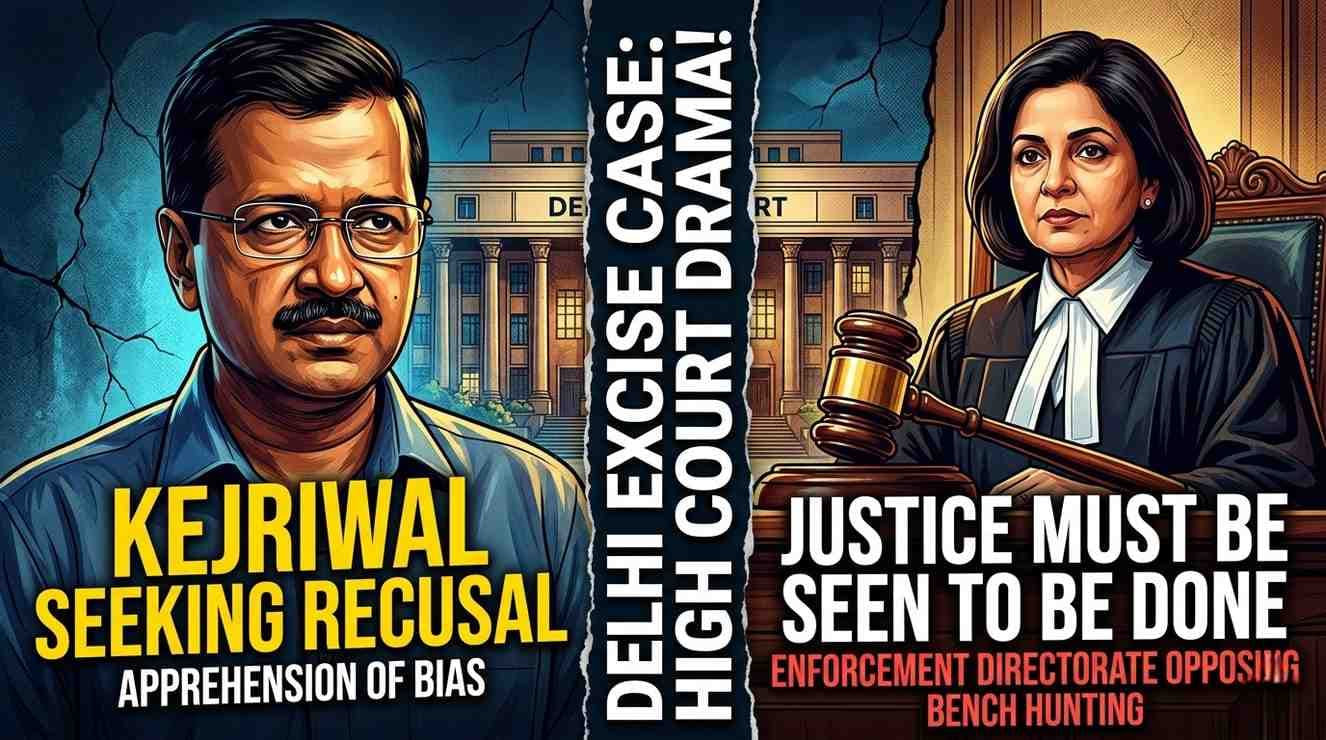
The Delhi High Court recently took up a significant application filed by Delhi Chief Minister Arvind Kejriwal, seeking the recusal of Justice Swarana Kanta Sharma from hearing his plea in the excise policy case. The application was moved on the grounds of "apprehension of bias," with Kejriwal’s legal team arguing that the judge had previously passed orders in related matters that expressed a definitive view on the merits of the case. During the high-stakes proceedings, senior advocates representing Kejriwal contended that for the sake of judicial propriety and the principle that "justice must not only be done but seen to be done," the matter should be assigned to a different bench.
The Enforcement Directorate (ED) strongly opposed the recusal plea, labeling it as "bench hunting" and a strategic attempt to delay the judicial process. The ASG (Additional Solicitor General) representing the probe agency argued that a judge cannot be asked to recuse themselves simply because a party is dissatisfied with previous rulings. They maintained that judicial impartiality is a professional standard that should not be questioned based on the outcome of prior interim orders, asserting that the application lacked any foundational proof of personal interest or actual bias.
During the live-updated session, the Court questioned the timing of the application and the specific remarks in previous judgments that the petitioner found objectionable. Justice Sharma observed that the judiciary frequently deals with interconnected cases and that prior knowledge of a case file does not automatically translate to a closed mind. The arguments touched upon the "test of a reasonable person," debating whether an objective observer would truly perceive a lack of impartiality in the current bench's oversight of the excise policy investigation.
Beyond the specific case of the Delhi CM, this hearing highlights the growing trend of high-profile litigants seeking recusal in politically sensitive matters. Such pleas place the judiciary in a delicate position, balancing the need to prevent "judge-shopping" with the necessity of maintaining absolute public trust in the neutrality of the High Court. The outcome of this application is crucial, as it will determine who ultimately decides on the legality of Kejriwal’s arrest and his continued custody in the excise case.
The Court has currently reserved its order on the recusal application after hearing extensive arguments from both sides. Should the judge decide to recuse, the matter will be sent back to the Chief Justice for re-assignment; if the plea is dismissed, the bench will proceed to hear the merits of Kejriwal’s primary challenge against the ED’s actions. This procedural battle remains a pivotal subplot in the larger legal saga surrounding the now-scrapped Delhi liquor policy.