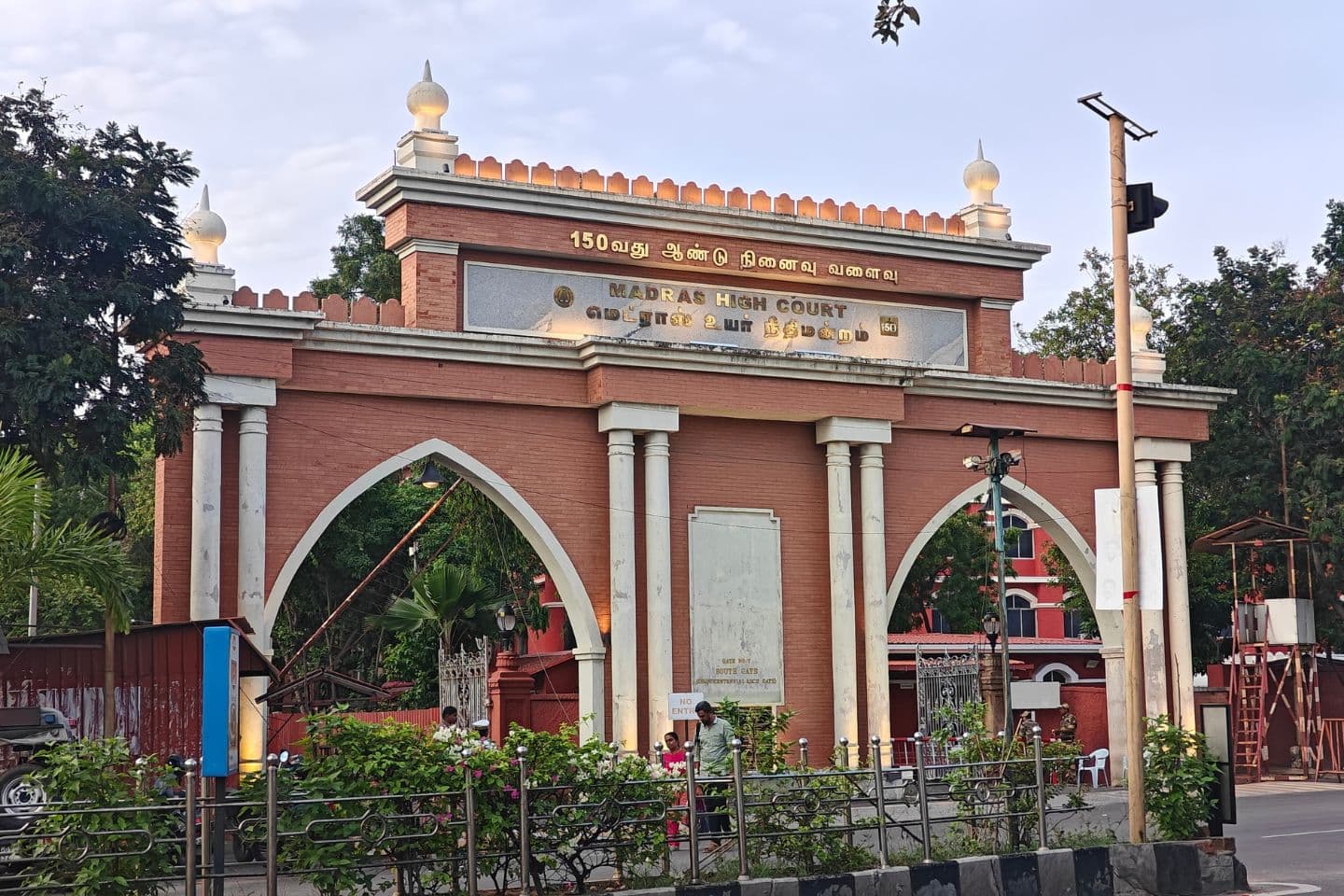
The petitioner, Krishnamoorthy, approached the Madras High Court seeking to quash criminal proceedings pending before the Judicial Magistrate, Palladam, in Tiruppur District. The case originated from a complaint lodged by the Village Administrative Officer of Avinashipalayam, which led the local police to register an FIR under Sections 189(2), 226 and 193(1) of the Bharatiya Nyaya Sanhita. The prosecution alleged that Krishnamoorthy, together with other persons, conducted a hunger strike without obtaining prior permission from the authorities, thereby causing inconvenience to the public and obstructing the free movement of persons.
The hunger strike was organised to press for the withdrawal of criminal cases that had been repeatedly filed against M Easan, an advocate and the founder of the Tamil Nadu Farmers Protection Association. The petitioner contended that the association had consistently engaged in lawful democratic activities, including representations, awareness campaigns, legal proceedings and peaceful agitations, and that the hunger strike was a collective expression of dissent aimed at drawing governmental and public attention to the plight of the association’s founder.
Arguments Advanced by the Parties
Krishnamoorthy’s counsel submitted that the protest was carried out on private property, that no prohibitory order was in force on the date of the agitation, and that the act of raising slogans and undertaking a hunger strike fell squarely within the ambit of the freedom of speech and expression and the right to assemble peacefully guaranteed under Articles 19(1)(a) and 19(1)(b) of the Constitution. It was further argued that the prosecution’specific and failed to identify any concrete act that could attract the offences alleged.
The State, represented by the Public Prosecutor, maintained that the hunger strike was conducted without the requisite permission, thereby constituting a public nuisance and causing obstruction to ordinary traffic. The prosecution urged the court to refrain from interfering with the trial, pointing out that a chargesheet had already been filed and that the matter deserved adjudication on its merits.
Court’s Examination of the Record
Justice M Nirmal Kumar, presiding over the matter, examined the final report filed by the investigating agency and the materials placed on record. The Court observed that the allegations in the final report were general in nature and did not contain any specific particulars linking the petitioner to the commission of an offence under the cited provisions. There was no evidence to show that any member of the public had lodged a complaint or suffered inconvenience on account of the protest.
The Bench further noted that the hunger strike and associated slogan‑raising took place on private land, and that no prohibitory order had been issued for the date in question. Consequently, there was no question of disobedience of any directive issued by the authorities. The Court emphasised that the mere act of expressing dissent through slogans and a hunger strike could not be construed as an offence, as such conduct is a hallmark of a functioning democracy and is expressly protected by the constitutional guarantees of free speech and peaceful assembly.
Legal Reasoning and Operative Outcome
Applying the principles laid down in precedents concerning the scope of Article 19, the Court held that the continuation of the criminal trial would constitute a clear abuse of the process of law. It reasoned that, absent any concrete allegation of public inconvenience or obstruction, the prosecution could not sustain a charge under Sections 189(2), 226 or 193(1) of the Bharatiya Nyaya Sanhita. The Bench concluded that the petitioner had merely exercised his constitutional rights and that the State’s attempt to criminalise peaceful protest was untenable.
Accordingly, the Court allowed the petition, quashed the criminal proceedings pending against Krishnamoorthy before the Judicial Magistrate, Palladam, and directed that no further action be taken in the matter. The judgment underscores the judiciary’s role in safeguarding democratic expression against indiscriminate use of criminal law to stifle legitimate protest.