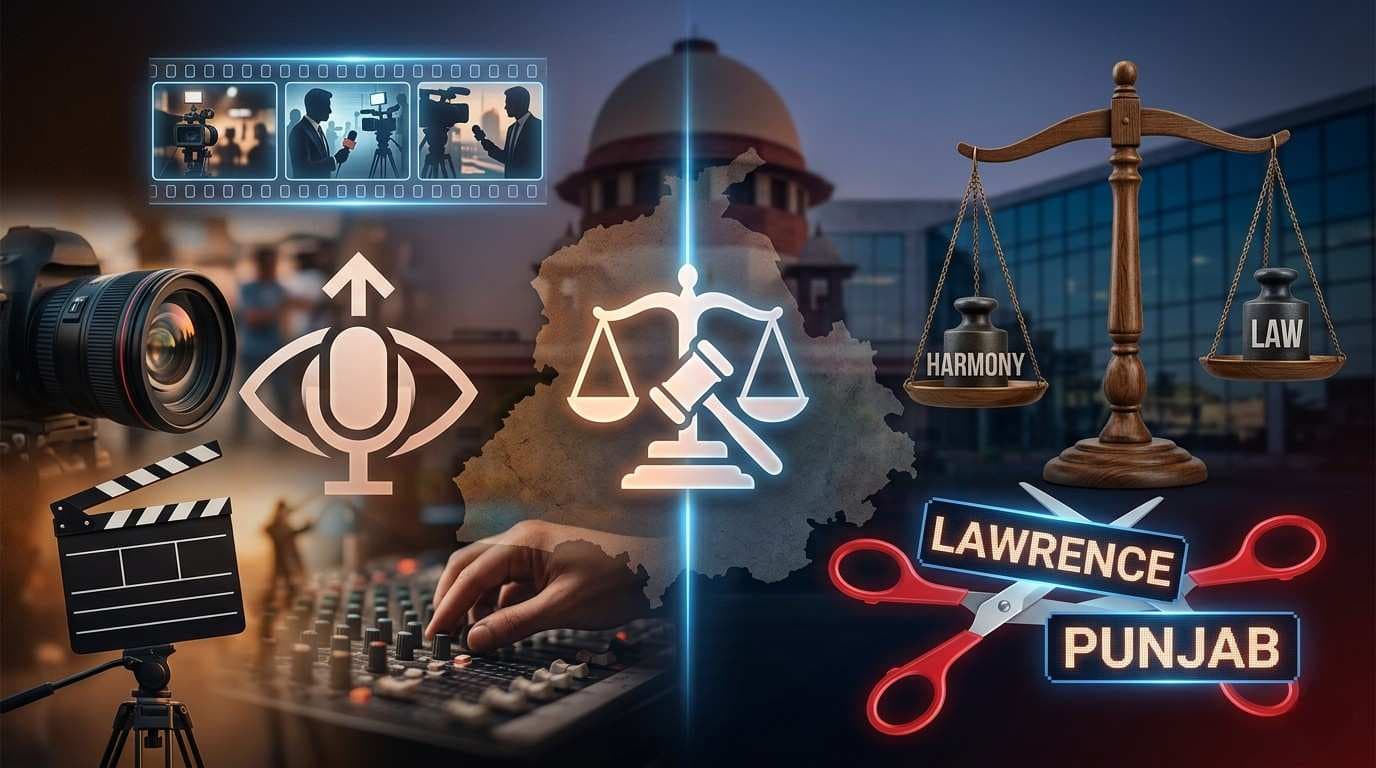
In a significant balancing act between freedom of expression and public order, the Punjab and Haryana High Court has cleared the path for Zee5 to release its documentary on the rise of organized crime. While the court set aside a central government advisory that had effectively stalled the project, it imposed a specific condition: the title must be sanitized. By directing the makers to remove the names "Lawrence" and "Punjab," the judiciary has signaled that while facts can be documented, the branding of such content must not inadvertently glorify criminal figures or unfairly stigmatize a state.
The legal battle began when the Ministry of Information and Broadcasting issued an advisory against the documentary, originally titled "Lawrence of Punjab," citing concerns about the glorification of gangster culture. Zee Entertainment challenged this as an unlawful pre-publication restraint, arguing that the content was an analytical study based on public records. Justice Jagmohan Bansal, after personally viewing the documentary, observed that the work did not actually glorify any individual but rather delivered a message about the short, destructive nature of a life in crime.
The court's decision to quash the Centre's advisory underscores the high threshold required for the state to suppress media content. The Bench noted that the apprehensions raised by the Punjab Police—concerning the influence on "impressionable youth"—were not sufficient to justify a total ban. This reaffirms that under Article 19(1)(a), the right to share information already available in the public domain cannot be easily curtailed by speculative fears of social unrest, provided the content itself remains objective.
However, the directive to change the title highlights the court's sensitivity to "branding" in the digital age. By removing "Lawrence Bishnoi" and "Punjab" from the title, trailers, and posters, the court aimed to prevent the documentary from becoming a beacon for "fandom" or creating a misleading connotation that links an entire state to organized crime. This move acknowledges that a title often carries more weight in social media amplification than the actual nuanced content of the documentary itself.
The Punjab government had argued fiercely against the release, pointing to its ongoing efforts to remove thousands of videos glorifying "gun culture." They contended that a border state like Punjab is particularly vulnerable to the romanticization of gangsters. While the court respected these security concerns, it maintained a distinction between "criticizing" crime and "glorifying" it. The ruling suggests that documenting a criminal’s journey as a cautionary tale is a legitimate journalistic endeavor that serves the public interest.
Interestingly, even the counsel for Lawrence Bishnoi had objected to the series, claiming it would damage his reputation and prejudice his ongoing trials. The court dismissed these concerns with a touch of judicial wit, noting that since the individual had already participated in widely-viewed televised interviews, a documentary based on existing public records could hardly be seen as a new infringement on his reputation. This reinforces the principle that those who operate in the public eye cannot selectively claim privacy over their public history.
This judgment serves as a vital precedent for the burgeoning OTT (Over-The-Top) industry in India. It clarifies that while filmmakers have the right to explore "dark" subjects like organized crime, they must exercise caution in how they package and market that content. The court has essentially proposed a "middle path": allow the message to be heard, but strip away the sensationalist labels that could provoke or mislead the public.
In the final analysis, the Punjab and Haryana High Court has upheld the spirit of a free press while addressing the state’s duty to maintain harmony. As Zee5 prepares for a renamed release, the case stands as a reminder that the judiciary remains the ultimate arbiter in the tension between creative liberty and civic responsibility. It ensures that while the story of gangsters can be told as a case study of a broken system, the law will not allow their names to be turned into brands.