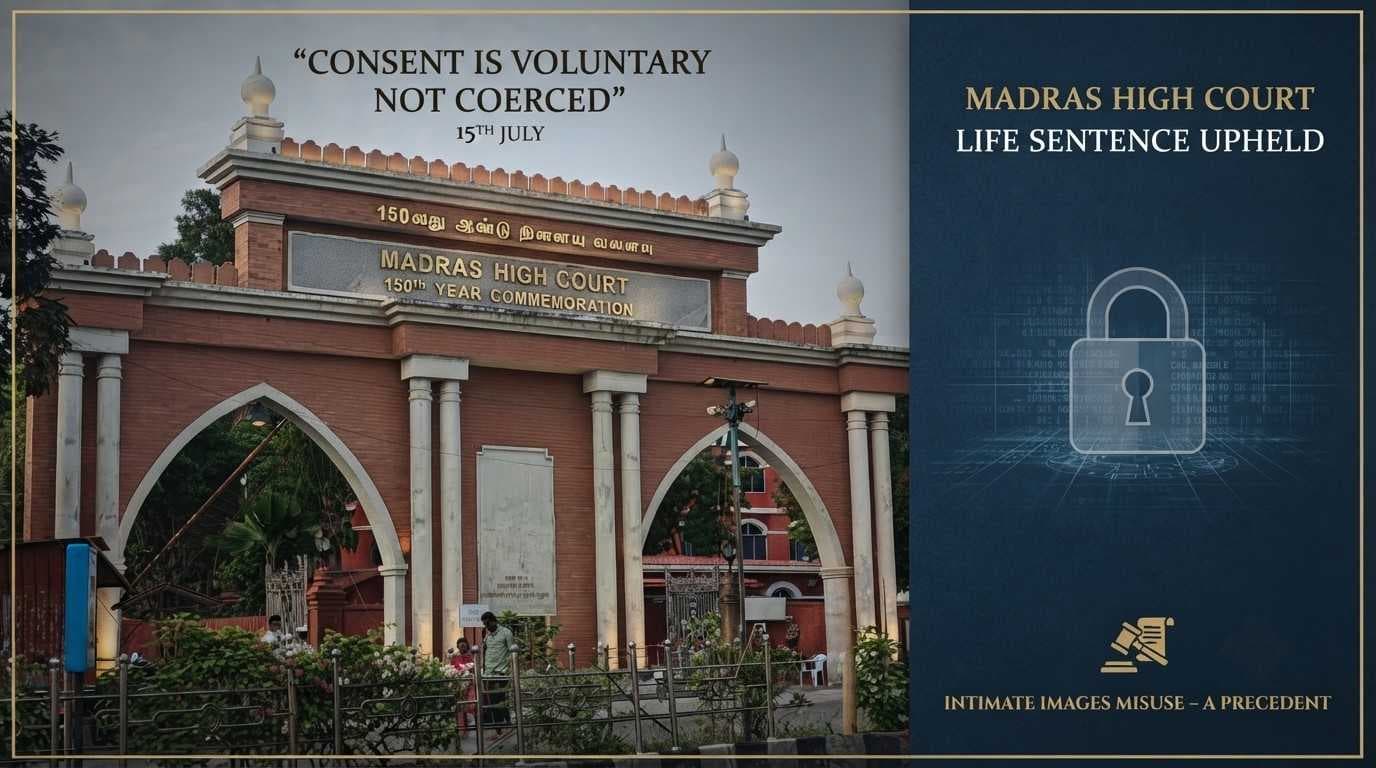
The Madras High Court, sitting with Justice Anand Venkatesh and Justice KK Ramakrishnan, recently dismissed an appeal challenging the life sentence awarded to a man convicted of sexually intimidating multiple women through the misuse of their intimate images. The appellant had contended that the relationships with the complainants were consensual, arguing that repeated physical intimacy demonstrated mutual agreement. The Bench, however, rejected this contention, emphasizing that consent must be free, voluntary, and devoid of any element of coercion, deception, or intimidation.
According to the court’s observations, the prosecution established that the accused obtained the women’s private photographs and subsequently used them as leverage to extract sexual favours. The women were allegedly threatened with the public dissemination of those images if they refused to comply. The trial court, after evaluating the evidence, concluded that the accused had committed offences punishable under Section 375 of the Indian Penal Code, read with provisions concerning criminal intimidation and voyeurism, and sentenced him to life imprisonment.
The appellant’s primary argument before the High Court rested on the premise that the existence of a physical relationship, irrespective of its nature, implied consent. The Bench, citing established jurisprudence on the definition of consent under the IPC, clarified that mere non‑resistance or passive submission does not constitute consent. It held that consent is vitiated when it is obtained by putting a person in fear of injury, by misrepresentation of fact, or by any form of deceit. In the present case, the court found that the accused’s conduct fell squarely within these categories, as the women’s acquiescence was procured through the threat of exposure of their intimate images.
Justice Venkatesh, delivering the judgment, observed that the law requires a nuanced examination of the surrounding circumstances whenever consent is pleaded as a defence. The Bench directed that courts must look beyond the frequency or pattern of physical interaction and scrutinise whether the agreement was tainted by any inducement, threat, or deception. The judgment reiterated that the burden lies on the prosecution to prove the absence of genuine consent beyond reasonable doubt, and that the defence cannot rely solely on the existence of a physical relationship to discharge that burden.
The High Court’s decision underscores the evolving judicial approach to sexual offences committed through digital means. By affirming the life sentence, the court signalled that exploitation of private images to secure sexual compliance constitutes a grave violation of personal autonomy and attracts stringent punishment. The ruling also serves as a precedent for lower courts to meticulously assess claims of consent in cases involving cyber‑enabled sexual intimidation, ensuring that victims are not denied justice on the ground of prior intimacy.
In disposing of the appeal, the Madras High Court upheld the trial court’s finding and confirmed the life imprisonment imposed on the appellant. The judgment reinforces the principle that consent must be ascertained through a holistic appraisal of the parties’ conduct, the presence of any coercive or deceptive tactics, and the voluntariness of the agreement, rather than being inferred from the mere occurrence of physical intimacy.