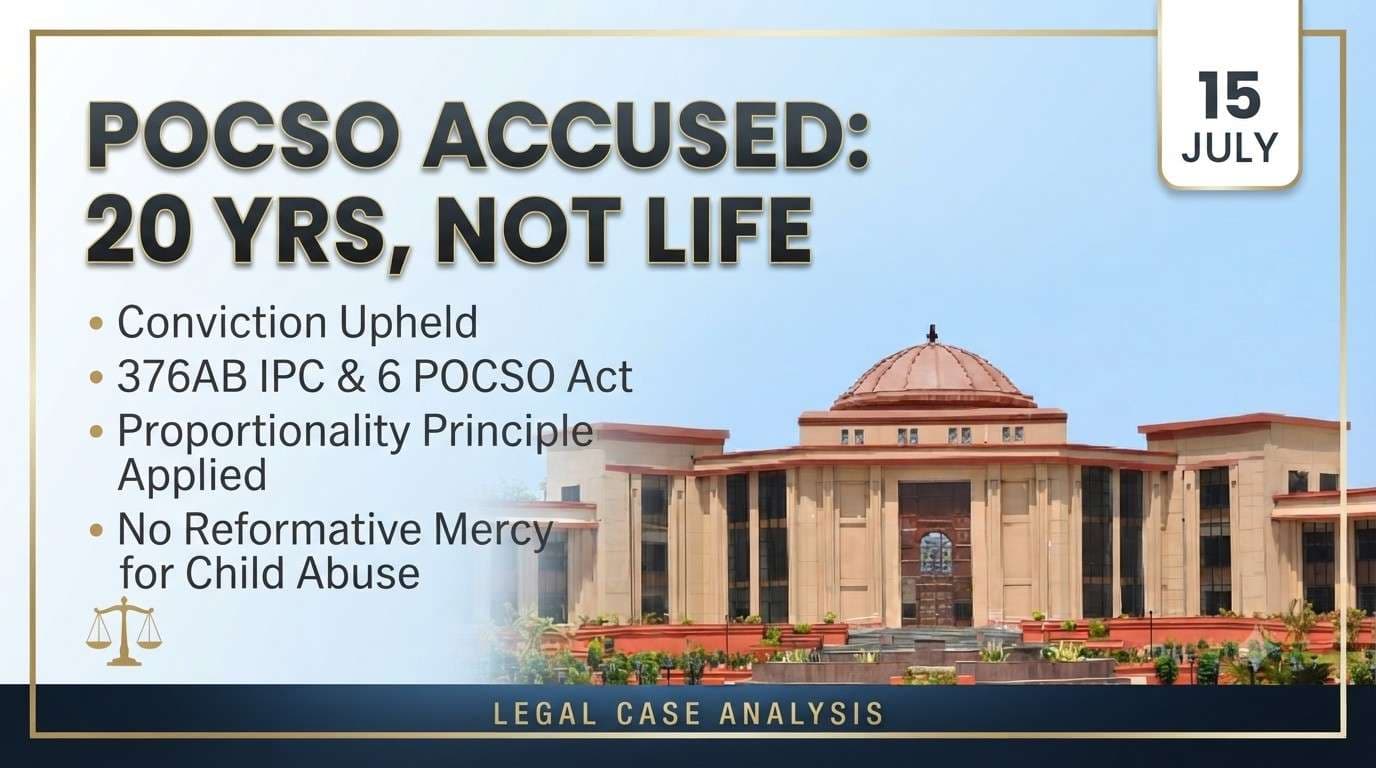
The Division Bench comprising Chief Justice Ramesh Sinha and Justice Ravindra Kumar Agrawal delivered the judgment after reviewing the conviction recorded by the trial court. The accused had been found guilty of committing penetrative sexual assault on a minor aged six years, an offence that attracts the enhanced punishment prescribed under Section 376AB of the Indian Penal Code and Section 6 of the Protection of Children from Sexual Offences Act, 2012. Both provisions mandate a minimum sentence of twenty years’ imprisonment, which may extend to imprisonment for life or, in certain circumstances, to death.
The trial court had sentenced the accused to imprisonment for life till natural death. Upon appeal, the High Court examined the appropriateness of the sentence in light of the statutory framework and the principles governing sentencing. The Bench observed that while punishment must be proportionate to the gravity of the offence, the reformative theory does not operate to mitigate responsibility in cases of sexual violence against children. The Court expressly noted the maxim “Men Are Not Improved By Injuries”, indicating that the offender’s character cannot be presumed to be reformed through the infliction of punishment alone.
Having considered the nature of the act, the age of the victim, and the legislative intent behind the enhanced penalties, the High Court concluded that a sentence of rigorous imprisonment for twenty years satisfied the requirement of proportionality without being excessive. The Court therefore modified the original order, reducing the term from life imprisonment to twenty years of rigorous imprisonment, while leaving the conviction intact.
The judgment underscores the High Court’s approach to sentencing in cases governed by special statutes for the protection of children. By upholding the conviction, the Bench affirmed the applicability of both the Indian Penal Code and the POCSO Act to the facts presented. The reduction of the sentence, however, reflects the Court’s exercise of discretion to ensure that the punishment imposed is neither disproportionate nor indiscriminately severe, while still adhering to the minimum prescribed by law.
Legal practitioners note that the decision clarifies the interplay between the mandatory minimum stipulated in Section 376AB IPC and the sentencing authority of the High Courts when the trial court imposes a term exceeding that minimum. The judgment signals that, although the legislature has prescribed a floor of twenty years, the courts may tailor the exact term within the statutory limits based on a proportionality assessment, provided that the reformative rationale is not invoked to justify a lesser term in offences of this nature.
The ruling also reinforces the deterrent objective inherent in the statutory scheme for child sexual abuse. By emphasizing that offenders are not rendered better by the mere imposition of injury, the Court aligns its reasoning with the legislative aim of imposing stringent penalties to deter recurrence and protect vulnerable minors. The High Court’s observation serves as a reminder that, in matters of sexual violence against children, the primary considerations remain the seriousness of the act and the need for a punishment that corresponds to its heinous character.
In sum, the Chhattisgarh High Court has upheld the conviction under Sections 376AB IPC and 6 POCSO, while adjusting the sentence to twenty years of rigorous imprisonment, guided by the principles of proportionality and the rejection of the reformative theory as a mitigating factor in such grave offences.