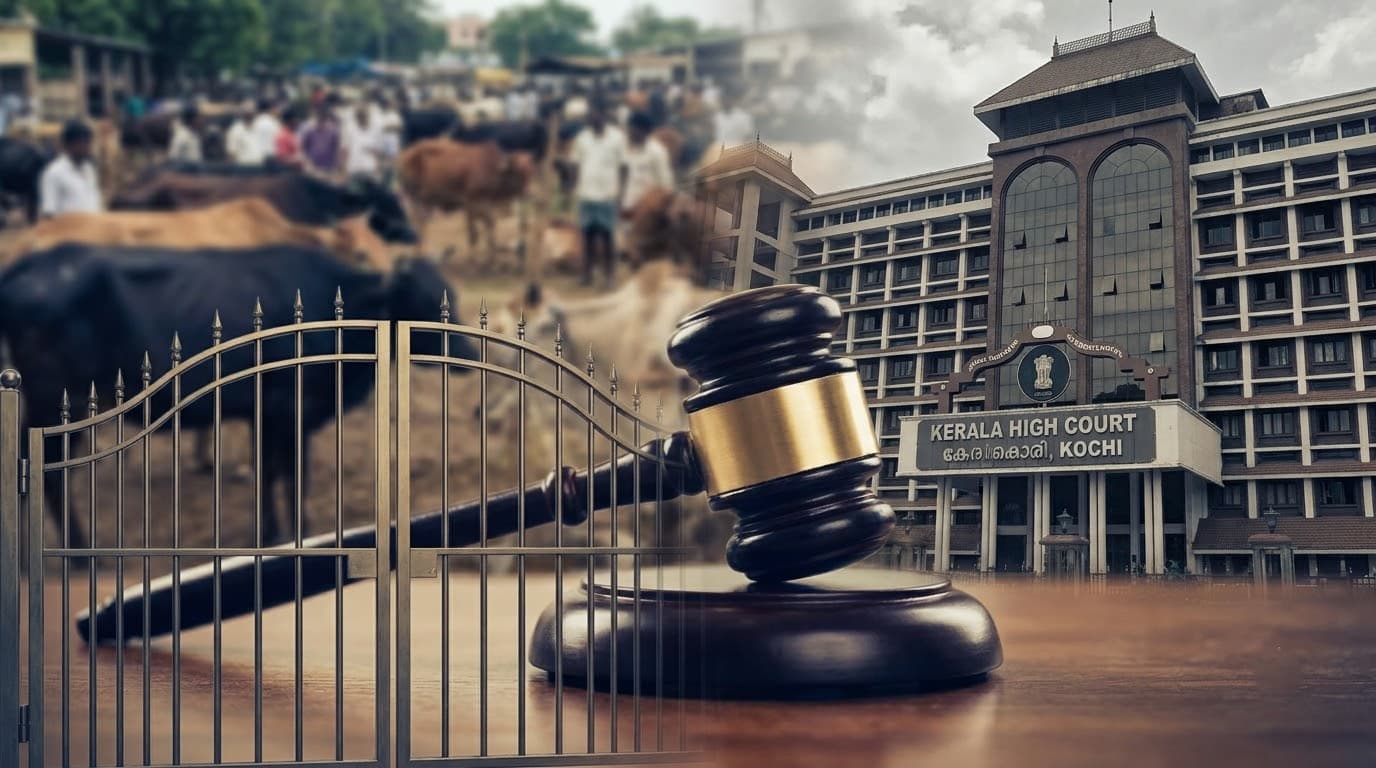
The Kerala High Court has issued a directive requiring the establishment of Animal Market Monitoring Committees in all districts of the state within a period of eight weeks. The court made it clear that if these committees are not constituted within the stipulated timeframe, it may be compelled to order the closure of all livestock markets operating within Kerala.
The observation was made during the hearing of a petition concerning the regulation and oversight of animal markets. The bench emphasized that the formation of such monitoring committees is not discretionary but a mandatory requirement under existing legal provisions governing the conduct and supervision of livestock trade. The court stressed that these committees are essential to ensure compliance with animal welfare standards, prevent illegal trade, and maintain hygienic conditions in markets where animals are bought and sold.
According to the court’s directions, each district must constitute a committee comprising representatives from relevant departments, including animal husbandry, police, revenue, and local self-government institutions. The committees are expected to conduct regular inspections, monitor adherence to guidelines laid down under the Prevention of Cruelty to Animals Act, 1960, and related rules, and submit periodic reports to the concerned authorities.
The bench further clarified that the responsibility for constituting these committees lies solely with the district administrations. It rejected any notion of delay or administrative inertia, stating that the legal mandate is clear and non-negotiable. The court noted that despite repeated instructions in previous orders, many districts have failed to take the necessary steps to set up these monitoring bodies.
In its order, the court fixed a timeline of eight weeks from the date of the judgment for compliance. It warned that if any district fails to constitute the committee within this period, the livestock markets operating within that district may be directed to shut down until the required oversight mechanism is put in place. The court indicated that it would not entertain further adjournments or pleas for additional time on grounds of administrative convenience.
The directive forms part of the court’s ongoing effort to enforce accountability in the regulation of animal markets. The bench recalled that similar directions had been issued in earlier proceedings, but the lack of action on the ground necessitated a firmer stance. It emphasized that the protection of animals from cruelty and the regulation of markets are not merely administrative matters but involve statutory duties that must be fulfilled without exception.
The court also directed the state government to file a compliance report after the expiry of the eight-week period, detailing the status of committee constitution in each district. It made it clear that the report must be verified and authenticated, and any false or misleading information would be viewed seriously.
While the court did not pass a final order closing any market at this stage, it made it unequivocally clear that continued inaction would trigger consequential directions. The bench reiterated that its intention is not to disrupt livelihoods arbitrarily but to ensure that the operation of livestock markets adheres to legal and ethical standards. It observed that the absence of monitoring mechanisms has led to instances of illegal trade, animal cruelty, and unsanitary conditions, which cannot be permitted to continue.
The order reflects the court’s commitment to enforcing statutory obligations related to animal welfare and market regulation. By setting a clear deadline and linking non-compliance to tangible consequences, the Kerala High Court aims to compel district authorities to act promptly and effectively in fulfilling their legal duties.