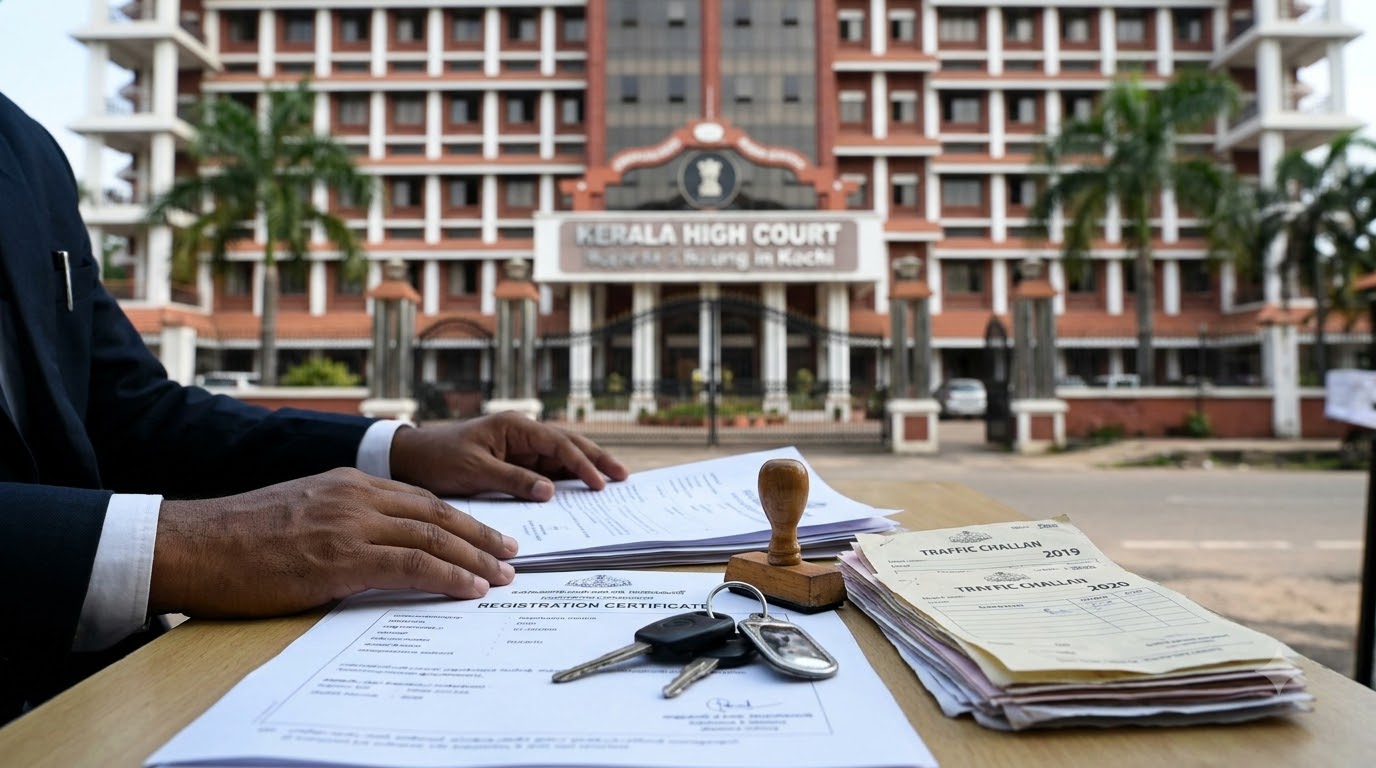
The Kerala High Court has ruled that transport authorities cannot refuse to process vehicle registration applications on the ground of unpaid traffic challans issued before October 1, 2020. Justice Murali Purushothaman held that Rule 167(7) of the Central Motor Vehicles Rules, 1989, introduced through the Eleventh Amendment Rules, 2020, operates prospectively as it constitutes substantive law lacking clear legislative intent for retrospective application.
The judgment arose from a petition filed by T.N. Arun Kumar, who purchased a car in 2015 through a loan from Bank of Baroda. After repaying the loan, Kumar approached the Regional Transport Office (RTO), Ernakulam, to remove the bank's hypothecation entry from the vehicle's registration certificate. The RTO declined to process the application, stating that the vehicle had been blacklisted due to traffic challans remaining unpaid for more than 90 days.
Kumar submitted that he had cleared all fines relating to challans issued after October 1, 2020. The outstanding challans pertained to speeding violations recorded between 2015 and 2019, a period prior to the commencement of Rule 167(7). Advocates Vipin Narayan and Ashwanth Padman represented the petitioner, while Government Pleader Sarath appeared for the RTO and Central Government Counsel Amal Parthasaradhy represented the Ministry of Road Transport and Highways.
What is the effect of Rule 167(7) of the Central Motor Vehicles Rules on pre-existing challans?
Rule 167(7) operates prospectively from October 1, 2020, and cannot be invoked to deny registration services based on challans issued before that date, as the provision imposes a new restriction that did not previously exist and lacks express retrospective language.
The Court examined the legislative history of Rule 167, which was introduced by the Central Motor Vehicles (Eleventh Amendment) Rules, 2020 and came into force on October 1, 2020. Under Rule 167(7), authorities are barred from processing certain applications related to driving licences or vehicle registration if challans remain unpaid beyond 90 days. Before this amendment, pending challans did not automatically prevent authorities from processing vehicle registration applications.
Justice Purushothaman observed that Rule 167(7) introduced a restriction that did not previously exist in law. The Court emphasised that unless a statute clearly provides otherwise, a new restriction cannot be imposed on the basis of acts or omissions occurring before the provision came into force. The Judge stated that Rule 167(7), being substantive in nature, operates prospectively as retrospectivity is not clearly made out by its language. In the absence of a clear legislative intention to confer retrospective effect, the provision cannot be invoked to interdict the processing of applications for registration of motor vehicles merely on the ground that challans issued prior to October 1, 2020 remain pending against the applicants.
Aspect | Pre-October 1, 2020 Position | Post-October 1, 2020 Position (Rule 167(7)) |
|---|---|---|
Legal Basis | No statutory bar on registration services due to pending challans. | Rule 167(7) CMVR, 1989 (Eleventh Amendment Rules, 2020). |
Effect of Unpaid Challans | Did not automatically prevent processing of registration applications. | Authorities cannot process specified applications if challans unpaid > 90 days. |
Applicability | Challans issued before 01.10.2020 governed by old regime. | Applies prospectively to challans issued on or after 01.10.2020. |
Consequently, the Court directed the RTO, Ernakulam, to process the petitioner's application for removal of the hypothecation entry without considering unpaid challans issued before October 1, 2020. The decision clarifies that the administrative blacklisting of vehicles based on pre-amendment violations lacks legal sanction under the current regulatory framework.
The ruling establishes that the restrictive regime under Rule 167(7) attaches only to violations occurring after its commencement. Vehicle owners with pending challans from the pre-amendment period are entitled to registration-related services without hindrance, unless separate statutory provisions expressly provide for retrospective recovery or enforcement.