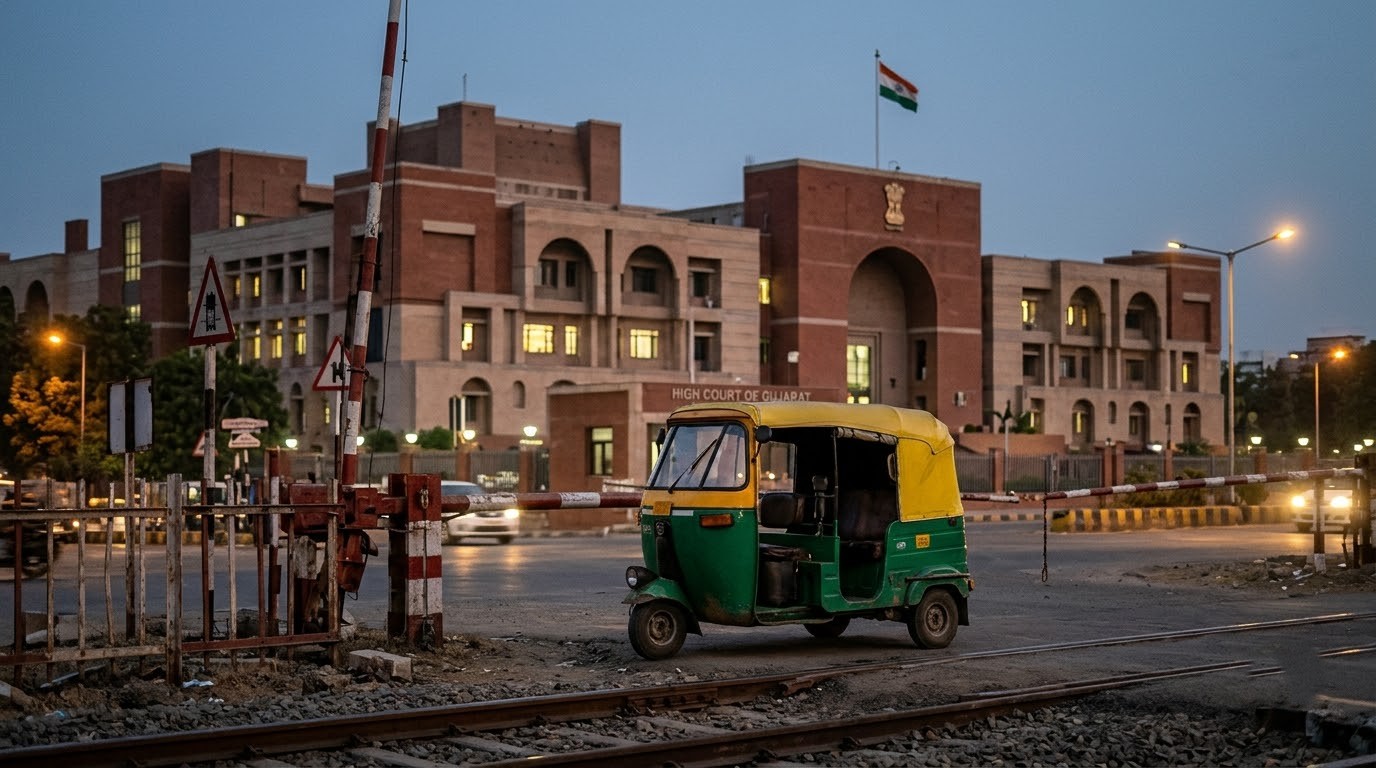
The Gujarat High Court has upheld the dismissal of a compensation claim filed by the legal heirs of an auto-rickshaw driver who died after his vehicle was hit by a train at an unmanned railway level crossing. Justice J.C. Doshi ruled that the accident resulted entirely from the deceased driver's own negligence, absolving the Union of India, representing the Railway Administration, and the vehicle owner of any liability.
The claim arose from an incident on August 27, 2003, when the deceased, Bachubhai Dabhi, was driving an auto-rickshaw carrying passengers on the Morbi-Rafaleshwar (Makansar) road. While attempting to cross the unmanned level crossing, the vehicle was struck by an approaching train and dragged along the tracks, resulting in Dabhi's death. A First Information Report was registered against the deceased, and an abated summary was subsequently filed.
The wife and children of the deceased subsequently filed a claim petition before the Motor Accident Claims Tribunal (MACT) seeking compensation from the auto-rickshaw owner and the Union of India. On August 25, 2009, the Tribunal dismissed the petition, holding the deceased solely negligent and finding no liability attributable to the Railways or the vehicle owner. The claimants challenged this order before the High Court.
The High Court conducted a joint reading of Section 161 of the Railways Act, which prescribes punishment for negligently crossing an unmanned level crossing, and Section 131 of the Motor Vehicles Act, which mandates specific precautions for drivers at unguarded railway crossings. The Court observed that these provisions collectively fasten a liability on the person approaching the crossing to take full precaution. Specifically, the driver is required to stop the vehicle, alight, and ensure that no train or trolley is approaching from either side before proceeding across the track.
Examining the evidence on record, the Court found that the deceased had crossed the unmanned level crossing hurriedly, ignoring the fact that two other auto-rickshaws intending to cross the track had stopped and were waiting for the train to pass. The evidence indicated that the deceased was frightened upon seeing the train at close quarters, and the rickshaw stopped in the middle of the track before being dashed by the running train.
The Court remarked that the deceased was at the peak of his negligence. It found that in a hurry to secure more fare from a folk fair, he impulsively attempted to cross the railway level crossing without following the mandated rules and provisions of law, ignoring the two stationary rickshaws, and consequently lost his life in the unfortunate incident.
Regarding the liability of the Railways, the Court referred to the Supreme Court ruling in Union of India vs United India Insurance Company Limited (1997). It noted that the Supreme Court had observed the Railways bear no statutory duty under clauses (c) and (d) of Section 13 of the Railways Act to erect gates, chains, or bars, or to employ persons to operate them, unless the Central Government specifically requires the railway to do so by requisition.
While acknowledging that the Railways bear a common law liability, the Court held that such liability cannot be fastened onto the administration in the absence of any proven inaction or non-performance of a statutory or mandatory duty. The Court noted that although the crossing was unmanned, a sign board was present. Furthermore, evidence from the loco pilot and co-loco pilot established that the train had continuously blown its horn from the time it left the railway station until the accident occurred. No omission on the part of the Railway to perform its statutory duty was established.
Consequently, the High Court affirmed the Tribunal's finding that the claim petition was rightly dismissed due to the self-negligence of the deceased. The appeal filed by the claimants was dismissed, and the order of the MACT dated August 25, 2009, was upheld.
What statutory duties apply to a driver at an unmanned railway crossing under Indian law?
Under Section 131 of the Motor Vehicles Act and Section 161 of the Railways Act, a driver approaching an unguarded railway crossing must stop the vehicle, get down, and personally ensure no train is approaching from either side before crossing. Failure to observe this mandatory precaution constitutes negligence per se, fastening liability solely on the driver for any resulting accident.