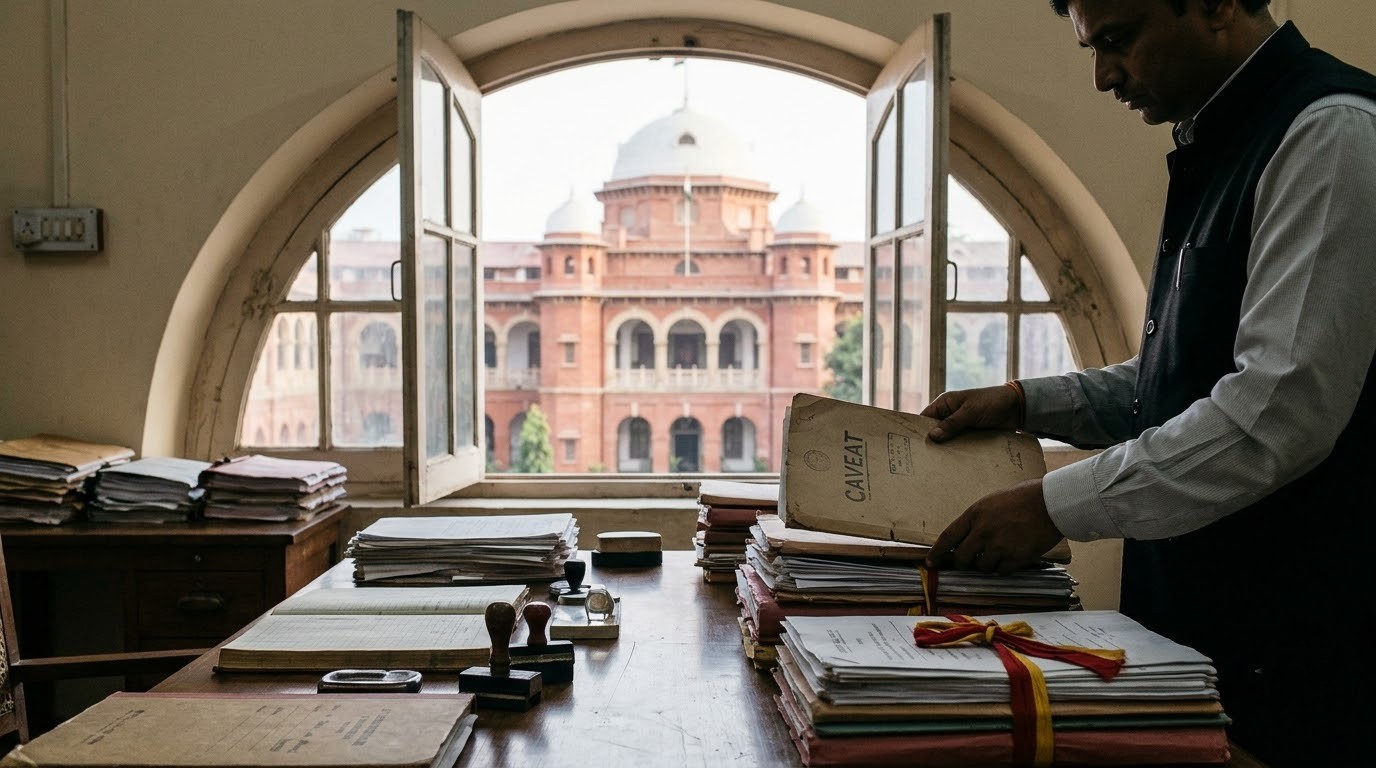
The Allahabad High Court has directed its administrative wing to examine a representation seeking the introduction of a formal mechanism for the filing, registration, and notification of caveats in criminal proceedings. A Division Bench comprising Justice Rajan Roy and Justice Manjive Shukla passed the order while disposing of a Public Interest Litigation (PIL) filed by advocate Anupriya Agarwal.
The petition highlighted a gap in the Allahabad High Court Rules, 1952, which currently do not prescribe a specific procedure for caveats in criminal matters such as bail applications, anticipatory bail, criminal appeals, revisions, and petitions seeking the quashing of criminal cases. A caveat plea serves as a request to the court to hear a party before passing any order that may affect their interests.
Why Did The Court Refer The Matter To The Administrative Side?
The Bench observed that while the PIL prima facie raises an important issue concerning access to justice, the subject matter essentially pertains to court procedure. Consequently, the Court directed that the petitioner's representation, addressed to the Chief Justice and annexed to the writ petition, be considered on the administrative side.
The petitioner's counsel contended that the absence of a criminal caveat mechanism severely prejudices the rights of victims of crimes and informants. Counsel submitted that without a formal notification system, victims' counsel face difficulties in tracking the listing of such cases and contesting proceedings instituted by accused persons. The plea urged a reasoned decision on the representation dated October 13, balancing victim rights, fair procedure, the liberty of the accused, and the need for expeditious criminal justice administration.
In view of the procedural nature of the prayer, the Bench closed the writ petition on the judicial side, clarifying that the representation would be examined administratively.
Aspect | Details |
|---|---|
Case Title | Anupriya Agarwal vs State of UP and Another |
Bench | Justice Rajan Roy and Justice Manjive Shukla |
Petition Type | Public Interest Litigation (PIL) |
Core Issue | Absence of caveat filing mechanism in criminal proceedings under Allahabad High Court Rules, 1952 |
Rules Challenged | Chapter XXII, Rule 5 (Writ Petitions other than Habeas Corpus) |
Court's Disposition | Writ petition closed on judicial side; representation referred to administrative side for examination |
Petitioner's Counsel | Advocates Saksham Agarwal, Pranshu Agrawal, and Rakesh Kumar Agarwal |
Respondent's Counsel | Chief Standing Counsel and Advocate Shishir Jain |
The Court's direction underscores the distinction between adjudicating rights and framing procedural rules. By referring the matter to the administrative side, the Bench has acknowledged the legislative function inherent in rule-making while recognising the substantive impact of procedural gaps on stakeholders in the criminal justice system. The administrative examination will now determine whether Chapter XXII of the High Court Rules requires amendment to incorporate a structured caveat regime for criminal proceedings, a step that could significantly enhance the participatory rights of victims and informants at the pre-hearing stage.