Supreme Court Sets Aside High Court Order Refusing To Quash Proceedings
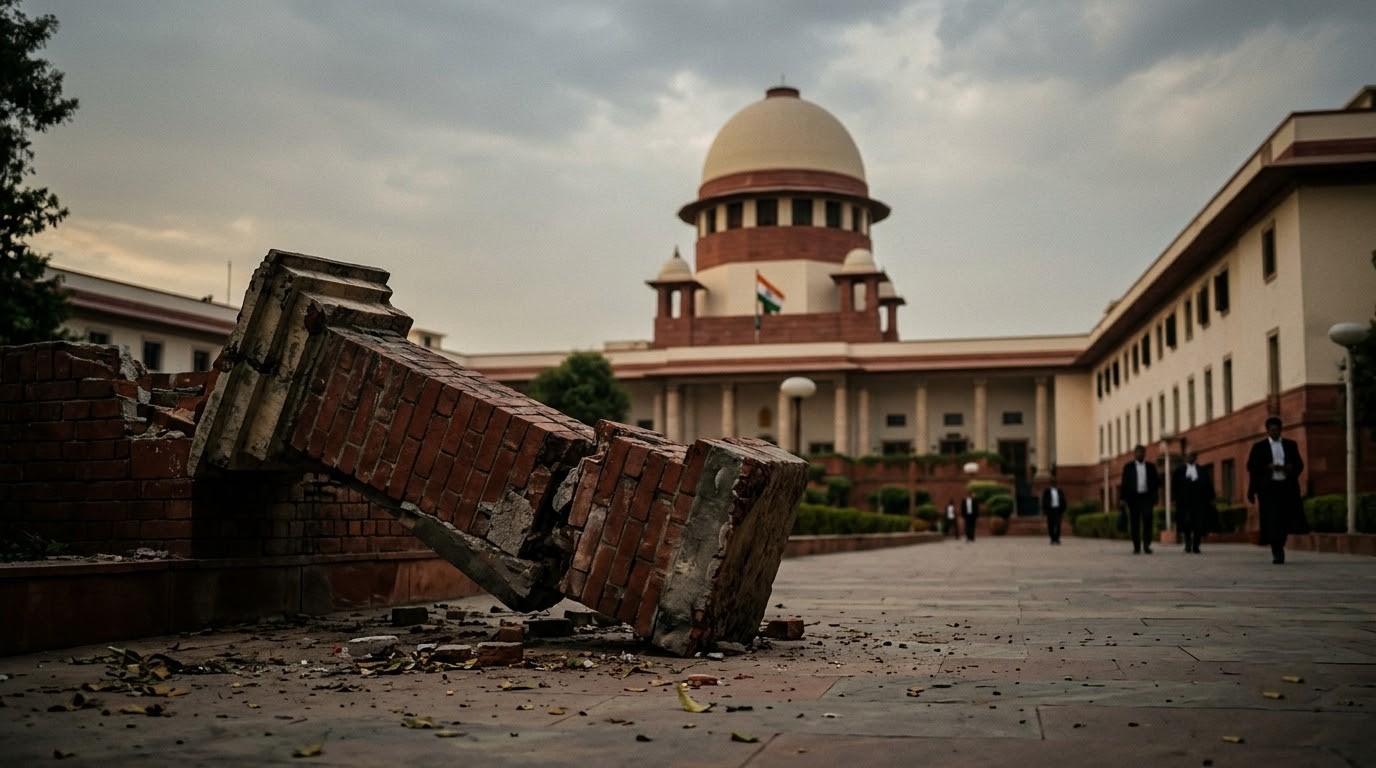
A Bench of Justices J B Pardiwala and Manmohan has quashed criminal proceedings against Matin Shankarrao Bhosale and another administrator of Prashnachinha Adivasi Ashram Shala in Mangrul Chawala, Amravati district. The appeal challenged the Bombay High Court's refusal to interfere with a charge-sheet filed under Section 304 read with Section 34 of the Indian Penal Code (IPC). The case arose from the death of a 12-year-old student, Ku Bharati, who was crushed by a collapsing brick-and-cement pillar on the school premises on February 19, 2020.
Court Distinguishes Civil Liability From Criminal Culpability
The Bench held that the charges under Section 304 IPC could not be sustained. Culpable homicide requires proof of intention to cause death or knowledge that the act was likely to cause death. The court found no evidence that the appellants voluntarily committed an offence or possessed knowledge that substandard construction would in all probability result in a student's death.
Addressing the lesser offence under Section 304A IPC (causing death by negligence), the court ruled that the accused's act must be the causa causans—the direct, proximate, and efficient cause of death. The Bench observed that simple negligence or lack of care is insufficient for criminal conviction. Civil liability does not automatically translate into criminal liability; there must be a high degree of gross or culpable negligence involving recklessness.
What Is The Legal Standard For Criminal Negligence Under Section 304A IPC?
Criminal negligence under Section 304A IPC requires the accused's act to be the direct, proximate, and efficient cause of death (causa causans), not merely a necessary condition (causa sine qua non). Simple negligence or failure to maintain civil standards of care is insufficient; the prosecution must prove a high degree of gross or culpable negligence involving recklessness.
Chain Of Causation Broken By Contractor's Role
The court carefully examined the chain of causation. It noted that multiple factors may have contributed to the tragedy. The contractor who executed the construction work might, at most, face a prima facie case of negligence. However, the administrators' alleged negligence could not be regarded as the causa causans; at best, it was a causa sine qua non. The Bench stated that if due care had been taken by the contractor to ensure student safety, the incident likely would not have occurred.
Legal Provision | Requirement for Conviction | Application to Appellants |
|---|---|---|
Section 304 IPC (Culpable Homicide) | Intention to cause death or knowledge that act is likely to cause death | Not satisfied; no voluntary commission or knowledge of probability of death |
Section 304A IPC (Death by Negligence) | Act must be causa causans (direct, proximate cause); high degree of gross/culpable negligence | Not satisfied; administrators' role not immediate cause; contractor's negligence intervened |
Judicial Anguish Does Not Override Legal Rigour
The Bench recorded profound anguish over the death of the child. The court acknowledged that dictating the order was a painful experience and that the thought of a 12-year-old girl crushed beneath a school pillar made their hearts bleed with pain and agony. The Bench recognized the enduring suffering of the parents.
However, the court immediately cautioned against allowing emotion to overwhelm judicial reason. The Bench stated that such thoughts must not allow the mind of a judge to get boggled, otherwise justice cannot be done. The court affirmed that however harsh one may find the law, it remains the law and must be respected.
High Courts Must Quash Proceedings Disclosing No Offence
The Supreme Court reiterated the obligation of High Courts to quash criminal proceedings when uncontroverted allegations in an FIR or charge-sheet disclose no offence. This power must be exercised to prevent abuse of process and secure the ends of justice. The court concluded that the appellants should not face trial under either Section 304 or Section 304A IPC, as the chain of causation had been broken and their role was not the immediate cause of the child's death.
The observations regarding the contractor's potential liability were clarified as prima facie and subject to evidence at any future trial.