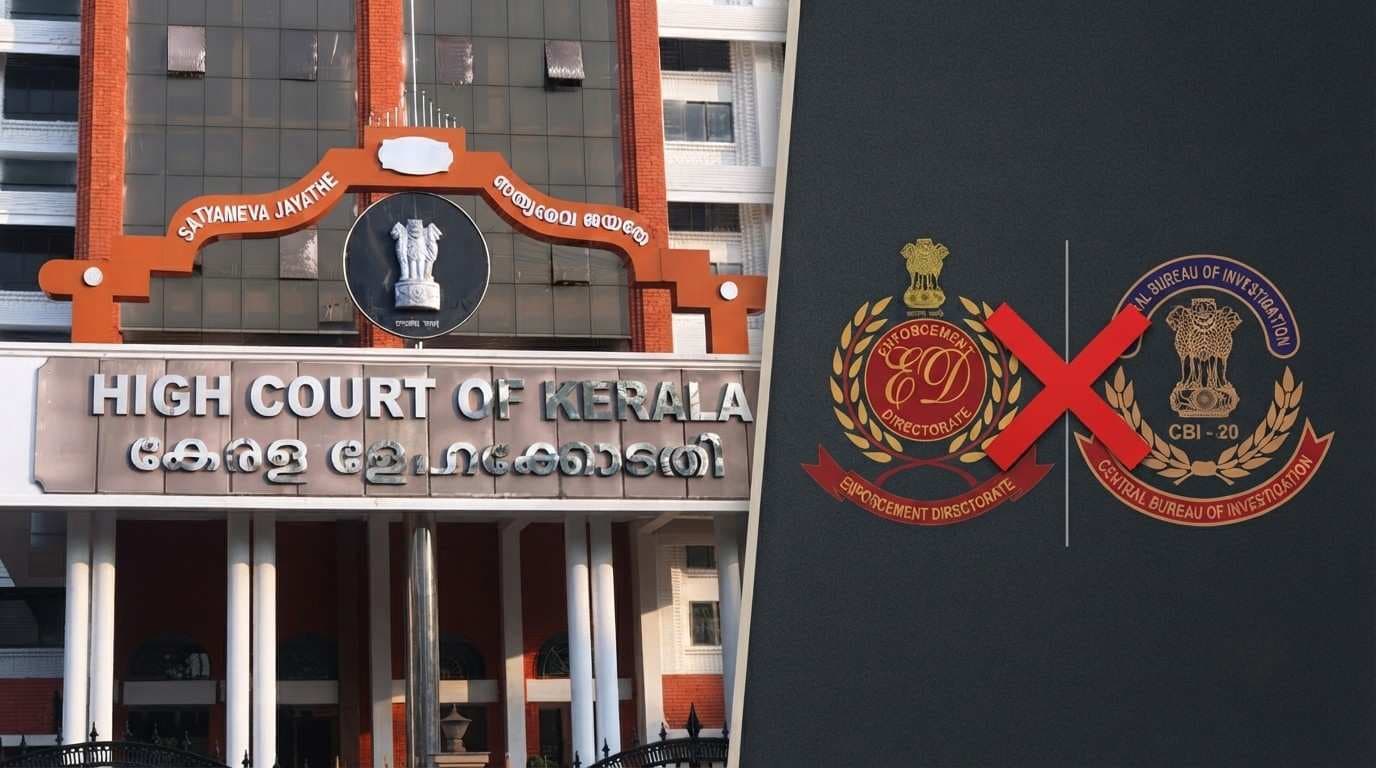
The Kerala High Court, sitting as a Division Bench comprising Chief Justice Soumen Sen and Justice Syam Kumar VM, dismissed a public interest litigation seeking a Central Bureau of Investigation probe into the assault on Enforcement Directorate officials. The Bench observed that the extraordinary power to direct a CBI investigation may be exercised only in rare and exceptional circumstances where there is material showing that the investigating agency is acting with bias or that a fair investigation is not possible.
The Court noted that the petition, filed by advocate Jojo Jose, asked for a CBI inquiry into the incident that occurred on May 27, 2026, when ED officers were attacked after completing a search at the residence of former Chief Minister Pinarayi Vijayan. The search had been carried out as part of the central agency’s probe into the CMRL case, which involves allegations against Exalogic, an information technology firm owned by Vijayan’s daughter Veena Thaikkandiyil.
According to the averments placed before the Court, after the search concluded, nearly three hundred persons surrounded the vehicle of the ED officials and pelted stones and bricks at them. It was also alleged that sticks and rods were used in the assault. The petitioner contended that the State police investigation might be influenced and therefore sought central agency intervention.
The Bench, however, emphasized that constitutional courts must exercise restraint before directing a CBI probe. It held that the record did not prima facie show that the investigating agency was acting in breach of its duty or had failed to act impartially. The Court stated that the power to order a CBI investigation must be used sparingly and with circumspection, particularly in the context of cooperative federalism, and should be invoked only when it is manifest that the State investigating agency is biased and that there is no possibility of a fair investigation, having regard to the likely influence of State machinery.
On June 4, 2026, the Court had directed the Government Pleader to file a status report on the actions taken by the police. In response, the State submitted a detailed report indicating that the Inspector Station House Officer of the Museum Police Station had taken over the investigation. The report mentioned that scene mahazars had been prepared, scientific and video graphic evidence had been collected, and twenty‑five accused had been identified and arrested. It further stated that statements of forty‑four witnesses had been recorded and that additional evidence, including forensic examination of seized mobile phones, call data records, fingerprints and other materials, was being gathered before the final report would be filed.
The State also denied any allegations of intelligence failure or deliberate inaction by the police. After examining the status report, the Court concluded that there was no basis to find that the investigation lacked fairness or impartiality. Consequently, the Bench dismissed the petition.
Appearances in the matter included advocate Radhakrishnan R representing the petitioner, standing counsel Jaisankar V Nair appearing for the Enforcement Directorate, advocate Sreelal N Warrier for the Central Bureau of Investigation, special government pleader C Rasheed for the Director General of Police, and Additional Solicitor General P Sreekumar, instructed by Central government counsel Amal Parthasaradhy, appearing for the Union government.
The judgment underscores the high threshold that must be met before a constitutional court can order a central agency investigation into alleged offences investigated by State police, reinforcing the principle that such direction is warranted only when clear evidence of bias or impossibility of a fair trial is present.