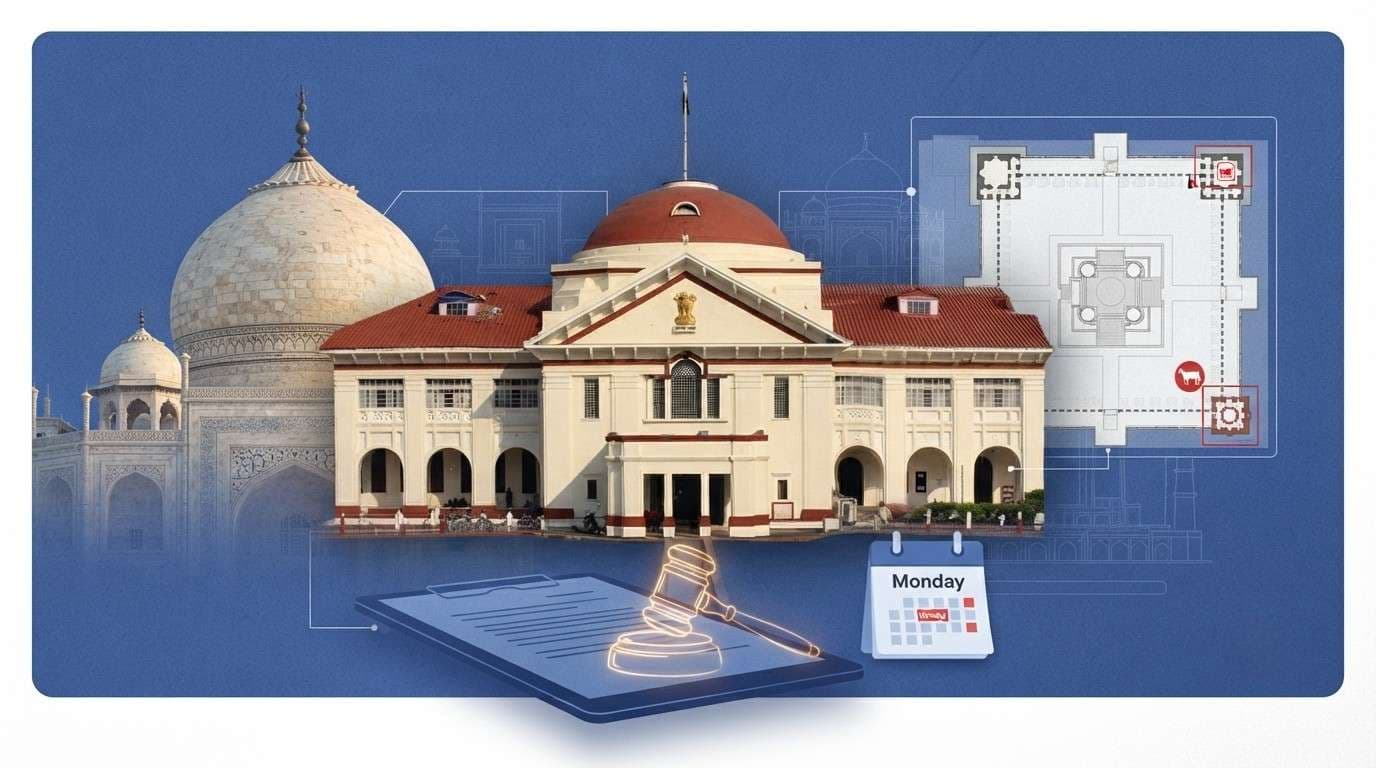
The dispute originates from a regular suit filed in 2015 before the Civil Judge (Senior Division), Agra. The plaintiffs, acting through next friend Advocate Hari Shankar Jain on behalf of the deity Lord Sri Agreshwar Mahadev Nagnatheswar Virajman, asserted that the Taj Mahal is in fact an ancient Hindu temple known as Tejo Mahalaya. They sought a declaration that the monument is a Hindu place of worship and an injunction permitting Hindus to perform darshan and pooja within its precincts, relying on the fundamental right guaranteed under Article 25 of the Constitution.
Petitioners’ Historical and Architectural Claims
The plaintiffs’ pleading traces the monument’s origin to 1155‑56 AD, attributing its construction to Raja Paramardi Dev. They state that the property subsequently came under the control of Raja Maan Singh and later Raja Jai Singh of Jaipur in the seventeenth century. According to the suit, the Mughal emperor Shahjahan seized the Tejo Mahalaya palace from Raja Jai Singh and converted it into a memorial for his queen, altering certain parts to incorporate Islamic features. The plaintiffs contend that at least 109 archaeological and historical indicators support the claim that the structure is a Hindu temple. They point to the presence of a kalash and lotus‑petal decoration on the marble dome, which they describe as symbols of Hindu worship. Additionally, they cite an Archaeological Survey of India record that identifies a structure on the south‑east corner of the site as a gaushala, a feature they argue is intrinsic to Hindu temple complexes but absent from Muslim mausoleums.
Lower Court Orders
In 2019 the plaintiffs moved an application for the appointment of an advocate‑commissioner to conduct inspection, photography and videography of the Taj Mahal. The Additional Civil Judge (Senior Division), Agra rejected the application. The court’s order cited two grounds: first, the plaintiffs had not produced revenue documents such as khasra or khatauni necessary to ascertain the exact gata number of the suit property; second, the described boundaries and area of the monument (stated as 77 bighas) did not correspond with the defendants’ documents. A revision petition challenging this order was filed before the Additional District Judge, Agra. In April of the current year that court held the revision petition to be non‑maintainable.
High Court Pleas
Aggrieved by both the original order and the revision ruling, the plaintiffs have approached the Allahabad High Court. Their petition argues that the Agra court’s reasoning suffers from patent illegality, material irregularity and a failure to exercise jurisdiction. They maintain that the objections raised by the lower court are wholly irrelevant to the purpose of appointing an advocate‑commissioner, whose role is to facilitate the collection of material evidence that cannot be adequately established through oral testimony alone. The petition emphasises that there is no dispute over the identity of the suit property, which is a universally recognised ancient monument. It further asserts that the physical features, structural characteristics and locked portions of the Taj Mahal require visual documentation to substantiate the claim of Hindu religious character, and that such documentation cannot be obtained without the commissioner’s authority to photograph and videograph the site. The plaintiffs note that, as the Taj Mahal is a protected monument, they themselves lack the right to take photographs inside or outside the premises, reinforcing the need for a court‑appointed commissioner.
Present Status
The matter is listed for hearing on the forthcoming Monday before the Allahabad High Court. No interim order has been passed, and the court has not yet expressed any opinion on the merits of the claim. The proceedings will determine whether the appointment of an advocate‑commissioner for a survey of the Taj Mahal shall be granted, thereby allowing the plaintiffs to pursue the evidentiary basis of their suit.