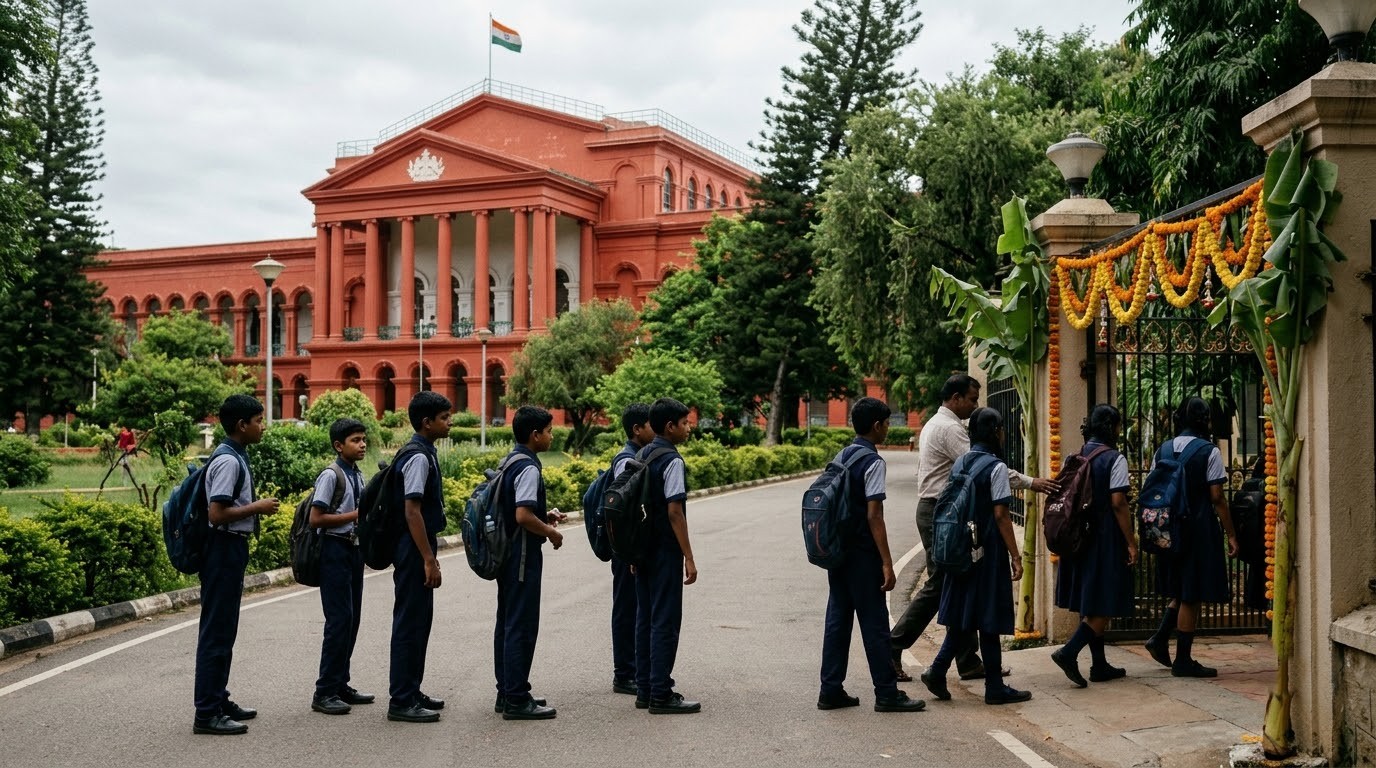
The Karnataka High Court has quashed a First Information Report (FIR) registered against a retired assistant teacher, ruling that taking select students to a private housewarming ceremony while excluding others who were not invited does not constitute the offence of untouchability under the Scheduled Castes and Scheduled Tribes (Prevention of Atrocities) Act, 1989. Justice V. Srishananda delivered the judgment, setting aside the criminal proceedings initiated under Section 3(1)(r) of the Act.
Background Of The Case
The controversy originated from a complaint filed on March 12, 2020, by the mother of two children studying in a government school. The complainant alleged that the petitioner, then serving as a government teacher, took students of Classes 5, 6, and 7 to a housewarming ceremony organised by a private individual. The complainant contended that her children were deliberately left behind while other students were taken to the event. She argued that this differential treatment amounted to the practice of untouchability.
Acting on the complaint, the police registered an FIR against the petitioner invoking Section 3(1)(r) of the SC/ST (Prevention of Atrocities) Act. The provision penalises the intentional insult or intimidation of a member of a Scheduled Caste or Scheduled Tribe in any place within public view with the intent to humiliate. The petitioner approached the High Court seeking the quashing of the FIR and the underlying complaint.
Petitioner's Submissions
The petitioner submitted that the housewarming ceremony was a strictly private function hosted by a private person. She argued that she had only accompanied those students who had received a personal invitation to attend the event. The petitioner maintained that the children of the complainant were not invited by the host and, therefore, their non-participation was not a result of any discriminatory conduct on her part.
Additionally, the petitioner contended that if there was any grievance regarding the alleged violation of school timings or the propriety of a teacher attending a private function during working hours, the appropriate remedy lay in approaching the competent departmental authority. She argued that the criminal law should not be invoked to address what was essentially an administrative or disciplinary matter.
Court's Findings On Untouchability
The High Court examined whether the act of not taking the complainant's children to a private function could be construed as "practising untouchability" within the meaning of the SC/ST Act. Justice V. Srishananda observed that the event in question was a private housewarming ceremony organised by a private individual. The court emphasised that the teacher had merely accompanied those students who had been specifically invited by the host.
The court held that the exclusion of children who were not invited to a private function cannot, by any stretch of imagination, be categorised as the practice of untouchability. The judgment clarified that if a private person does not invite certain children to a private function, and a teacher attends that function with the invited students, such conduct does not attract the provisions of the Atrocities Act.
Does Non-Invitation To A Private Event Amount To Untouchability Under The SC/ST Act?
No. The Karnataka High Court held that a teacher accompanying only those students who were personally invited to a private housewarming ceremony, while excluding children who were not invited by the host, does not constitute the practice of untouchability or an offence under Section 3(1)(r) of the SC/ST (Prevention of Atrocities) Act.
Comparison Of Allegations And Judicial Findings
Aspect | Complainant's Allegation | High Court Finding |
|---|---|---|
Nature of Event | School-related activity implying discrimination | Private housewarming ceremony by a private host |
Basis of Exclusion | Caste-based discrimination / Untouchability | Non-receipt of invitation from private host |
Teacher's Role | Deliberately left out specific children | Accompanied only invited students |
Applicability of Sec 3(1)(r) SC/ST Act | Alleged offence made out | No offence disclosed; FIR quashed |
Disposition
Accepting the petitioner's contentions, the High Court concluded that the FIR and the complaint did not disclose any offence under the SC/ST (Prevention of Atrocities) Act. The court noted that the allegations, even if taken at face value, did not satisfy the ingredients of Section 3(1)(r). Consequently, the court allowed the petition and quashed the criminal proceedings pending against the retired assistant teacher. The ruling underscores that social exclusion from a purely private event, governed by the host's invitation list, cannot be equated with the constitutional and statutory prohibition of untouchability.