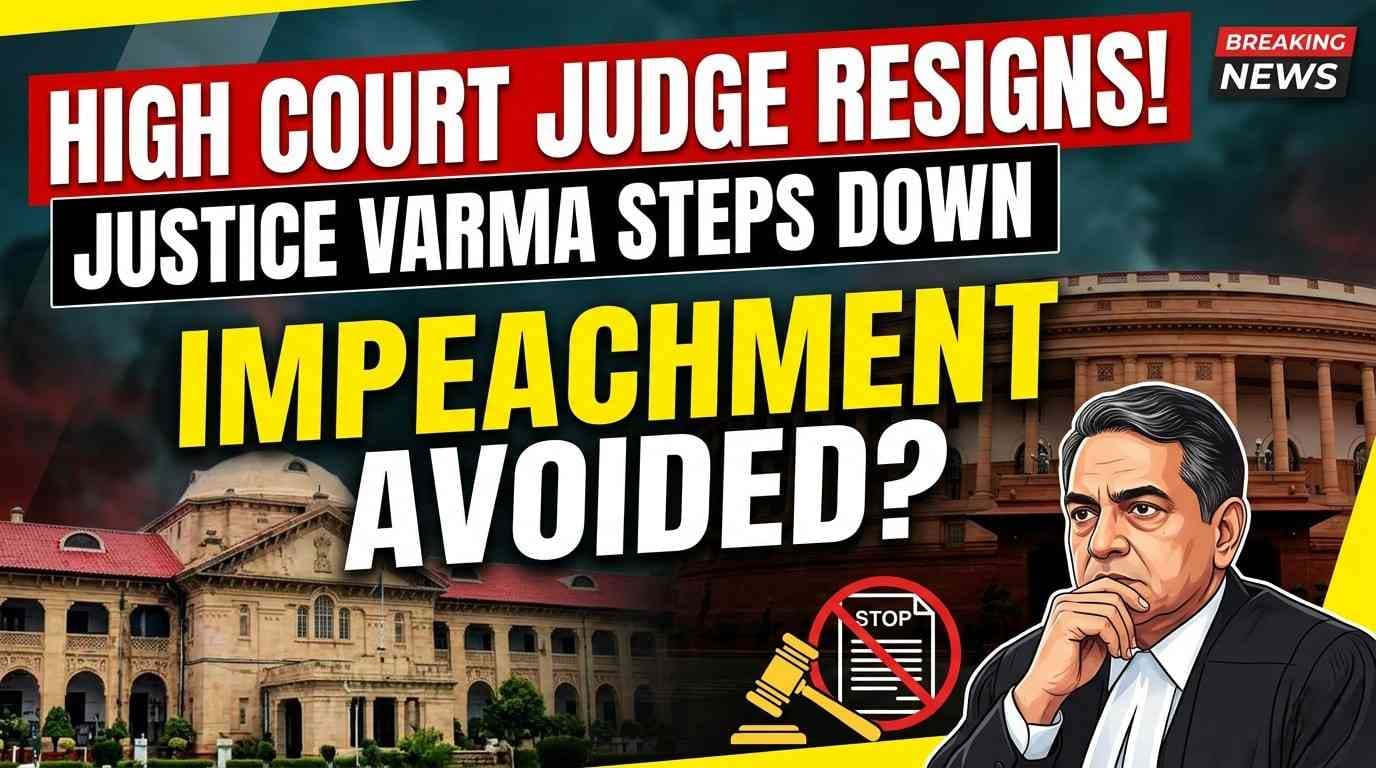
Justice Yashwant Varma has tendered his resignation as a judge of the Allahabad High Court, a move that comes at a time of intense scrutiny surrounding his judicial tenure. The resignation was submitted directly to the President of India, marking an abrupt end to his service on the bench. While the formal letter cites personal reasons for the departure, the timing has drawn significant attention from the legal fraternity, as it coincides with the initiation of preliminary steps toward impeachment proceedings.
The resignation follows a series of allegations that had recently been brought to the attention of the Supreme Court collegium and the Ministry of Law and Justice. Although the specific nature of the charges remained largely confidential during the initial investigative stages, reports indicate that the controversy centered on issues of judicial propriety and administrative conduct. The potential for a formal impeachment motion in Parliament had created a high-pressure environment, leading many to view this resignation as a preemptive measure to avoid a protracted and public removal process.
In the Indian judicial system, the impeachment of a High Court judge is a rare and complex constitutional procedure, requiring a two-thirds majority in both houses of Parliament. By resigning before the formal introduction of such a motion, a judge effectively brings the impeachment process to a halt, as the proceedings are aimed at removing a sitting officer. Justice Varma’s exit ensures that the administrative inquiry into his conduct will not transition into a legislative trial, although it leaves several questions regarding the underlying allegations unanswered.
Justice Varma, who had previously served in various capacities within the judiciary and was known for several notable judgments during his career, now joins a small group of judges who have stepped down amidst the threat of constitutional removal. His departure creates a vacancy in the Allahabad High Court, the country's largest high court, which is already grappling with a significant backlog of cases and a high number of unfilled judicial positions.
The legal community has reacted with mixed sentiments to the development, with some calling for greater transparency in the "in-house" inquiry system of the judiciary. Critics argue that allowing a judge to resign under the cloud of impeachment prevents a definitive finding of guilt or innocence, which is essential for maintaining public trust in the legal system. Conversely, others suggest that a quiet exit is a pragmatic way to protect the dignity of the institution from the spectacle of a political trial.
As per protocol, once the President accepts the resignation, it will be formally notified by the Department of Justice. This development marks the conclusion of Justice Varma's judicial career and shifts the focus back to the Supreme Court’s oversight mechanisms. The case serves as a stark reminder of the rigorous standards of accountability expected of the higher judiciary and the significant constitutional safeguards in place to address concerns of judicial misconduct.