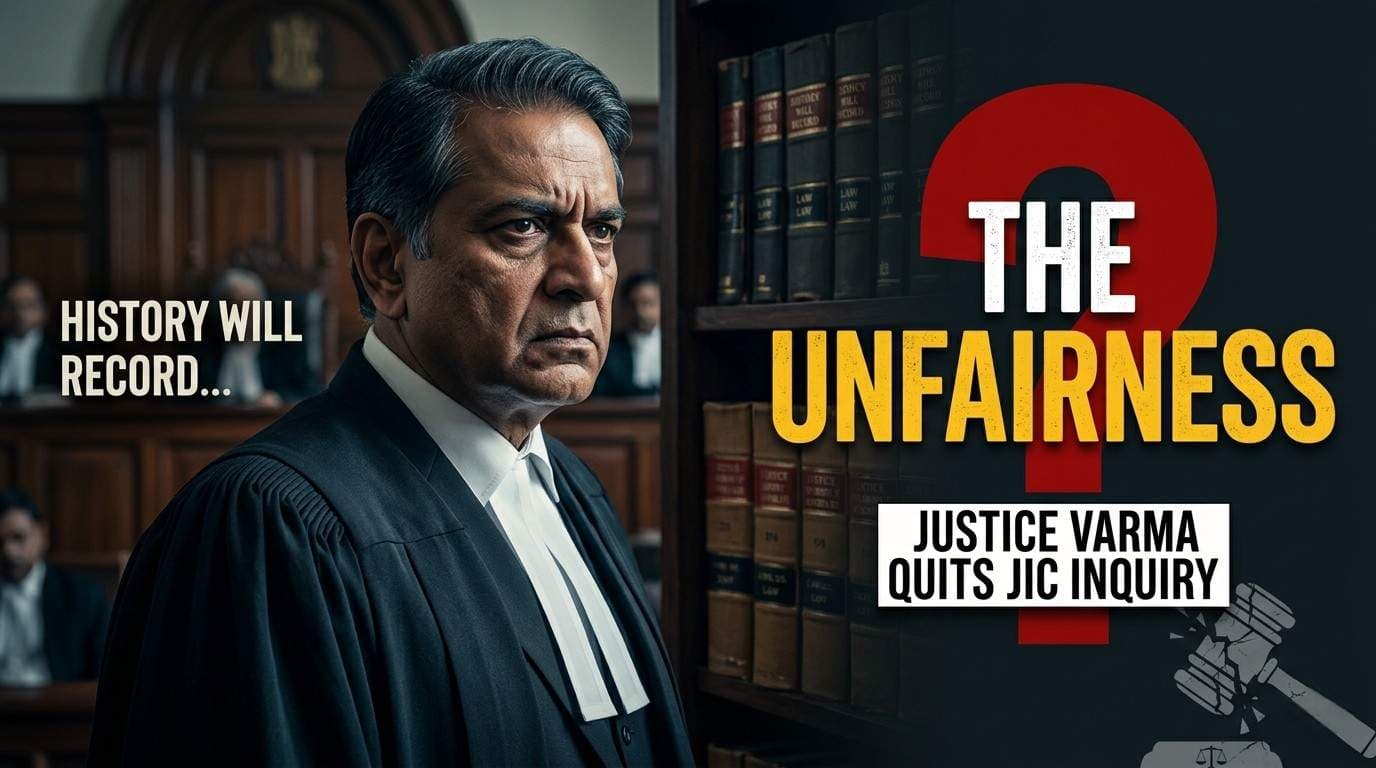
In a dramatic development within the higher judiciary, Justice Yashwant Varma has announced his withdrawal from the ongoing Judicial Inquiry Committee (JIC) proceedings established to investigate allegations against him. His decision was accompanied by a pointed statement asserting that "history will record the unfairness" of the process, signaling a complete breakdown of trust between the judge and the inquiry panel. This move follows his recent resignation from the Allahabad High Court, further intensifying the controversy surrounding his departure from the bench.
Justice Varma expressed deep-seated grievances regarding the procedural conduct of the inquiry, alleging that he was denied a fair opportunity to defend himself against the accusations. In his communication, he highlighted that the principles of natural justice were compromised, leaving him with no choice but to distance himself from what he termed a "predetermined" outcome. By withdrawing from the proceedings, the former judge has essentially challenged the legitimacy of the internal oversight mechanism designed to ensure judicial accountability.
The inquiry was initiated following complaints that touched upon judicial propriety, leading to a high-level probe involving senior members of the legal fraternity. Justice Varma’s legal team had previously raised objections regarding the evidence being considered and the refusal of the committee to allow certain witnesses to be cross-examined. The judge’s statement suggests that the inquiry had moved beyond a fact-finding mission and had become, in his view, an exercise in administrative overreach aimed at tarnishing his professional legacy.
This withdrawal places the Judicial Inquiry Committee in a complex position. Typically, such inquiries are intended to provide a clear resolution to allegations of misconduct; however, the absence of the primary subject of the probe creates a procedural vacuum. While the committee may still choose to submit a report based on existing evidence, the lack of participation from Justice Varma ensures that the findings will likely remain contested and subject to public and legal debate for years to come.
The phrase "history will record" has resonated strongly within the legal community, drawing parallels to past instances where judges felt sidelined by the collegium or administrative inquiries. Legal experts are divided on the development, with some viewing it as an act of defiance against a potentially flawed system, while others see it as an attempt to avoid a definitive verdict on the merits of the allegations. Regardless of the perspective, the event highlights a significant friction point between individual judicial rights and the systemic need for accountability.
Ultimately, Justice Varma’s exit from the inquiry marks a bitter end to a long judicial career. The development serves as a critical case study for the "in-house" procedure of the Indian judiciary, sparking calls for more transparent and standardized protocols for investigating sitting and former judges. As the files are moved toward a final administrative conclusion, the cloud of "unfairness" claimed by Justice Varma remains a significant footnote in the history of the Allahabad High Court’s recent administrative challenges.