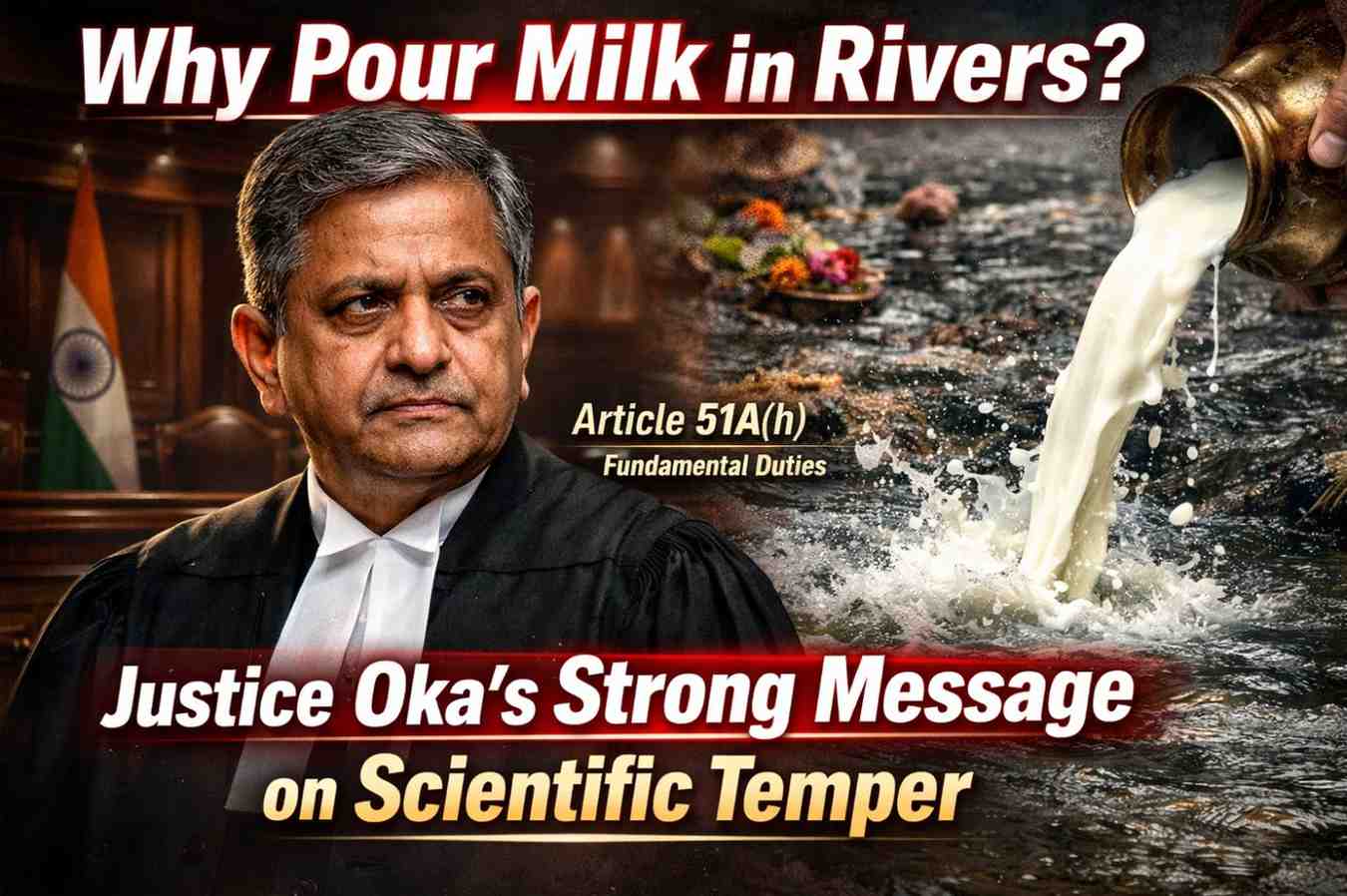
During a recent public address, Supreme Court Justice Abhay S. Oka emphasized the critical need for developing a "scientific temper" among the citizenry, as mandated by the Fundamental Duties under Article 51A(h) of the Indian Constitution. Reflecting on contemporary social practices, Justice Oka remarked that resources like milk would not be "poured into rivers" or wasted in rituals if individuals approached their traditions and daily actions with a spirit of inquiry and rationalism.
Justice Oka highlighted that the Constitution does not merely provide rights but also expects citizens to fulfill certain duties, one of the most vital being the promotion of scientific temper, humanism, and the spirit of reform. He argued that a scientific temper is not limited to those in the fields of science or technology; rather, it is a way of life that encourages questioning superstitions and irrational practices that lead to the wastage of essential resources in a country still grappling with poverty and malnutrition.
The Justice noted that the "blind following" of traditions without understanding their underlying purpose often results in environmental degradation and social stagnation. By citing the example of pouring milk into rivers, he pointed out the irony of wasting a nutritious food source in a ritualistic manner while millions of children in the country suffer from hunger. He called for a re-evaluation of such practices, urging that religious and cultural traditions should evolve to align with modern rational values and social responsibility.
Beyond ritualistic waste, Justice Oka extended the concept of scientific temper to the judiciary and the legal profession. He suggested that judges and lawyers must also apply a rational and evidence-based approach to their work, avoiding biases and preconceived notions. He emphasized that the legal system itself must be a site for reform, where outdated laws and procedures are discarded in favor of more efficient and logically sound alternatives.
The address also touched upon the role of education in fostering this constitutional value. Justice Oka lamented that the current education system often focuses on rote learning rather than encouraging students to ask "why." He urged educators and parents to nurture curiosity in the younger generation, as a rational population is the strongest defense against misinformation and the exploitation of faith for regressive ends.
Justice Oka's comments align with his long-standing judicial record of advocating for environmental protection and social reform. He reminded the audience that the "spirit of reform" mentioned in the Constitution is a continuous process. To be a truly modern nation, he argued, India must bridge the gap between its scientific achievements in space or medicine and the persistence of irrational habits in public and private life.
The lecture concluded with a call to action for the legal community to lead by example. Justice Oka suggested that lawyers and judicial officers should use their influence to promote awareness about fundamental duties, helping to transform the "constitutional vision" of a rational society into a lived reality.