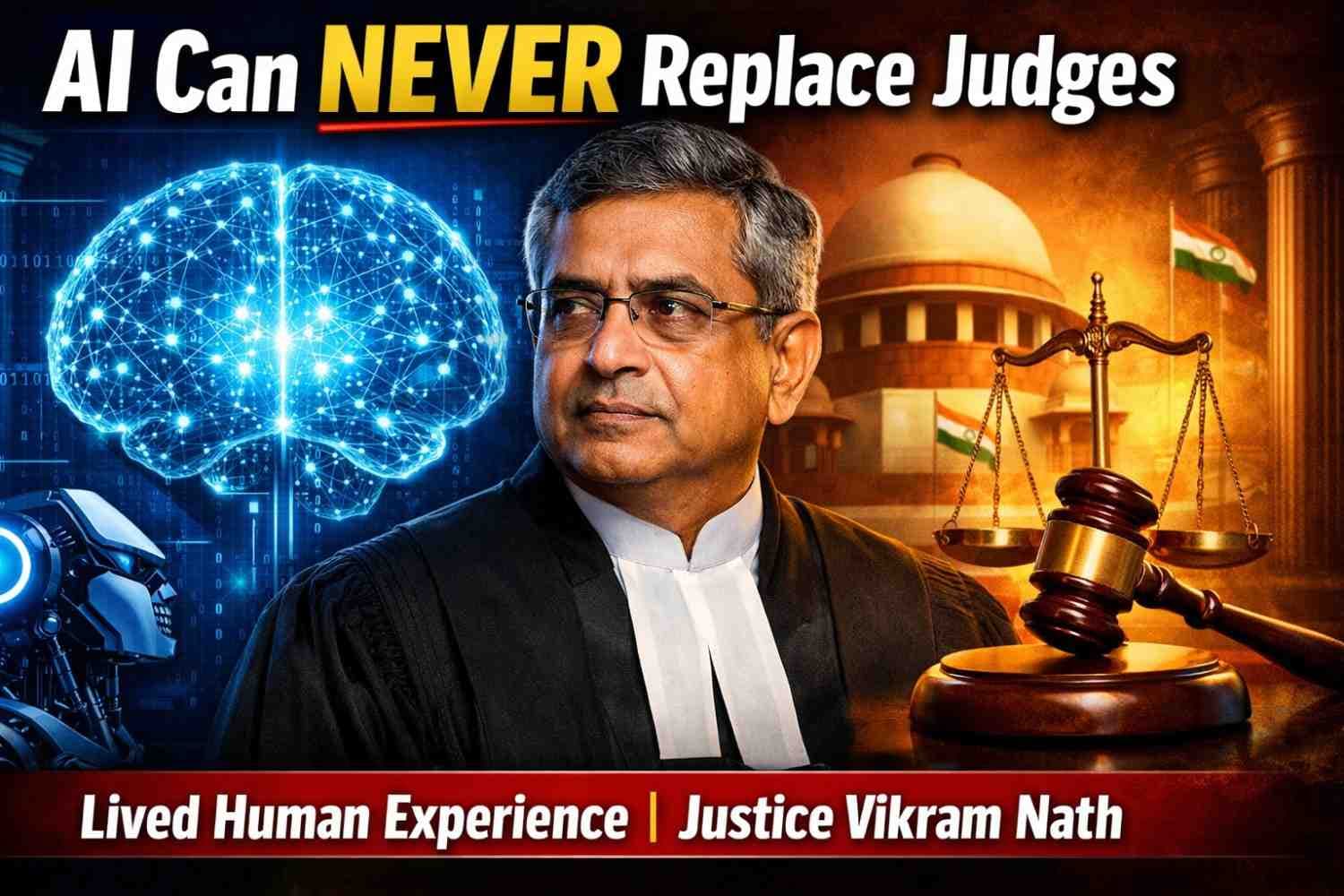
During a recent legal symposium, Supreme Court Justice Vikram Nath offered a profound perspective on the integration of technology in the judiciary, asserting that Artificial Intelligence can never replace the "lived human experience" essential to the act of judging. While acknowledging that AI can be a powerful tool for administrative efficiency and legal research, he maintained that the core responsibility of adjudication is an inherently human endeavor that requires empathy, moral reasoning, and an understanding of societal nuances.
Justice Nath emphasized that judicial decision-making is not merely a technical exercise of applying rules to facts, but a complex process involving the evaluation of human behavior and credibility. He argued that an algorithm, regardless of its sophistication, lacks the "constitutional soul" and the capacity for compassion required to deliver true justice. According to the Justice, the "lived experience" of a judge—formed through years of interaction with diverse sections of society—is a critical component that cannot be coded into a machine.
The address also highlighted the risks of "algorithmic bias" and the lack of transparency in AI systems. Justice Nath cautioned that if the judiciary becomes overly dependent on automated tools, there is a danger of perpetuating existing prejudices hidden within the data used to train these systems. He stressed that the "right to a reasoned order" from a human mind is a fundamental aspect of the fair trial process, and delegating this to a "black box" algorithm would undermine public confidence in the rule of law.
Justice Nath further noted that the law is not static; it evolves through creative interpretation and the recognition of changing social values. He expressed concern that AI, which operates on historical data, might struggle to adapt to novel legal challenges or to depart from outdated precedents when justice demands it. The ability to "distinguish" cases and forge new legal paths is a uniquely human capability that preserves the dynamism of the Indian legal system.
While cautioning against over-reliance, Justice Nath did not dismiss technology entirely. He advocated for a "human-centric" approach where AI serves as an assistant to handle repetitive tasks, such as case management, data categorization, and preliminary research. By offloading these administrative burdens, judges can dedicate more time to the qualitative aspects of their work, potentially reducing the massive backlog of cases in Indian courts.
The Justice also touched upon the ethical obligation of the legal fraternity to remain technologically literate. He urged lawyers and judges to understand the limitations of the tools they use, specifically citing the danger of "AI hallucinations"—where software generates fabricated legal citations. He suggested that the responsibility for the accuracy of a legal submission must always rest with the human professional, not the software.
Reflecting on the future of the profession, Justice Nath reminded the audience that the ultimate goal of the judiciary is to protect the rights of the individual against the might of the state or the indifference of the majority. This protective role, he argued, requires a level of moral courage and ethical conviction that is currently beyond the reach of Artificial Intelligence.
In conclusion, Justice Nath’s remarks serve as a balancing force in the ongoing debate over digital transformation in the courts. His vision is one of a "hybrid judiciary" where technology enhances capacity, but the final, decisive "gavel" remains firmly in human hands. Judging, he concluded, is not just a job of calculation, but a "human responsibility" that must be guarded against mechanical erosion.