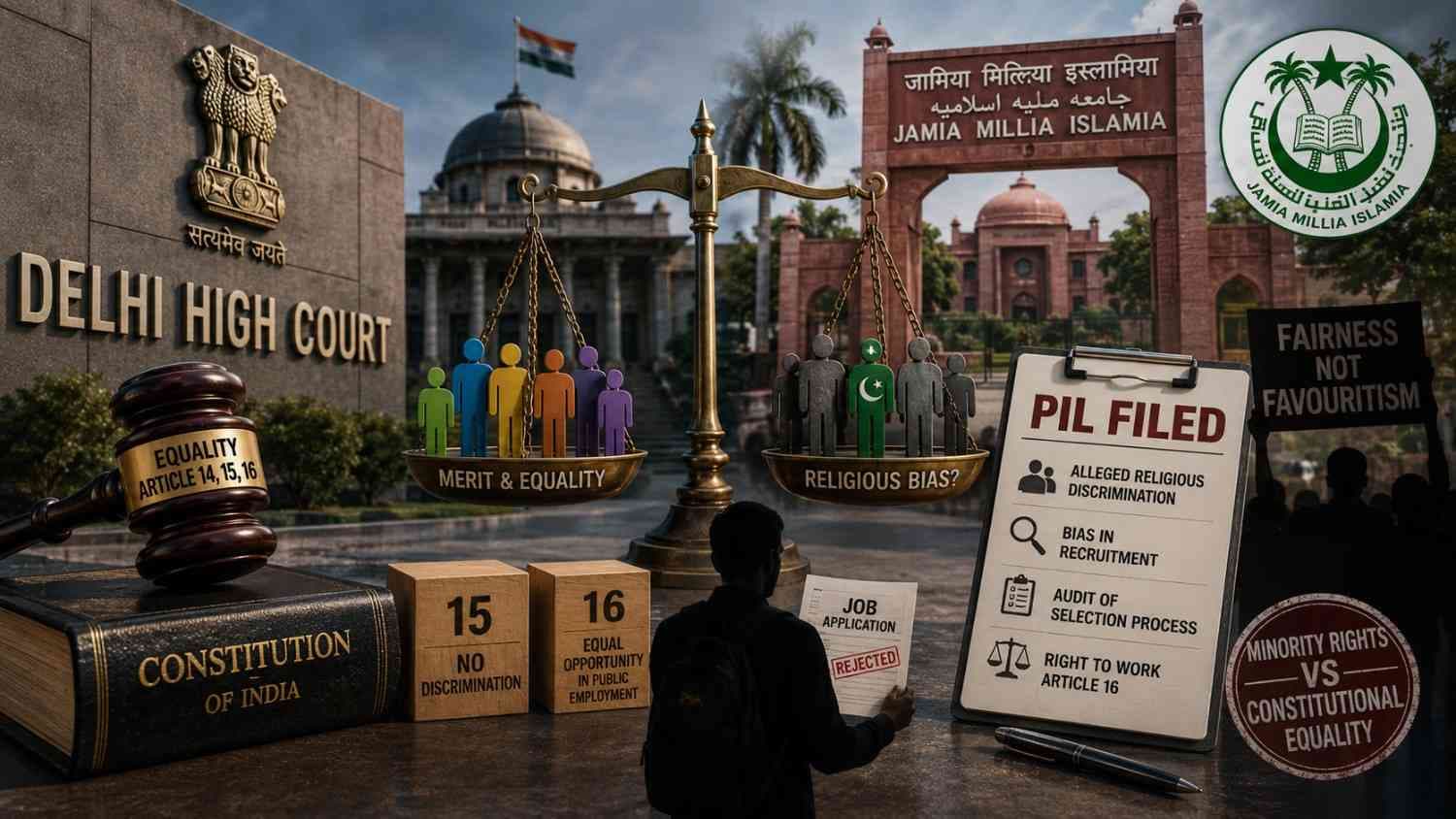
The Delhi High Court's decision to seek a response from Jamia Millia Islamia marks the beginning of a high-stakes legal examination into the administrative autonomy of minority-status institutions versus the constitutional rights of job seekers. The PIL argues that JMI, while receiving substantial federal funding, must adhere strictly to the non-discriminatory principles enshrined in Articles 15 and 16 of the Indian Constitution, which prohibit discrimination on the grounds of religion in matters of public employment.
The petitioner contends that recent recruitment drives at the university have shown a statistical and procedural bias that favors Muslim candidates over those from other religious backgrounds. The plea alleges that this practice not only undermines meritocracy but also creates a "religious ghettoization" of a public-funded institution. By challenging these practices, the PIL seeks a court-monitored audit of the university’s selection committees and recruitment data from the past several years.
Jamia Millia Islamia, which was declared a minority institution by the National Commission for Minority Educational Institutions (NCMEI) in 2011, is likely to defend its practices based on the special protections afforded to minority institutions under Article 30. This creates a complex legal intersection: can an institution's "minority character" allow it to bypass standard reservation policies and secular hiring mandates applicable to other central universities? The Delhi High Court’s eventual ruling will need to reconcile the university's right to "administer and establish" with the state's duty to ensure equal opportunity.
The High Court Bench has underscored the importance of transparency in the recruitment of academic and non-academic staff. The judges noted that any allegation of systematic bias in a premier educational institution requires thorough investigation to maintain public trust. The court has directed the university to provide detailed affidavits explaining their current selection criteria and the composition of their interview boards to ensure that no "invisible barriers" exist based on faith.
This legal battle comes at a time of heightened sensitivity regarding the status of minority institutions in India. Similar debates have surrounded other institutions like Aligarh Muslim University (AMU), where the tension between "minority status" and "central university" obligations remains a subject of intense judicial scrutiny. The JMI case adds a new dimension by specifically focusing on the "right to work" and the potential for religious exclusion in the public sector.
Beyond the legal technicalities, the PIL highlights the broader socio-political debate over the "secular character" of state-funded education. If the court finds merit in the allegations, it could lead to a landmark restructuring of how minority universities conduct their hiring, potentially mandating a more diverse and representative workforce. Conversely, a ruling in favor of the university would bolster the legal shield protecting the administrative freedom of minority-run entities.
Ultimately, the Delhi High Court's intervention serves as a check on administrative discretion. As the university prepares its response, the focus remains on whether the "minority" label can be used to justify exclusivity in a modern, diverse democracy. The case serves as a reminder that in the halls of justice, the constitutional promise of equality (Article 14) is often the final arbiter of how institutions, regardless of their history or status, must treat the citizens they serve and employ.