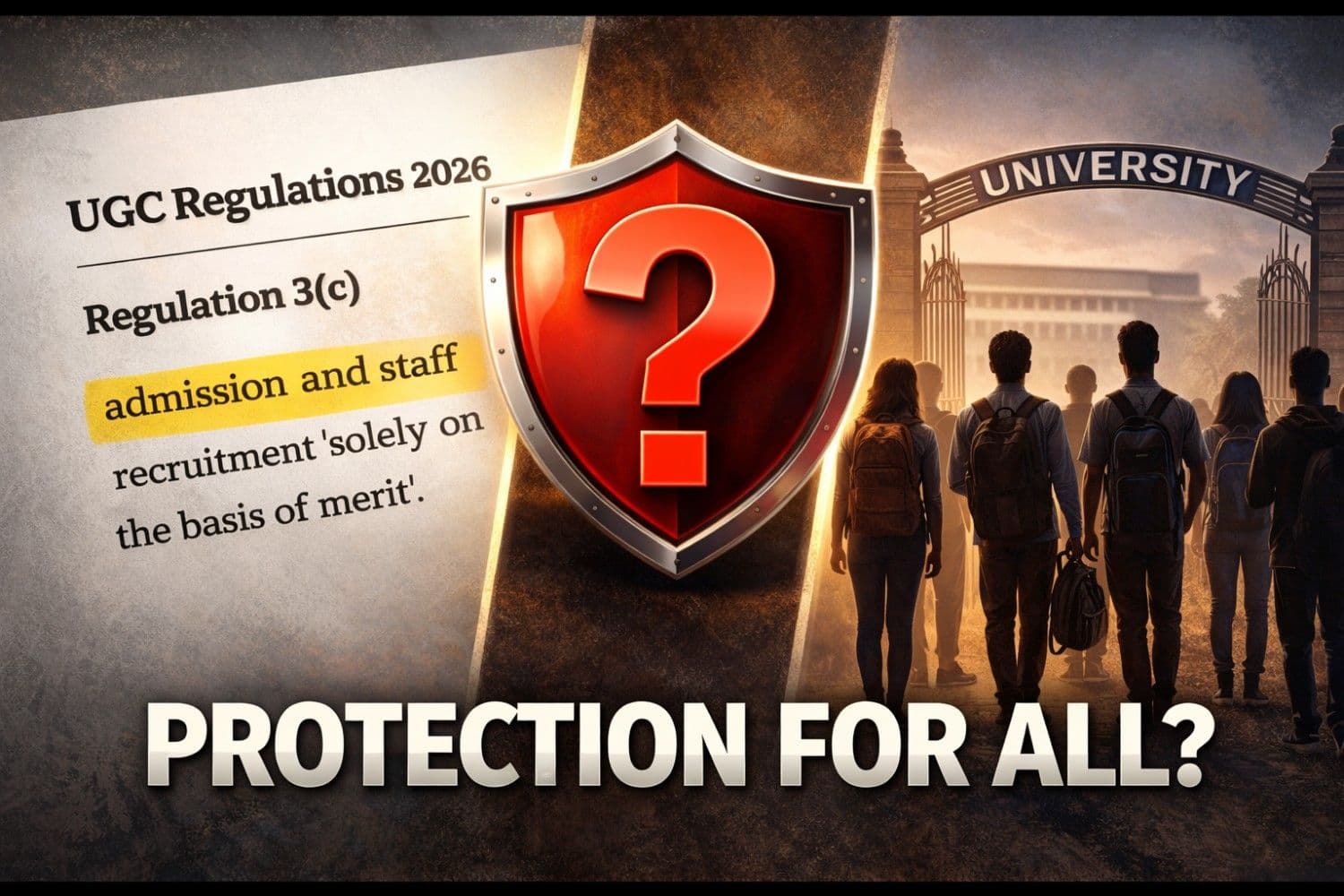
New Delhi: A fresh legal challenge has been mounted in the Supreme Court against the newly enacted University Grants Commission (Promotion of Equity in Higher Education Institutions) Regulations, 2026. The plea contends that the regulations, while well-intentioned, are constitutionally flawed because they define "caste-based discrimination" in a way that excludes a large section of the student population.
The petition, filed by Advocate Vineet Jindal, targets Regulation 3(c), which limits the definition of caste discrimination to acts committed only against members of Scheduled Castes (SC), Scheduled Tribes (ST), and Other Backward Classes (OBC).
The core of the controversy lies in the text of Regulation 3(c). It defines "caste-based discrimination" as discrimination "only on the basis of caste or tribe against the members of the scheduled castes, scheduled tribes, and other backward classes."
The petitioner argues that this definition violates Article 15(1) of the Constitution, which prohibits discrimination against any citizen on grounds of caste. By restricting the protection only to SC/ST/OBC students, the UGC has allegedly denied institutional redressal to students from the General or other categories who might also face caste-based harassment or bias.
"The provision, in its present exclusionary form, denies grievance redressal and institutional protection to persons belonging to non-SC/ST/OBC categories."
It is pertinent to note that these Regulations were framed following a long-standing PIL filed in 2019 by Radhika Vemula and Abeda Salim Tadvi—mothers of Rohith Vemula and Payal Tadvi, two students whose suicides sparked a nationwide conversation on campus casteism.
While the Supreme Court had pushed the UGC to create a "strong and robust mechanism" to tackle this menace, the current petition argues that the resulting regulations have swung to an extreme that ignores the principle of caste-neutrality.
The plea seeks a direction to the Centre and UGC to:
- Redefine "caste-based discrimination" in a caste-neutral manner so that anyone facing bias can seek help.
- Ensure that Equal Opportunity Centres and Equity Helplines are accessible to all students, regardless of their caste identity.
- Declare the current exclusionary mechanism as violative of Articles 14 (Equality) and 21 (Right to Life).
This petition opens a complex constitutional debate: Can anti-discrimination laws be "asymmetric" (protecting only the historically oppressed), or must they be "symmetric" (protecting everyone equally)? While the intent of the UGC was to protect vulnerable communities, the Supreme Court will now have to decide if excluding others from the definition of discrimination itself is legally sustainable.