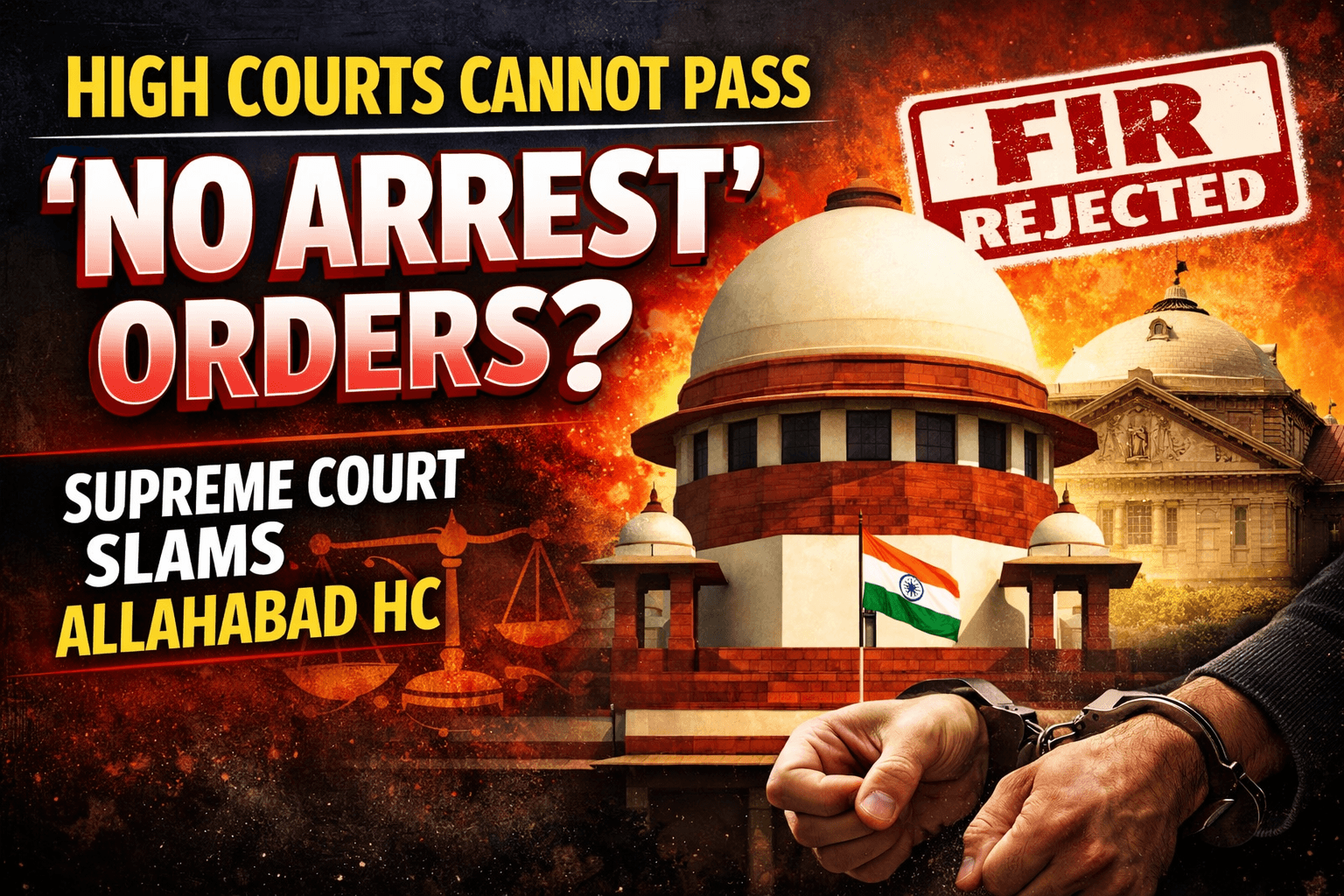
In a significant judgment that reinforces the boundaries of judicial intervention in criminal investigations, the Supreme Court of India has ruled that High Courts cannot grant blanket protection from arrest or impose rigid timelines for investigations while simultaneously refusing to quash an FIR.
The Division Bench, comprising Justice Sanjay Karol and Justice Nongmeikapam Kotiswar Singh, set aside orders passed by the Allahabad High Court which had protected three individuals accused in a massive arms license fraud case from arrest until the filing of a police report.
The case originates from an investigation by the Special Task Force (STF) in Uttar Pradesh. An inquiry revealed a sophisticated racket involving the procurement of arms licenses through forged documents, false affidavits, and manipulated birth dates.
Three primary respondents were at the center of the Supreme Court appeal:
- Mohammad Zaid Khan: Accused of obtaining a license by submitting a forged date of birth.
- Mohammad Arshad Khan: Alleged to have procured five different arms licenses using forged PAN cards, Aadhaar cards, and driving licenses to portray himself as a "skilled marksman" for importing foreign ammunition.
- Sanjay Kapoor: A retired Arms Clerk in the Agra District Magistrate’s office, accused of conspiring with applicants to process these fraudulent files.
When the STF registered an FIR under various sections of the IPC (Forgery and Cheating) and the Arms Act, the accused approached the Allahabad High Court seeking to quash the criminal proceedings.
The Allahabad High Court declined to quash the FIR, noting that the allegations required a full investigation. However, while disposing of the petitions, the High Court issued two controversial directions:
- Time-Bound Probe: It directed the police to finish the investigation within exactly 90 days.
- Interim Protection: It ordered that the accused "shall not be arrested" until the trial court takes cognizance of the case, provided they cooperate with the probe.
The State of Uttar Pradesh challenged these directions in the Supreme Court, arguing that such orders paralyze the police's power to conduct a thorough investigation.
The Supreme Court engaged in a detailed analysis of whether a court should tell an investigator how fast to work.
Justice Sanjay Karol, writing the judgment, observed that investigation is a "long, winding road" filled with unpredictable twists. Witnesses may resile, documents may turn out to be fakes, and new evidence might require the police to change strategy entirely.
"Timelines are imposed reactively and not prophylactically," the Court noted. This means that a court should only set a deadline if there is evidence that the police are intentionally sitting on a case or causing "unexplained stagnation." In this case, since the investigation had just begun, the High Court’s 90-day limit was seen as an "intrusion into the investigative domain."
The most critical part of the judgment addressed the High Court’s decision to shield the accused from arrest after refusing to quash the case.
The Supreme Court referred to its landmark 2021 ruling in Neeharika Infrastructure v. State of Maharashtra. In that case, the Court had explicitly cautioned High Courts against passing "no coercive steps" orders while declining to quash an FIR.
The Bench noted that:
- Sanction of Law: There is no legal provision that allows a High Court to act as an "anticipatory bail court" while deciding a writ petition to quash an FIR, especially without following the strict requirements of Section 438 of the CrPC (now Section 482 of BNSS).
- Mechanical Reliance: The Allahabad High Court had relied on a previous case (Shobhit Nehra v. State of UP). However, the Supreme Court pointed out that Shobhit Nehra involved a private family dispute where personal liberty was at high risk. The current case, by contrast, involved a serious fraud against the State.
- Application of Mind: The Court emphasized that a precedent (a previous judgment) is not a "mechanical exercise." Judges must see if the facts of the old case actually match the facts of the new one.
The Verdict and Its Impact
The Supreme Court allowed the State's appeals and set aside the High Court’s directions. While it gave the accused a two-week window of protection to seek regular legal remedies (like applying for anticipatory bail), the "blanket protection" was stripped away.
Key Takeaways for Legal Professionals and Citizens:
- Police Autonomy: Courts should generally not interfere with the pace of an investigation unless there is clear proof of bad faith or extreme delay.
- No "Backdoor" Bail: A petition to quash an FIR (under Article 226 or Section 482 CrPC) cannot be used as a shortcut to get bail without following the standard bail procedures.
- Liberty vs. Investigation: While Article 21 protects personal liberty, it does not mean an accused has an absolute right to avoid arrest during a legitimate probe into serious crimes like forgery of state documents.
This judgment serves as a stern reminder to High Courts across India to follow the "Neeharika" guidelines scrupulously and avoid passing orders that might unintentionally obstruct the course of justice.
Case Title: State of U.P. & Anr. vs. Mohd Arshad Khan & Anr. Citation: 2025 INSC 1480
Judgment Link : https://api.sci.gov.in/supremecourt/2025/56410/56410_2025_11_1501_67133_Judgement_19-Dec-2025.pdf