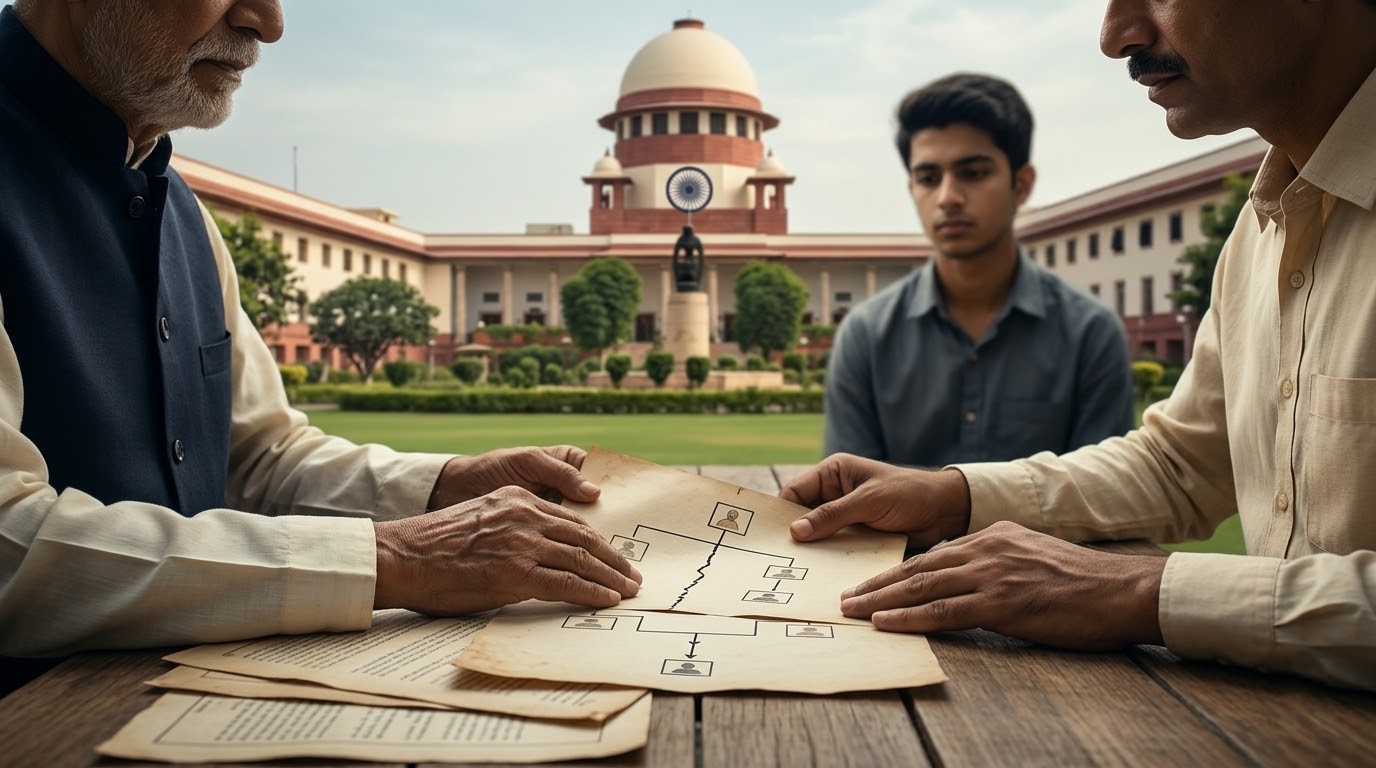
The Supreme Court has held that a grandson possesses no birthright in property that devolved upon his father through a partition of the grandfather's estate under Section 8 of the Hindu Succession Act, 1956. A bench comprising Justice Augustine George Masih and Justice Sunita Agarwal dismissed an appeal filed by a son seeking a half-share in land his father had received and subsequently sold, affirming that the father's share became his exclusive individual property upon partition.
Factual Background and Procedural History
The dispute originated from a suit filed in 1997 by the appellant, a minor represented by his mother, seeking partition and possession of a half-share in agricultural land. The appellant contended the land was joint family property inherited by his father (Defendant No. 1) from the grandfather, and consequently, by him. The appellant was born in 1994.
In 1994, a compromise decree was passed in a partition suit filed by the appellant's aunt regarding the grandfather's property. Under this decree, the father received the suit land. The father subsequently sold the land to Defendants 2 and 3 via registered sale deeds in 1997. The City Civil Court, Chennai, passed a preliminary decree for partition, but the First Appellate Court set it aside, ruling that a son inheriting under Section 8 takes the property absolutely, excluding his son's birthright. The Madras High Court upheld this view, stating the appellant acquired no right by birth in the property which came to his father by partition after the grandfather's death.
Arguments Before the Supreme Court
The appellant relied on Section 29A of the Hindu Succession (Tamil Nadu Amendment) Act, 1989, arguing that the compromise decree did not convert the father's share into self-acquired property and that the father held it as karta of a coparcenary. It was further submitted that the purchasers could not acquire a greater title than the vendor, and that the father, who remained ex parte until his death in 2024, had not established legal necessity for the sale. The appellant cited Rohit Chauhan v. Surinder Singh and Arshnoor Singh v. Harpal Kaur in support.
The respondents countered that the case concerned a grandson seeking succession to his grandfather's property, governed strictly by Section 8. They argued that neither Section 6 nor Section 29A of the Tamil Nadu Amendment applied. Reliance was placed on CWT v. Chander Sen, Vimalben Ajitbhai Patel v. Vatslabeen Ashokbhai Patel, and Radha Bai v. Ram Narayan. They further submitted that the compromise decree was unchallenged, the purchasers were bona fide, and the suit was collusive.
Court's Analysis and Reasoning
The bench analysed the precedents and statutory framework. Referring to CWT v. Chander Sen, the Court noted that when a son inherits property under Section 8, he takes it in his individual capacity and not as karta of his own undivided family. The bench emphasised that the express words of Section 8 cannot be ignored and must prevail. The Court also relied on Bhanwar Singh v. Puran, which held that a joint coparcenary does not continue after partition among the heirs of the grandfather. In Radha Bai v. Ram Narayan, it was held that a grandson or granddaughter is clearly excluded from the Class I heirs.
Does a Grandson Have a Birthright in Property Allotted to His Father Under Section 8 Partition?
No. The Supreme Court held that a grandson has no right by birth in property allotted to his father following a partition of the grandfather's estate under Section 8 of the Hindu Succession Act, 1956. The property becomes the father's absolute self-acquired property, and the son's son is not a Class I heir entitled to claim a share in the grandfather's estate.
Statutory Provision and Judicial Precedent Comparison
Provision / Case | Key Principle |
|---|---|
Section 8, Hindu Succession Act, 1956 | Self-contained scheme for devolution of a Hindu male's intestate property; son inherits in individual capacity. |
Section 29A, Tamil Nadu Amendment Act, 1989 | Appellant argued it preserved coparcenary character; Court found it inapplicable to Section 8 devolution. |
CWT v. Chander Sen | Son inheriting under Section 8 takes property absolutely, not as karta of a joint family. |
Radha Bai v. Ram Narayan | Grandson/granddaughter excluded from Class I heirs; no birthright in grandfather's property. |
Bhanwar Singh v. Puran | Joint coparcenary does not survive partition among grandfather's heirs. |
Operative Order
Applying the established legal position, the bench concluded that a son's son is not mentioned as an heir under Class I of the Schedule and therefore could not acquire any right in the property of his grandfather under the provision. In the codified Hindu law, the right of a son's son in his grandfather's property is not recognised where the property has devolved under Section 8 and been partitioned. Consequently, the appeal was dismissed, upholding the concurrent findings of the First Appellate Court and the Madras High Court that the appellant was not entitled to a decree for partition and possession.