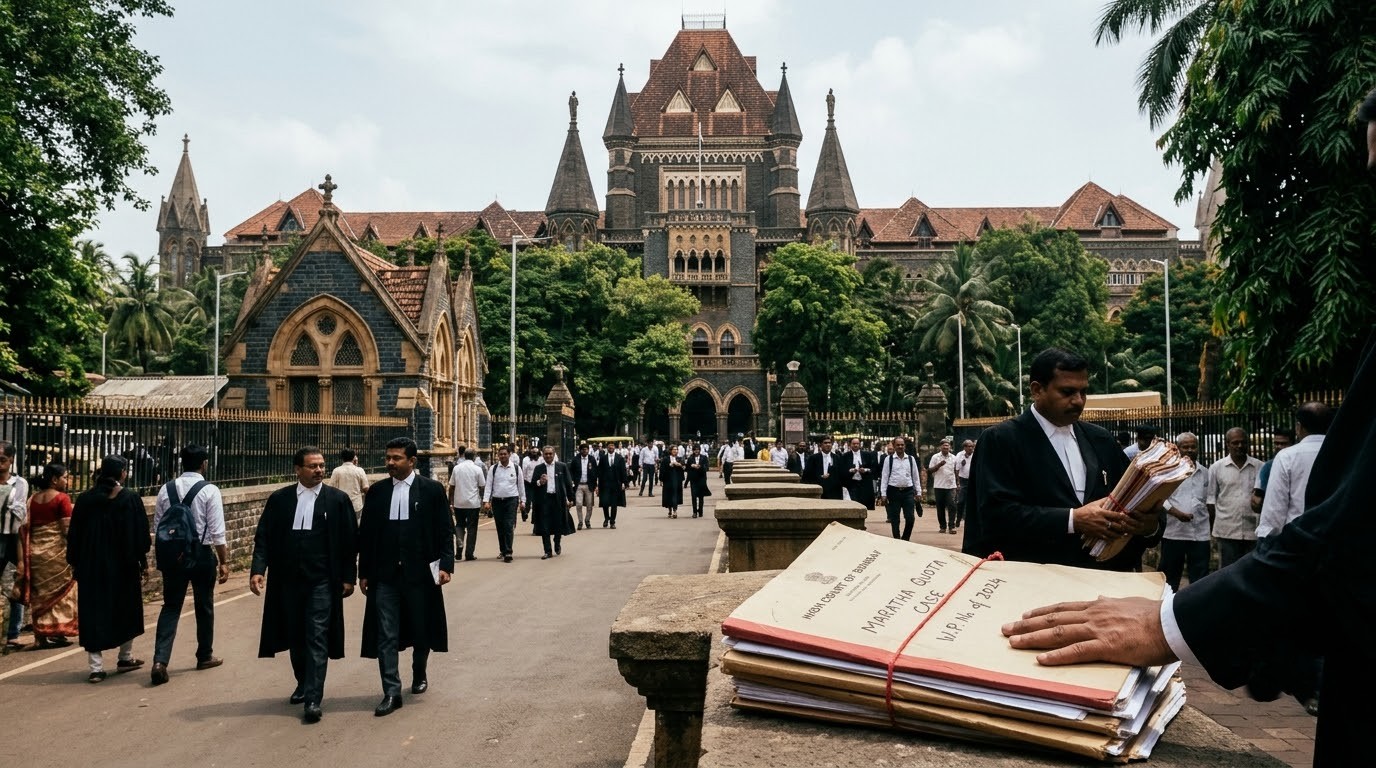
The Bombay High Court on November 5 declined to grant a day-to-day hearing schedule for the batch of petitions challenging the constitutional validity of the Maharashtra State Reservation for Socially and Educationally Backward Classes Act, 2024. The legislation provides a 10 percent quota to the Maratha community in public education and employment within the State. A full bench headed by Justice Makarand Karnik, and comprising Justice Nijamoodin Jamadar and Justice Sandeep Marne, dismissed the application moved by certain parties seeking an accelerated hearing calendar.
Why Did The Bombay High Court Refuse Day-To-Day Hearings For The Maratha Quota Case?
The bench held that the matters are already receiving priority hearings at fixed, regular intervals and that the existing schedule adequately addresses the urgency of the case. The court noted that every possible endeavour is being made to prioritize the public interest litigation and connected matters, rendering a separate day-to-day direction unnecessary.
In its order, the bench stated that it had given anxious consideration to the request. It noted that a fixed session for hearing the matters is being assigned at regular intervals, with due regard to the workload concerning the extant regular assignment. Since the matters are being heard on a regular basis, the court was not inclined to accede to the request for day-to-day hearings. The next date of hearing has been fixed for November 27.
Third Full Bench Constituted To Hear The Challenge
The present bench is the third full bench constituted to adjudicate the challenge to Maratha reservation. The petitions were initially heard by a full bench led by then Chief Justice Devendra Upadhyay, alongside Justice Girish Kulkarni and Justice Firdosh Pooniwalla. That bench ceased to function following the transfer of Chief Justice Upadhyay to the Delhi High Court.
Subsequently, a new full bench was constituted under Justice Ravindra Ghuge. That bench heard the matter substantially from May 2025 until August 2025. However, the proceedings were interrupted again following the elevation of Justice Ghuge as the Chief Justice of the Calcutta High Court. The current bench, led by Justice Karnik, was constituted in September 2024.
Progress Of Hearings Before The Current Bench
Since its constitution on September 18, the bench led by Justice Karnik has held four sittings. The court has already heard submissions advanced by Senior Advocate Arvind Datar for one of the petitioners challenging the quota. At present, the bench is hearing arguments by Senior Advocate Pradeep Sancheti, who is also contesting the validity of the reservation. The bench indicated that the hearings would continue on the next listed date.
Legislative Background And Prior Judicial History
The impugned Act was passed by the Maharashtra Legislature on February 20, 2024, and notified on February 26, 2024. The State government relied on a report submitted by the Maharashtra State Backward Class Commission (MSBCC), headed by Justice (retd.) Sunil Shukre. The report cited exceptional circumstances and extraordinary situations to justify granting reservation to the Maratha community, which exceeds the 50 percent ceiling on total reservations.
This legislative attempt follows the invalidation of a previous enactment. In 2018, the Devendra Fadnavis-led government enacted the Maharashtra State Reservation for Socially and Educationally Backward Classes (SEBC) Act, granting 16 percent reservation to Marathas. The Bombay High Court upheld the 2018 law in June 2019 but reduced the quota to 12 percent in education and 13 percent in government jobs.
In May 2021, a Constitution Bench of the Supreme Court struck down the SEBC Act, 2018. The apex court held that no extraordinary circumstances justified a separate reservation for Marathas breaching the 50 percent limit mandated by the Indra Sawhney judgment (1992). The Supreme Court also questioned the empirical data submitted to establish the community's social backwardness. A review petition filed by the State was rejected in April 2023. A curative petition remains pending before the Supreme Court.
Enactment | Year | Quota Provided | Judicial Outcome |
|---|---|---|---|
SEBC Act | 2018 | 16% | Struck down by Supreme Court (May 2021) |
SEBC Act (HC Modified) | 2019 | 12% (Education), 13% (Jobs) | Reduced by Bombay High Court (June 2019) |
SEBC Act, 2024 | 2024 | 10% | Under challenge before Bombay High Court |
The current challenge tests whether the 2024 Act, backed by the Justice Shukre Commission report, satisfies the constitutional requirements of exceptional circumstances and empirical backwardness to breach the 50 percent threshold.