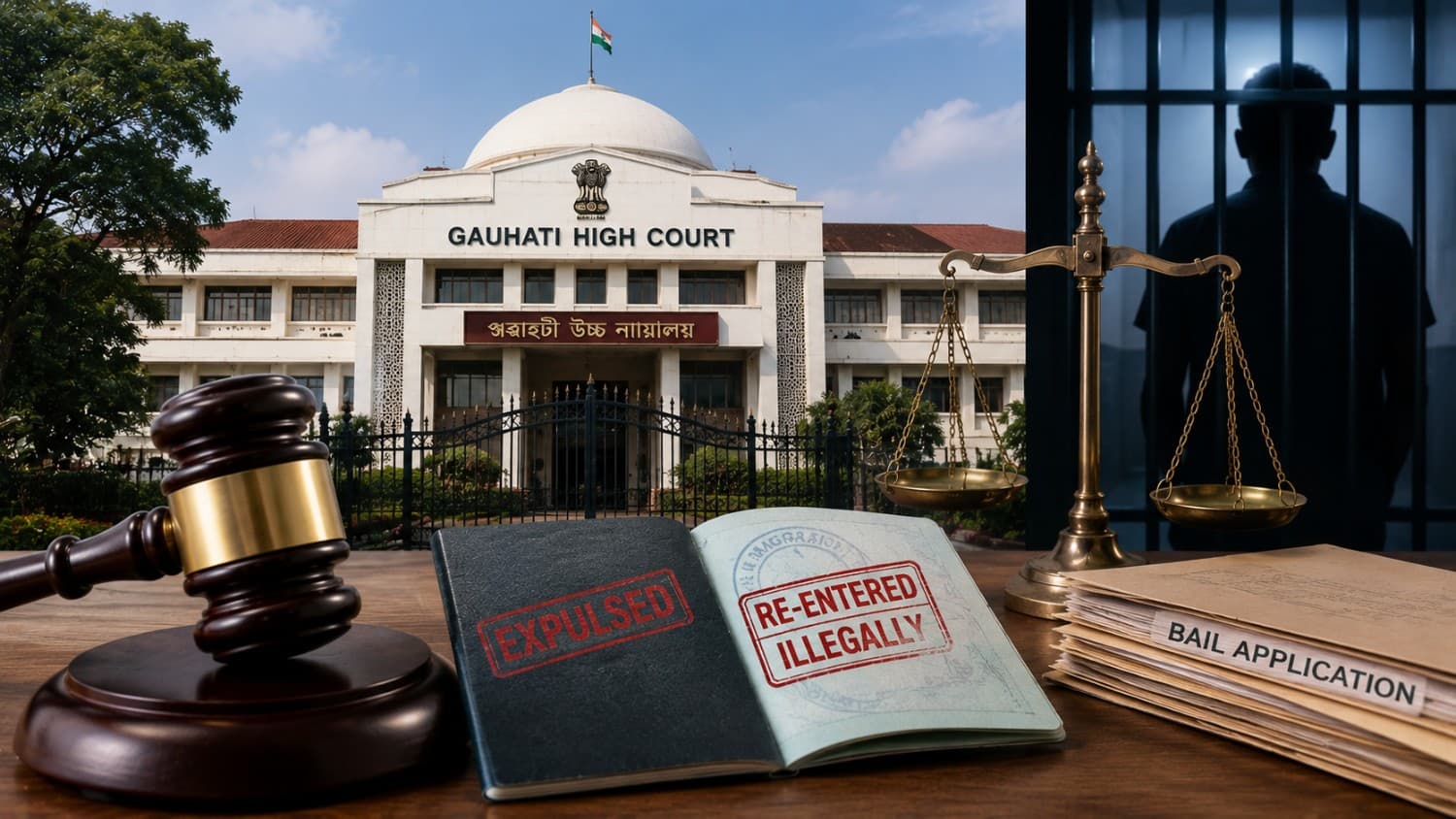
The Gauhati High Court recently dismissed a bail plea filed by Uttam Das, a man declared a foreign national through an ex-parte opinion of the Foreigners' Tribunal in Goalpara dated September 1, 2009. The court, comprising Justice Kalyan Rai Surana and Justice Susmita Phukan Khaund, ruled that the petitioner, despite prolonged detention, was not entitled to bail as he had re-entered India illegally after being expelled from the country.
The court observed that Das had been pushed back to Bangladesh on April 9, 2010, but was subsequently apprehended again in Indian territory without valid documentation. It noted that although the Foreigners' Tribunal's ex-parte opinion declaring him a foreign national had been challenged, the Gauhati High Court had dismissed the plea, and the opinion had attained finality. Following this, the Judicial Magistrate took cognisance of the offence, leading to Das's conviction on September 26, 2017, under Section 6(a) of the Passport (Entry into India) Rules, 1950, and Section 14(c) of the Foreigners Act, 1946. He was sentenced to two years of rigorous imprisonment and a fine of Rs 2,000.
The bench clarified that the Immigration and Foreigners Order, 2025, empowers the State to impose restrictions on the movement of illegal migrants pending their expulsion. It held that under paragraph 12 of this Order, similar to Section 4 of the Foreigners Act, 1946, the State may detain or confine such individuals. Consequently, the court rejected the argument that prolonged detention entitled Das to bail, stating that the learned standing counsel for FT and Borders matters had demonstrated that the petitioner had been expelled and thereafter re-entered India illegally.
Das had sought relief on multiple grounds, including direction to apply for citizenship under the Citizenship (Amendment) Act, 2019, release from the Holding Centre at Matia on bail, and a stay on his deportation. He argued that since 2016, the State had not taken steps to deport him to Bangladesh, thereby justifying bail on grounds of prolonged detention. He further contended that his wife had applied for registration under Section 6(A) of the Citizenship Act and that, as a Bangladeshi Hindu belonging to a minority community, he was entitled to exemption from expulsion under the Immigration and Foreigners (Exemption) Order, 2025, and beneficent provisions of the Citizenship Amendment Act.
The court, however, noted that the benefit of the Citizenship (Amendment) Act, 2019, is available only to immigrants who entered India from Bangladesh on or before December 31, 2014, and who belong to specified minority communities. It referenced a Supreme Court judgment holding that such benefits apply only to those who migrated between January 1, 1966, and March 24, 1971 (both inclusive), and who have registered with the registering authority within the prescribed period. Since Das did not meet these criteria—particularly in terms of timing and registration—the court held he was not entitled to the claimed benefit.
Regarding his claim under the Immigration and Foreigners (Exemption) Order, 2025, the court observed that no such exemption had been granted or applied for in his case, and the mere fact of belonging to a minority community in Bangladesh did not automatically entitle him to protection from expulsion. The bench reiterated that in Assam, foreign nationals detected without valid documents are subjected to proceedings before the Foreigners' Tribunal, and upon being declared illegal migrants, are liable to expulsion. If expulsion is not feasible due to any reason, such persons may be held in designated centres.
The court ultimately refused to grant bail, stay deportation, or direct authorities to permit a citizenship application, emphasizing that illegal re-entry after expulsion negates any claim to bail on the ground of prolonged detention. It stressed that the State's power to detain pending expulsion remains intact under the prevailing legal framework, and mere lapse of time does not undermine the legitimacy of such detention when the individual's re-entry was unlawful.