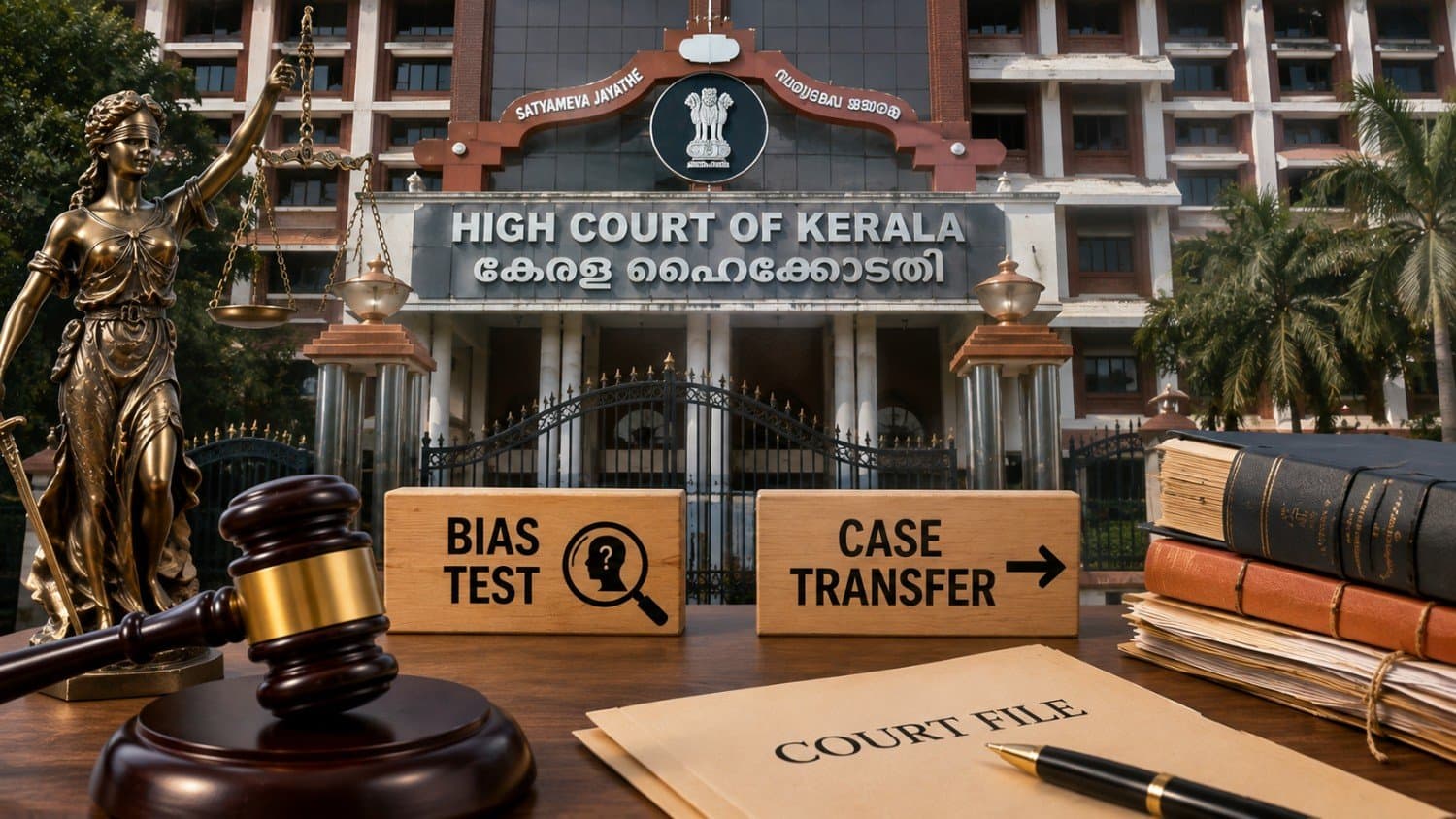
The Kerala High Court recently allowed the transfer of a petition for recovery of money and gold ornaments from the Family Court, Thodupuzha, to the Family Court, Muvattupuzha, following a plea by the wife/petitioner who apprehended bias in the proceedings before the Thodupuzha court.
The petitioner contended that the Family Court, Thodupuzha, had granted her ex-husband’s divorce petition on grounds of cruelty without considering her serious allegations against him, including the filing of POCSO cases by her against the husband for sexually abusing their daughters. She argued that the divorce petition was filed in retaliation for those complaints and that the Thodupuzha court failed to take note of the pendency of the POCSO cases while adjudicating the divorce matter.
The petitioner further stated that she had filed an appeal challenging the divorce decree and had also lodged a complaint before the Judicial Registrar (District Judiciary) alleging bias in the Thodupuzha court’s decision. Despite notice being served, the husband did not appear before the High Court in response to the transfer petition.
After hearing the petitioner, Justice Mohammed Nias C.P. referred to the Supreme Court’s judgment in Kumaon Mandal Vikas Nigam Ltd. v. Girja Shankar Pant [2001 (1) SCC 182] to outline the legal test for bias. The Court observed that the test for bias is not whether the judicial officer believes himself to be impartial or whether the litigant subjectively feels aggrieved. Instead, the law adopts an objective standard, requiring examination from the standpoint of a reasonable, fair-minded, and informed observer who is neither the judicial officer nor the disgruntled litigant.
The Court emphasized that a judge’s personal conviction of impartiality is not conclusive, as justice must not only be done but must also appear to be done. It warned that if the test for bias were based solely on the litigant’s perception, every unsuccessful litigant could allege bias merely because an earlier case was decided against them, which would seriously undermine judicial independence and the finality of adjudication.
The Court clarified that a litigant’s dissatisfaction, suspicion, or loss of confidence, however genuine, does not constitute legal bias unless the apprehension is one that an independent, reasonable, and informed person would entertain. In the present case, the Court noted that a complaint had been made on the administrative side regarding the Thodupuzha court’s conduct, and the husband had not responded to either that complaint or the current petition. On this basis, the Court held that the petitioner’s apprehension of bias was not completely unfounded.
Justice Mohammed Nias C.P. explicitly stated that he was not expressing any opinion on the correctness or otherwise of the allegations against the learned judge of the Family Court, Thodupuzha. The transfer was directed solely with a view to preserving the litigant’s confidence in the administration of justice and to avoid any possible perception of bias.
The Court concluded that, in the interest of justice, it would be appropriate to direct the transfer of the proceedings from the Family Court, Thodupuzha, to the Family Court, Muvattupuzha. The case is identified as Tr.P(C) No. 135 of 2025. The petitioner was represented by counsel Silpa S., V.O. Philomina, Joseph Jose, and Arthur B. George.