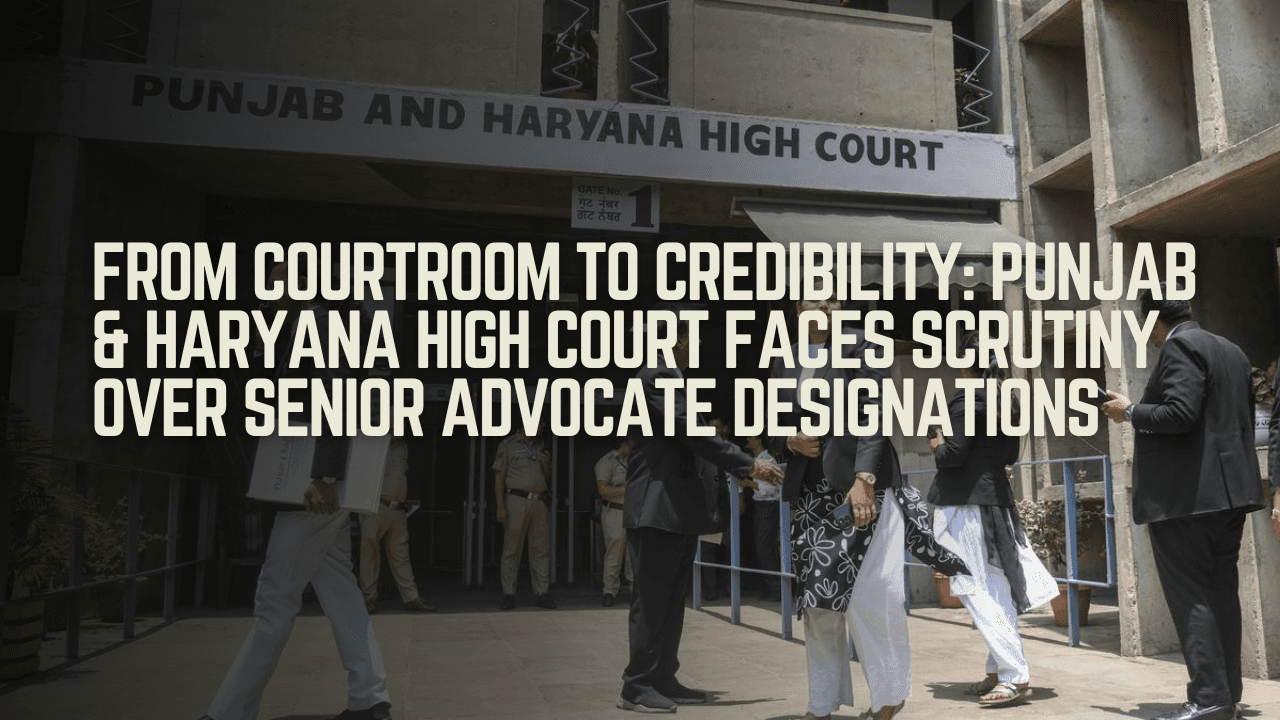
The designation of Senior Advocate represents one of the most prestigious recognitions in the Indian legal profession, conferring not just honor but also significant professional advantages. However, this coveted title has increasingly become a subject of intense scrutiny, with questions about transparency, fairness, and accountability dominating legal discourse. The recent controversies surrounding the Punjab & Haryana High Court's designation process have brought these concerns into sharp focus, highlighting the urgent need for systemic reforms that ensure merit-based selection and eliminate allegations of favoritism and nepotism.
As India's judiciary grapples with mounting public expectations for transparency, the Senior Advocate designation process has emerged as a critical test case for judicial accountability. The lack of clear criteria, opaque selection procedures, and absence of reasoned decisions have created an environment where perceptions of bias can flourish, undermining public confidence in the legal system itself.
Understanding the Bar and the Designation Process
The institution of Senior Advocates in India traces its origins to the British colonial system of Queen's Counsel, adapted to suit the Indian legal framework post-independence. Under Section 16 of the Advocates Act, 1961, the Supreme Court and High Courts are empowered to designate advocates as "Senior Advocates" based on their ability, standing at the Bar, and special knowledge or experience in law.
The designation carries substantial benefits: Senior Advocates enjoy the right of pre-audience in courts, command higher fees, and are generally not expected to file documents or appear in matters involving interlocutory proceedings. They occupy a position of eminence that influences not just their practice but also the development of jurisprudence through their arguments before constitutional courts.
Traditionally, the process involved recommendations from the Bar Council or Bar Associations, followed by approval by the Chief Justice and judges of the respective court. However, the absence of standardized criteria and transparent procedures across different High Courts created significant disparities. Some courts maintained informal systems where seniority and personal connections often outweighed merit, while others attempted to establish more structured evaluation mechanisms.
The Supreme Court, recognizing these inconsistencies, issued guidelines in the case of Indira Jaising v. Supreme Court of India (2017), mandating the formation of a permanent committee comprising the Chief Justice, two senior-most judges, Attorney General or Solicitor General, and a Bar representative. The guidelines emphasized objective criteria including years of practice, reported judgments, pro bono work, and specialized knowledge. Despite these reforms, implementation has remained uneven, particularly at the High Court level.
Recent Controversies at Punjab & Haryana High Court
The Punjab & Haryana High Court has found itself at the center of a significant controversy regarding its Senior Advocate designation process. In recent months, allegations have surfaced that the Bar Council's recommendations were influenced by considerations other than merit, with accusations of nepotism and favoritism dominating discussions within the legal community.
The controversy intensified when several advocates challenged the opacity of the selection process, pointing to instances where deserving candidates with extensive experience and notable contributions to jurisprudence were overlooked in favor of those with perceived connections to influential members of the Bar or judiciary. The Bar Council was accused of failing to publish clear criteria, not maintaining transparency in the evaluation process, and not providing reasons for acceptance or rejection of applications.
Following sustained pressure from the legal community and civil society organizations, the Punjab & Haryana High Court initiated a review of its designation procedures. The High Court constituted a committee to examine the existing framework and propose reforms that would enhance transparency and accountability. This move was welcomed by many as a step toward restoring confidence in the system, though critics argued that more fundamental structural changes were necessary.
The controversy also sparked broader discussions about the role of Bar Associations in the designation process. While Bar representatives are meant to provide insights into an advocate's standing and reputation, concerns have been raised about potential conflicts of interest and the influence of internal Bar politics on recommendations. Some legal experts have advocated for greater involvement of independent legal academics and retired judges in the evaluation process to ensure impartiality.
Landmark Judgments and Judicial Pronouncements
The evolution of the Senior Advocate designation system has been significantly shaped by judicial interventions. The landmark case of Indira Jaising v. Supreme Court of India (2017) marked a watershed moment, with the Supreme Court acknowledging the need for institutional reforms to address concerns about transparency and fairness.
In this case, the Court laid down comprehensive guidelines requiring the formation of a permanent committee for designation, specification of objective criteria, maintenance of records of deliberations, and communication of reasons for rejection to unsuccessful applicants. The judgment emphasized that the designation process must be insulated from arbitrary decision-making and should reflect the constitutional values of equality and merit.
Another significant judgment came in Supreme Court Advocates-on-Record Association v. Union of India (2015), commonly known as the NJAC judgment, where the Court, while primarily dealing with judicial appointments, also touched upon the broader principle of transparency in legal institutions. The Court's emphasis on collegium transparency has had indirect implications for the Senior Advocate designation process, reinforcing the argument that all judicial and quasi-judicial functions must meet high standards of accountability.
More recently, various High Courts have issued their own guidelines building upon the Supreme Court's framework. The Delhi High Court, for instance, has implemented a relatively transparent system with published criteria, regular designation cycles, and reasoned communication to applicants. These progressive measures have been cited as models for other High Courts to emulate.
Analysis of Transparency Issues
The transparency deficit in the Senior Advocate designation process manifests in several critical areas. First, the absence of uniform, published criteria across High Courts creates confusion and enables subjective decision-making. While the Supreme Court's guidelines provide a framework, their interpretation and application vary significantly, leaving room for discretionary assessments that may not always be merit-based.
Second, the lack of reasoned decisions for rejected applications denies unsuccessful candidates the opportunity to understand deficiencies in their applications or to challenge potentially arbitrary rejections. This opacity not only affects individual advocates but also prevents the development of a consistent jurisprudence around what constitutes merit for Senior Advocate designation.
Third, the composition of selection committees remains problematic in some jurisdictions. While judicial members bring legal expertise, the absence of diverse perspectives—including those from legal academia, civil society, and different sections of the Bar—can result in insular decision-making that perpetuates existing power structures.
Fourth, the influence of Bar politics cannot be ignored. In many High Courts, Bar Association recommendations carry significant weight, yet these associations themselves may be subject to internal factionalism and power dynamics that have little to do with assessing legal merit. The interplay between Bar politics and judicial decision-making creates opportunities for favoritism and undermines the integrity of the process.
The transparency issues are not merely procedural concerns; they have substantive implications for access to justice and the quality of legal representation. When designation is perceived as being based on connections rather than competence, it discourages talented advocates from aspiring to excellence and may result in less capable lawyers occupying positions of influence. This ultimately affects the quality of legal arguments before courts and the development of jurisprudence.
Moreover, the lack of transparency perpetuates existing inequalities within the legal profession. Advocates from marginalized communities, women lawyers, and those without traditional connections to legal dynasties face additional barriers in a system that lacks clear, objective criteria. Ensuring transparency is thus not just about procedural fairness but also about promoting diversity and inclusion in the upper echelons of the legal profession.
Conclusion
The controversy surrounding Senior Advocate designations at the Punjab & Haryana High Court and similar concerns across other jurisdictions underscore the urgent need for comprehensive reforms. While the Supreme Court's guidelines in Indira Jaising represent a significant step forward, their inconsistent implementation reveals the gap between policy and practice.
True transparency requires more than just procedural compliance; it demands a cultural shift within the judiciary and the Bar toward greater accountability and openness. This includes publishing detailed criteria, ensuring diverse representation on selection committees, providing reasoned decisions for all applications, and creating mechanisms for challenging potentially arbitrary rejections.
The legal profession must recognize that the Senior Advocate designation is not merely an individual honor but a public trust. Those who receive this designation wield considerable influence over the administration of justice, and the process by which they are selected must therefore meet the highest standards of integrity and fairness.
As India continues its journey toward a more transparent and accountable legal system, the Senior Advocate designation process serves as both a challenge and an opportunity. By embracing reforms that prioritize merit, diversity, and transparency, the judiciary and the Bar can strengthen public confidence in the legal profession and ensure that this prestigious designation truly reflects excellence in advocacy and contribution to the rule of law.
The path forward requires sustained commitment from all stakeholders—judges, advocates, Bar Associations, and civil society—to create a system that is not only fair in principle but also perceived as fair in practice. Only through such collective effort can the institution of Senior Advocates fulfill its intended purpose of recognizing and promoting legal excellence while maintaining the trust and confidence of the public it ultimately serves.