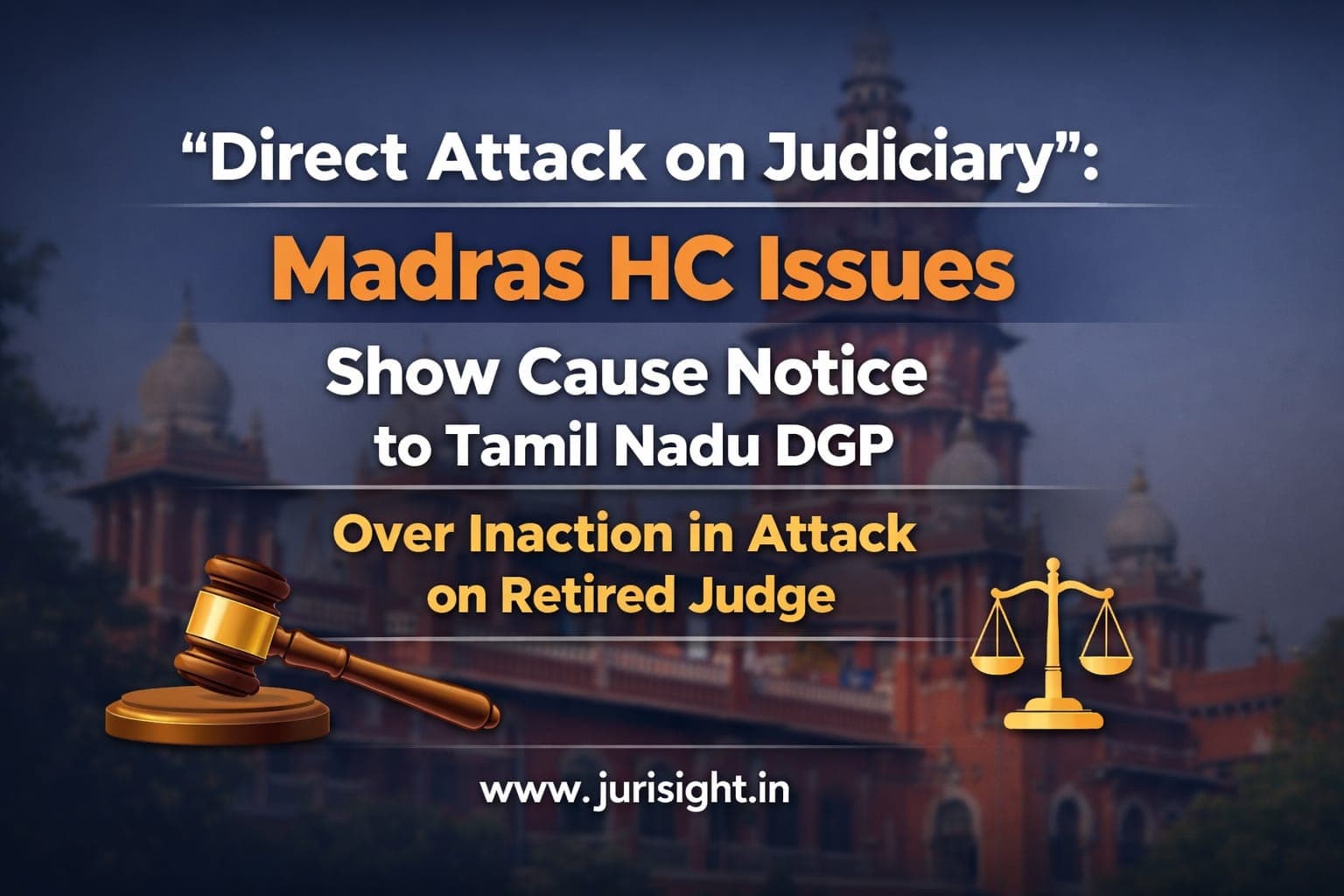
The Madurai Bench of the Madras High Court has taken a stern view of the "continued inaction" by the Tamil Nadu police regarding a complaint involving the intimidation and verbal abuse of a retired High Court judge.
A Division Bench comprising Justice G. Jayachandran and Justice Kumaresh Babu observed that the failure of the police to act on a complaint filed by a Court-appointed administrator—who is a former judge of the High Court—amounts to a "direct attack on the judiciary."
The Court has now issued a show-cause notice to the Tamil Nadu Director General of Police (DGP), the Chennai Commissioner of Police, and the Assistant Commissioner of Police (ACP), Kilpauk, asking them to explain why contempt of court proceedings should not be initiated against them.
The case arises from the long-standing and complex litigation surrounding the Pachaiyappa’s Trust, one of Tamil Nadu’s oldest and most prestigious charitable organizations. Founded in the 18th century through the will of philanthropist Pachaiyappa Mudaliar, the Trust manages a massive network of educational institutions, including the iconic Pachaiyappa’s College in Chennai.
However, for the past decade, the Trust has been a playground for administrative disputes, allegations of financial mismanagement, illegal appointments, and bitter internal power struggles. To stabilize the situation, the High Court had appointed retired Justice V. Parthiban as the Court-Appointed Administrator in December 2023.
As an administrator, Justice Parthiban holds a unique role: he acts as an officer of the Court, carrying out the High Court’s directions to ensure the Trust is managed transparently and legally.
The current controversy stems from a disturbing report filed by Justice Parthiban on January 2, 2026. The report detailed an incident that took place on December 23, 2025, within the premises of a college run by the Trust.
According to the report:
- A group of "unruly elements" allegedly barged into the campus.
- They confronted the retired judge, who was performing his official duties as the administrator.
- The group reportedly misbehaved, used foul language, and hurled verbal abuse at him.
Despite a formal complaint being lodged by the Trust’s Secretary with the jurisdictional police and a representation submitted to the ACP, Kilpauk, no concrete action was taken. No FIR was registered, and no investigation was initiated against the troublemakers.
When the matter came up during a hearing of a review application related to the Trust's governance, the Division Bench expressed its deep displeasure at the police's lethargy.
The judges emphasized that Justice Parthiban was not acting in a personal capacity but as an arm of the Court. The Bench noted:
"Unfortunately, even after the matter is brought to the notice of the jurisdictional Police, no action so far has been taken. We are of the view that the abuse of the unruly elements and inaction by the Police is a direct attack on the Judiciary, as the Administrator appointed by this Court acts on behalf of it."
The Court further clarified that any obstruction or intimidation faced by a court-appointed official cannot be brushed aside as a "private dispute." Because the administrator represents the High Court’s authority, any interference with his work is an interference with the administration of justice itself.
The High Court has demanded accountability from the highest levels of the state police. The DGP, the Chennai Police Commissioner, and the ACP have been directed to:
- Show cause why they should not be held in contempt for their failure to act.
- File a detailed report explaining the reasons for the delay or inaction on the complaint.
- Appear in person or through counsel before the Court on January 30, 2026.
The Court has also directed its Registry to serve copies of this order and the administrator’s report to the State’s Advocate General and the Public Prosecutor to ensure the government is fully apprised of the gravity of the situation.
This order reinforces a critical legal principle: the safety and dignity of judicial officers—including retired judges serving in official capacities—are paramount. When the police fail to protect those carrying out the Court's orders, it weakens the rule of law.
The Pachaiyappa’s Trust case has seen multiple rounds of litigation over the years regarding voter lists, board elections, and property leases. The appointment of a retired judge was meant to bring "serious mismanagement" to an end. However, this recent incident suggests that "unruly elements" continue to attempt to obstruct the legal process through intimidation.
By treating the police's silence as a potential contempt of court, the Madras High Court has sent a clear message that it will not tolerate any attempt to undermine the authority of its appointed representatives.
Case Title: G. Anbazhagan Vs S. Jeyachandran & Ors.
Bench: Justice G. Jayachandran and Justice Kumaresh Babu
Date of Order: January 8, 2026