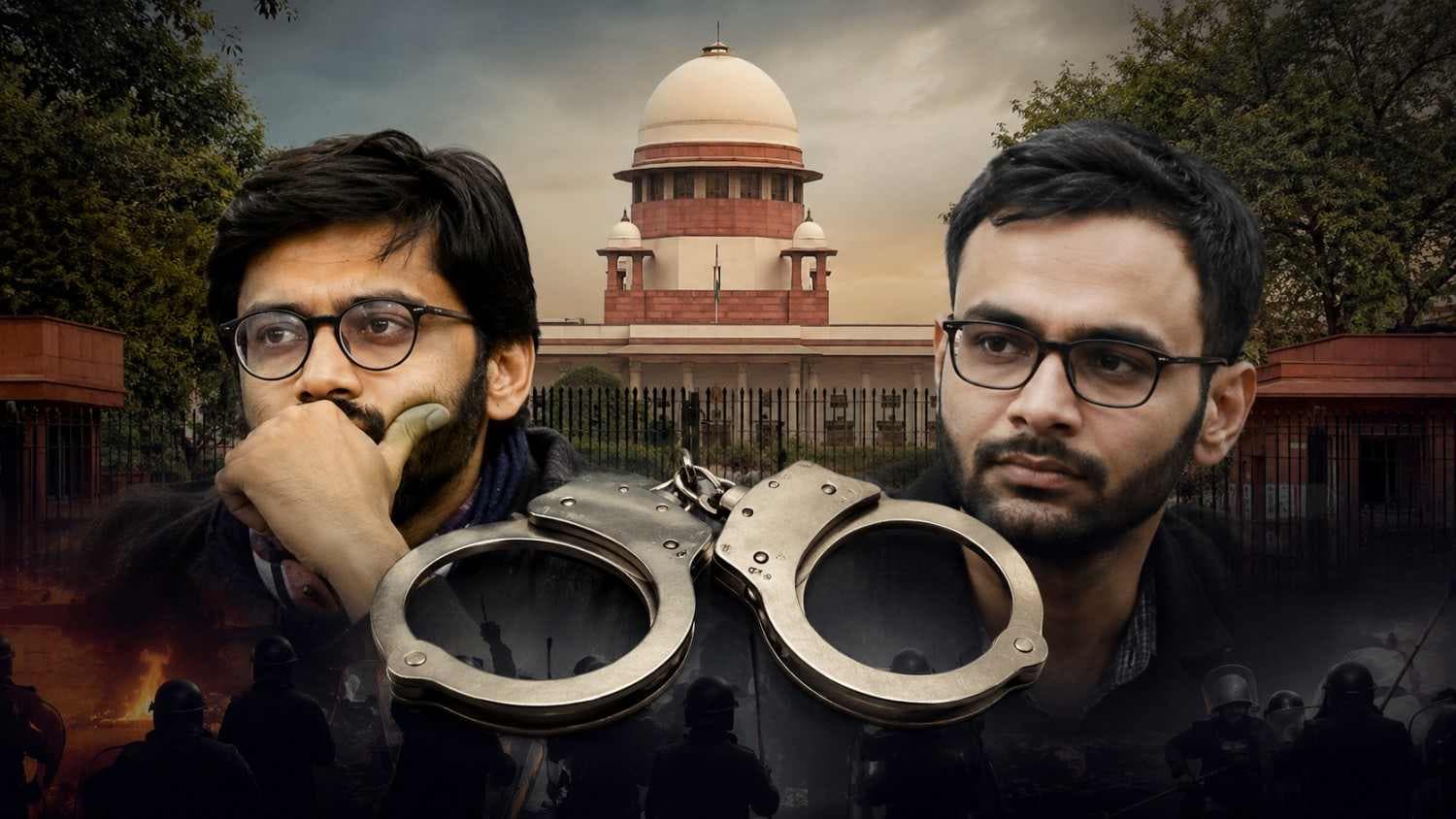
The Delhi Police has informed the Delhi High Court that the fresh bail applications moved by Umar Khalid and Sharjeel Imam in the larger conspiracy case relating to the 2020 North East Delhi riots are legally untenable and constitute an attempt to mislead the court by projecting an unrelated Supreme Court judgment as a change in circumstance. The applications were filed challenging the trial court’s rejection of their third bail pleas in the case registered under the Unlawful Activities (Prevention) Act, 1967.
The police, in its reply, has stated that Khalid and Imam are among the masterminds of the riots and that their continued detention is justified on the basis of their distinct risk profiles, as determined by the Supreme Court in its judgment in Gulfisha Fatima’s case. It further submitted that the apex court, while granting bail to Gulfisha Fatima and other co-accused, had expressly denied bail to Khalid and Imam, observing that their risk profiles were markedly dissimilar from those of the beneficiaries of the bail order.
The police has emphasized that the Supreme Court, in its order dated January 5, 2026, had granted bail to Gulfisha Fatima, Meera Haider, Shifa Ur Rehman, Mohd. Saleem Khan, and Shadab Ahmed, but denied the same to Khalid and Imam. The court had clarified that the two accused could renew their bail applications only after the examination of protected witnesses or upon the expiry of one year from the date of the order, whichever occurred earlier.
The police has objected to the petitioners’ reliance on the Supreme Court’s decision in Syed Iftikhar Andrabi v/s NIA to argue that there has been a change in circumstance. It submitted that the Andrabi judgment does not pertain to the Delhi riots case and that the factual findings recorded by the coordinate bench in Gulfisha Fatima’s case have not been questioned or overturned in the Andrabi judgment. Therefore, the police contended, the decision in Andrabi cannot override the specific findings and directions passed by the Supreme Court in the appellants’ own case.
The police has further pointed out that the trial court, while denying bail to Khalid and Imam, had expressly noted that it was bound to follow the Supreme Court’s judgment in Gulfisha Fatima’s case, which had denied bail to the two accused. The trial court had added that it had no option but to uphold the apex court’s directive that bail could not be considered until the completion of the examination of protected witnesses or the lapse of one year from the judgment, whichever was earlier.
The police has also referenced the procedural history, noting that in May, a division bench of the Delhi High Court led by Justice Aravind Kumar, while rejecting the bail pleas of Khalid and Imam, had observed a perceived conflict among different benches of the Supreme Court regarding the interpretation of the three-judge bench judgment in Union of India v. KA Najeeb, which had recognized prolonged delay in trial as a ground for bail under the UAPA. The division bench had referred the issue to a larger bench for definitive resolution.
The police has maintained that until such time as the larger bench settles the question of legal interpretation, or until the conditions specified by the Supreme Court in Gulfisha Fatima’s case are met, the bail applications of Khalid and Imam cannot be entertained on the grounds presently advanced. It has urged the court to reject the pleas as being premised on a misapprehension of the law and an impermissible attempt to re-agitate settled issues.