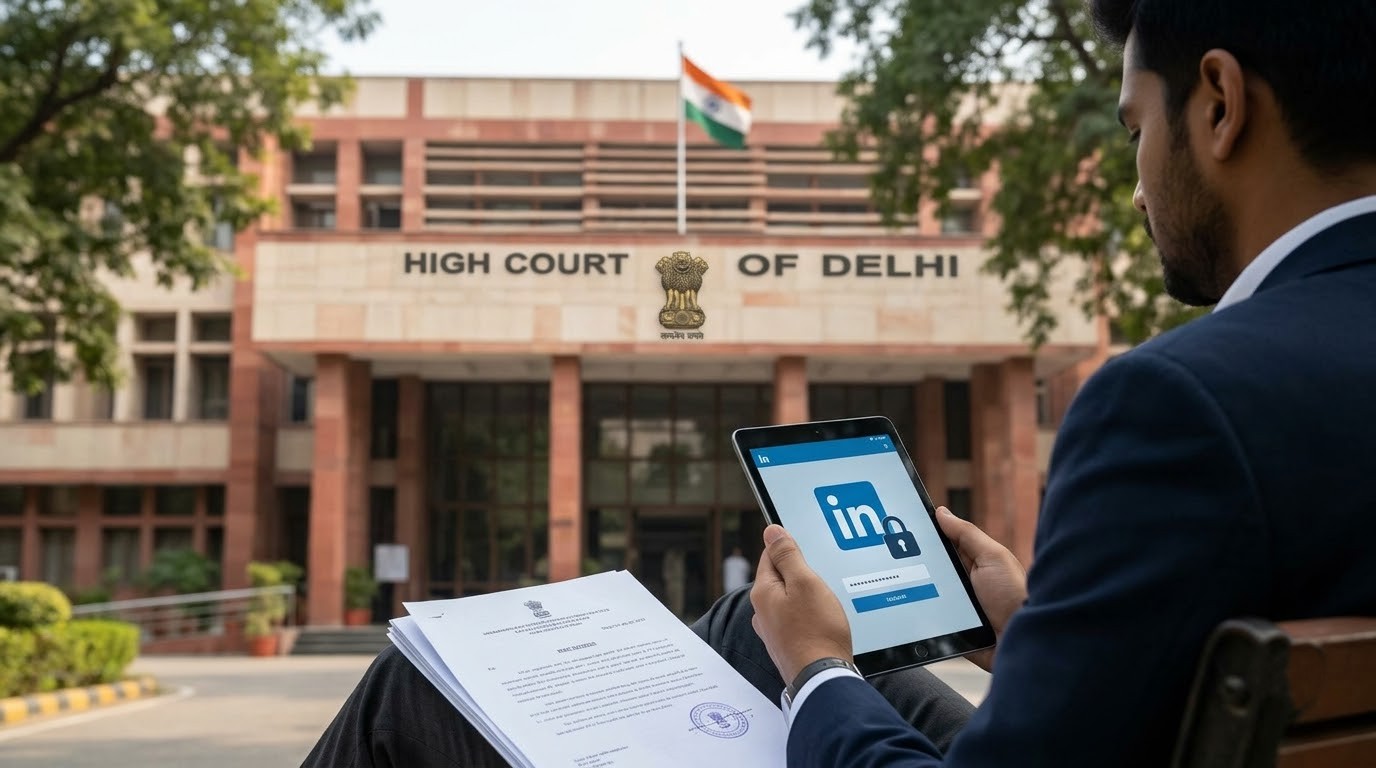
The Delhi High Court has delivered a significant judgment addressing the maintainability of writ petitions against private social media intermediaries. Justice Amit Mahajan dismissed a petition filed by Mayank Jain, which challenged the indefinite restriction imposed on his professional networking account by LinkedIn Technology Information Private Limited. The Court categorically ruled that private entities operating communication platforms do not discharge public functions or governmental duties, rendering them outside the scope of writ jurisdiction under Article 226 of the Constitution of India.
The petitioner had approached the court arguing that his profile was restricted without any prior warning or specification of the provisions violated under the platform user agreement. He submitted that despite submitting multiple representations and requesting a manual review, the platform responded only through template-based communications citing unspecified violations without furnishing supporting material. Although the Union of India was impleaded as a party, the primary reliefs sought by the petitioner were directed against the private corporate entity and its resident grievance officer.
Can a private social networking platform be subjected to writ jurisdiction under Article 226?
A private social networking platform cannot be subjected to writ jurisdiction under Article 226 unless it discharges a clear public duty or governmental function. The Delhi High Court held that merely providing a communication space for professional networking and expression does not amount to a state responsibility, making civil proceedings the appropriate remedy for aggrieved users.
The bench observed that while intermediaries such as LinkedIn play a substantial role in shaping professional discourse and information dissemination, public interaction remains merely a consequence of their commercial operations rather than an obligatory public duty. The Court emphasized that for a private entity to fall within the extraordinary writ jurisdiction of a constitutional court, its activities must be closely linked to a state obligation or undertaken through powers specifically conferred by law. Since the services provided by the platform are entirely voluntary and user-driven, neither the company nor its internal grievance officer can be viewed as public authorities.
Legal Parameter | Court Ruling | Appropriate Legal Remedy |
|---|---|---|
Writ Maintainability | Not maintainable against private intermediaries under Article 226 | Civil suit for damages or breach of contract |
Nature of Platform Function | Commercial communication service, not a public duty | Alternative statutory appeal before Grievance Appellate Committee |
Furthermore, the Court took note of the fact that the petitioner had already pursued an alternative statutory remedy by filing an appeal before the Grievance Appellate Committee established under the Information Technology Rules. Consequently, the High Court concluded that the constitutional writ jurisdiction was an incorrect forum for resolving contractual disputes involving private account restrictions. The bench clarified that the petitioner should pursue a civil suit if he seeks damages or private civil remedies, thereby upholding the dismissal of the writ petition.