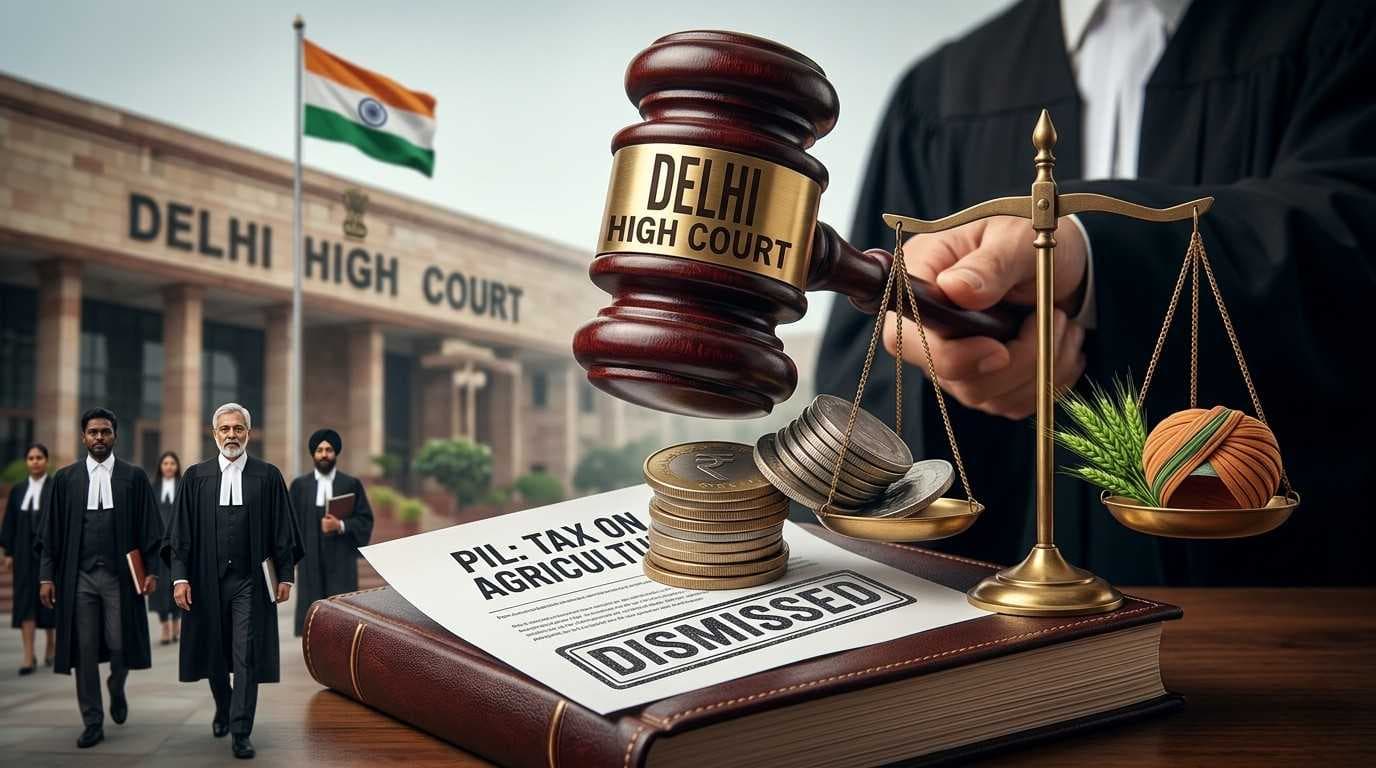
The Delhi High Court has dismissed a Public Interest Litigation (PIL) seeking to tax agricultural income in India, characterizing the plea as "thoroughly misconceived." In its ruling, the Bench led by Acting Chief Justice Manmohan and Justice Tushar Rao Gedela emphasized that the power to levy taxes is a sovereign function of the legislature. By refusing to entertain the petition, the judiciary has reaffirmed the clear separation of powers, stating that it cannot dictate fiscal policy or direct the government to introduce new taxation laws.
A central theme of the court's observation was that the decision to tax or exempt agricultural income is a matter of complex economic policy. The petitioner had argued that the exemption of large-scale farming income leads to significant revenue loss and creates an unfair playing field. However, the Court noted that such matters involve intricate socio-economic considerations, including food security and the welfare of the agrarian community, which are best addressed by elected representatives rather than through judicial mandates.
The Bench highlighted that the judiciary lacks the expertise and the mandate to evaluate the fiscal impact of such a massive structural change in the tax regime. The Court maintained that its role is to interpret the law and protect fundamental rights, not to step into the shoes of the Finance Ministry or Parliament. By dismissing the PIL, the judges signaled that "judicial activism" has its limits, especially when it concerns the core financial strategies of the state.
The judgment also touched upon the constitutional framework regarding agricultural taxation. Under the Indian Constitution, the power to tax agricultural income is primarily vested with the State governments, not the Central government. The Court observed that the petitioner failed to appreciate this federal distribution of power, making the plea legally flawed from its inception. The ruling serves as a reminder to litigants that PILs cannot be used as a shortcut to bypass constitutional boundaries.
Furthermore, the Court expressed concern over the increasing trend of using PILs to raise issues that are purely political or policy-oriented in nature. It noted that the judicial system is already burdened with a massive backlog of cases, and "misconceived" petitions of this nature consume valuable time that could be spent on genuine grievances. The Bench urged citizens and activists to engage with the legislative process and public debate for policy changes rather than seeking a "judicial shortcut."
The dismissal reinforces the principle of judicial restraint in matters of taxation. The Court noted that even if a policy seems debatable or "unfair" to some, it does not necessarily make it unconstitutional. As long as a policy is within the legislative competence of the government, the courts are generally unwilling to interfere. This provides a level of certainty to the government’s fiscal planning, ensuring that long-standing tax exemptions are not overturned by a single judicial order.
The ruling has been welcomed by various farmer organizations who argue that the agricultural sector, already grappling with climate change and fluctuating market prices, cannot bear the burden of income tax. On the other hand, it remains a point of debate among economists who advocate for a more inclusive tax base. Regardless of the economic debate, the Delhi High Court’s legal stance is definitive: the "taxation of the plow" is a decision for the ballot box, not the bench.
In conclusion, the Delhi High Court has upheld the sanctity of legislative domain by tossing out the challenge to agricultural tax exemptions. It sends a clear message to the legal community that policy-making is a deliberate process involving multiple stakeholders and experts, and the courtroom is not the appropriate forum for such discussions. As the gavel fell, the court ensured that the delicate balance between the three branches of government remains undisturbed, leaving the question of agricultural tax firmly in the hands of the people’s representatives.