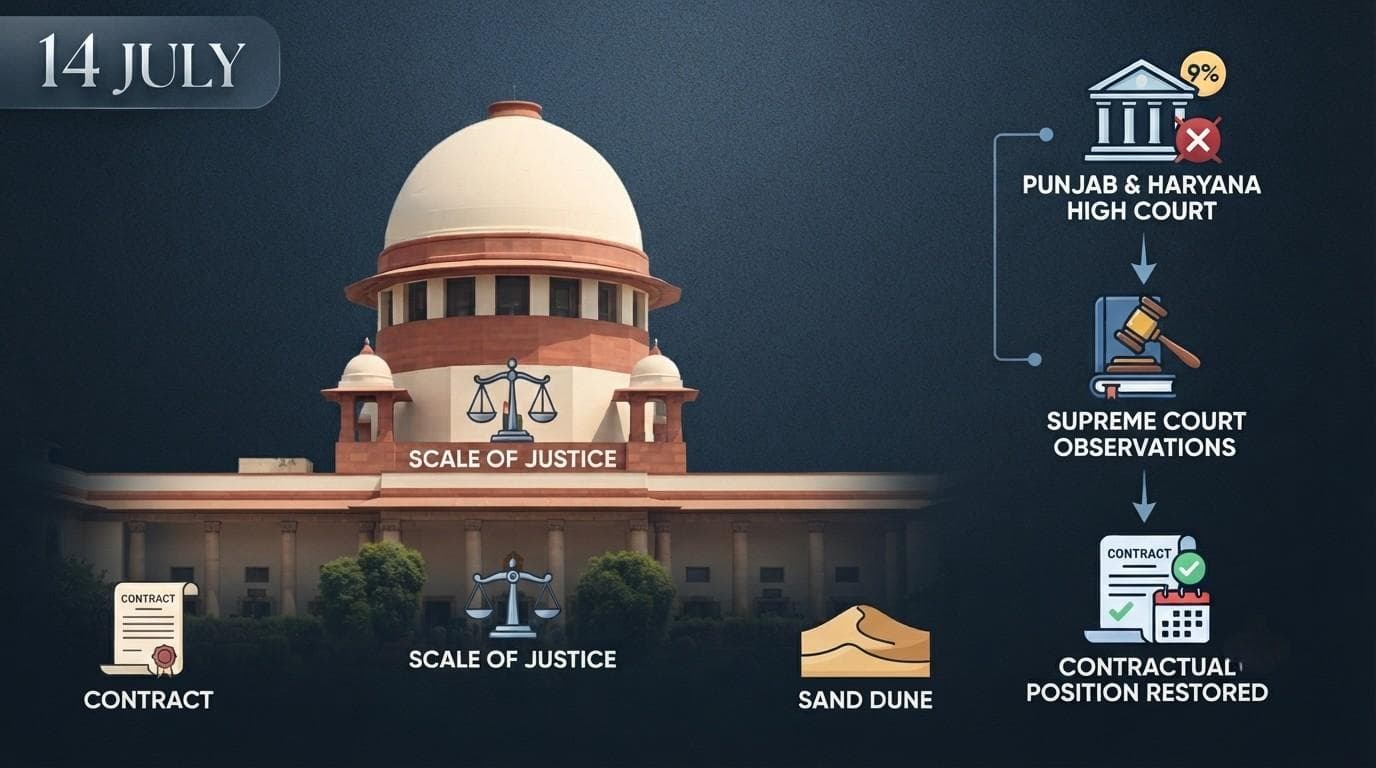
The dispute originated from a mining contract awarded by the State of Haryana for the extraction of Yamuna sand from the Bega Murthal Sand Zone. In April 1998 M/s. Jai Durgaa Finvest Pvt. Ltd. emerged as the highest bidder in an open auction and on 30 November 1998 entered into a three‑year agreement with the State. The agreement was executed on the statutory Form‑L, which contained Clause 19 stating: “The security deposited by the Contractor/Contractors shall not carry any interest. It shall be refunded to the Contractor within three months from the date of expiry or sooner determination of the contract.”
The contractor subsequently defaulted on monthly payments. Following notices issued under the agreement, the Director of Mines and Geology terminated the contract on 9 March 2000 and ordered forfeiture of the security deposit. The Punjab and Haryana High Court, in its judgment, declared Clause 19 “unsustainable in law” and directed the State to refund the security amount together with interest at nine percent per annum from the date of deposit. The State challenged that decision before the Supreme Court.
Supreme Court’s observations
A bench comprising Chief Justice Surya Kant and Justice V. Mohana heard the appeal. The Court observed that a stipulation in a commercial contract that denies interest on a security deposit is neither immoral nor unlawful and cannot be regarded as unsustainable in the legal sense. The bench emphasized that public policy cannot be invoked to nullify a contract that the parties have voluntarily accepted.
The judgment, authored by Justice Mohana, noted that the respondent had participated in the auction with full knowledge of the terms and had furnished an undertaking to abide by the Form‑L agreement. Once parties have entered into a contract with their eyes open and without protest, they cannot later assail the same as oppressive merely because the stipulation proves onerous after a substantial part of the contract period has elapsed.
The Court rejected the High Court’s reasoning that because the State charges interest on belated instalments it ought to pay interest on the security deposit. The bench held that such an analogy does not withstand scrutiny and that the courts are not empowered to rewrite contractual terms contrary to what the parties have agreed upon.
Operative outcome
Allowing the State’s appeal, the Supreme Court set aside the Punjab and Haryana High Court’s judgment and held that Clause 19 is a valid and binding term of the agreement. The Court clarified that the clause must be read as a whole: while it excludes interest on the security deposit, it also obliges the State to refund the amount within three months of the expiry or earlier termination of the contract.
Consequently, the bench ruled that no interest is payable for the first three months after termination of the contract. However, if the State retains the security deposit beyond that period, the contractor becomes entitled to interest for the period of retention. The Supreme Court thus restored the original contractual position and affirmed that parties are bound by the terms they have freely agreed to.