What is the legal status of a Fatwa under Indian law according to the Chhattisgarh High Court?
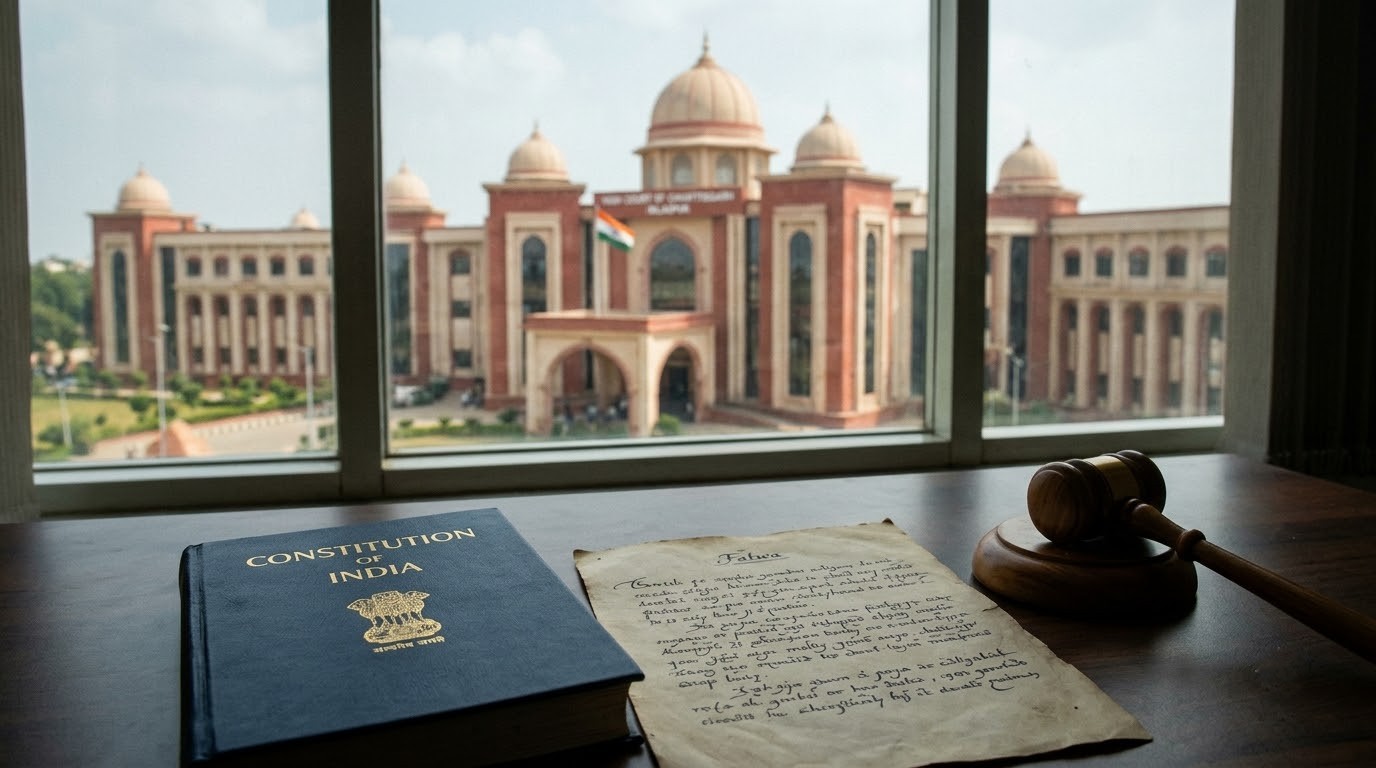
The Chhattisgarh High Court has reiterated that a Fatwa carries no binding legal force, lacks statutory recognition, and cannot be enforced through coercive methods or prejudice the legal rights of any individual.
The Chhattisgarh High Court has dismissed a writ petition instituted by a brother and sister who contended that a religious edict issued by a local mosque committee resulted in their social boycott. Justice Amitendra Kishore Prasad, presiding over the matter, held that religious opinions of this nature do not possess any statutory backing or binding enforceability. The petitioners had approached the bench seeking the quashing of an alleged directive issued by members of the Intezamiya Committee of Jama Masjid, alongside claiming compensation for harassment and humiliation stemming from the purported social boycott.
During the proceedings, the petitioners argued that the contentious edict was entirely arbitrary and infringed upon their fundamental right to life and personal liberty enshrined under Article 21 of the Constitution. They submitted that the mosque committee possessed no lawful authority to adjudicate upon their religious status or to command society to subject them to a boycott. Conversely, the State counsel placed reliance on an official inquiry report, which concluded that no directive targeting the petitioners had ever been promulgated and that no such boycott existed within the locality. Furthermore, the private respondents denied issuing any mandate against the petitioners, clarifying that the document in question merely constituted a response to a religious query concerning a marriage between a Sunni and a Shia Muslim.
In evaluating the legal dimensions of the dispute, the bench placed extensive reliance on the authoritative precedent established by the Supreme Court in the matter of Vishwa Lochan Madan versus Union of India. The apex court previously ruled that a Fatwa is strictly an expert opinion and is neither a judicial decree nor binding on the courts, the State, or private individuals. Because such a pronouncement does not originate from any legal judicial system recognized by the state, it cannot be executed through coercive mechanisms or force of law.
Applying these settled legal principles to the facts of the present case, the High Court observed that the private respondents disputed the construction placed upon the document by the petitioners and firmly denied orchestrating any social exclusion. The bench also highlighted the findings of the police inquiry report dated January 15, 2020, which verified the absence of any such edict or prevailing social ostracisation on the ground. The Court noted that the petitioners failed to produce cogent and tangible material establishing that the contested opinion had been actively enforced against them or that it directly resulted in any actionable infringement of their fundamental liberties.
Legal Parameter | Supreme Court Precedent | Chhattisgarh High Court Application |
|---|---|---|
Nature of Fatwa | Expert opinion, not a decree | No binding legal force or statutory backing |
Enforceability | Cannot be enforced through coercion | Cannot prejudice legal rights without proof of enforcement |
Consequently, the High Court concluded that the mere assertions raised within the writ petition were insufficient to warrant the constitutional reliefs prayed for by the litigants. The Court dismissed the writ petition while preserving the liberty of the petitioners to pursue any alternative remedies available to them under the applicable laws.