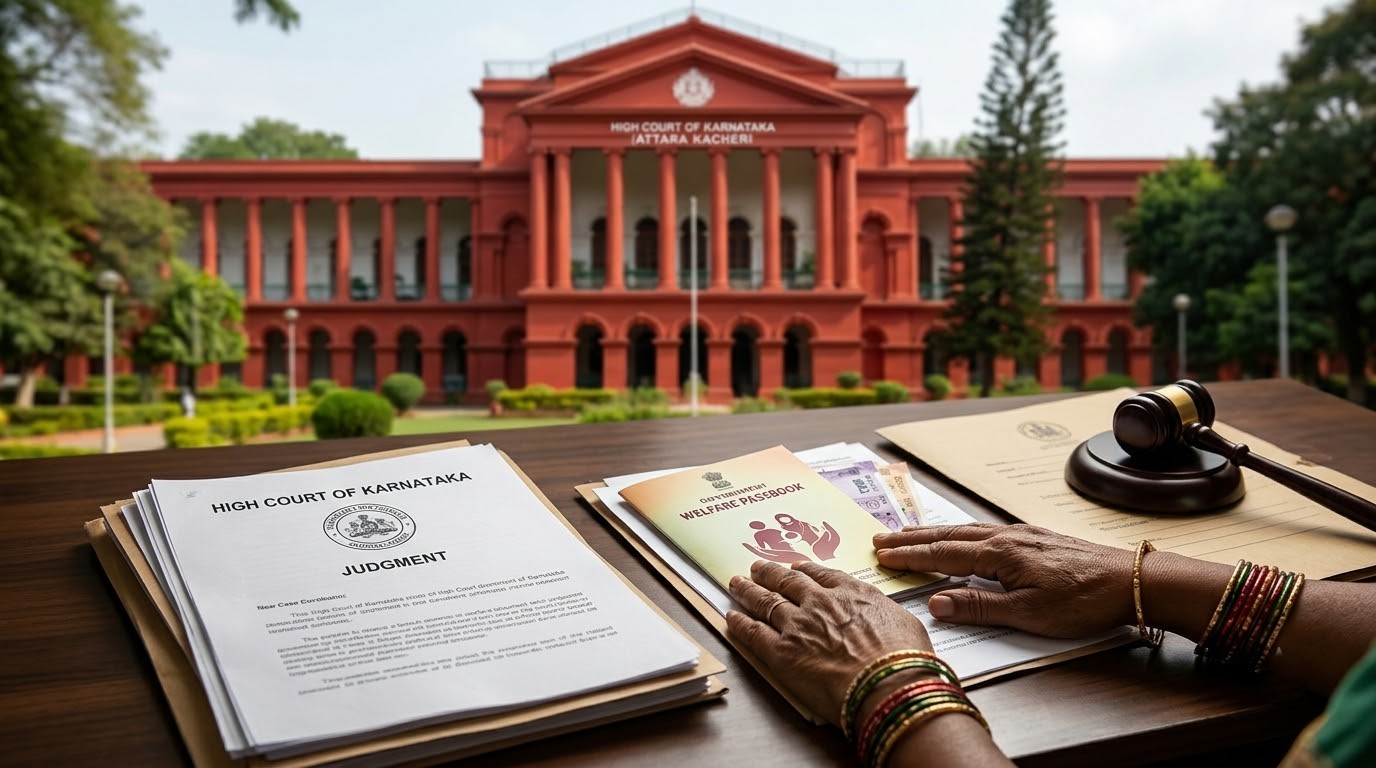
A division bench of the Karnataka High Court, comprising Justice Anu Sivaraman and Justice K S Bharat Kumar, on Thursday heard preliminary arguments in a public interest litigation challenging the non-disbursement of the Griha Lakshmi Yojana instalments for February and March 2025. The petition, filed by R Ganga and another beneficiary, seeks a writ of mandamus directing the state to release the arrears and to keep the allocated funds in escrow to prevent diversion.
State Argues Scheme Is Benevolent, Not Rights-Based
In a statement of objections filed before the court, the state government submitted that the Griha Lakshmi Yojana is a benevolent scheme. Its implementation, the government contended, depends largely upon administrative exigencies. The existence of a benevolent scheme providing financial assistance does not by itself confer an indefeasible right upon the petitioner to claim such financial assistance on the basis of legitimate expectation, particularly when the state is unable to disburse the assistance owing to genuine financial constraints. The petitioners cannot claim financial assistance under a benevolent scheme as a matter of right, nor can such a claim be founded solely on the doctrine of legitimate expectation, the objections stated.
Court Rejects Argument That All Beneficiaries Must Approach Court
During the hearing, the government advocate informed the bench that the petitioners are individual beneficiaries and cannot seek the release of amounts for all other beneficiaries who are not before the court. The bench orally rejected this argument, observing that the state cannot make all entitled beneficiaries come to court. Following this exchange, the government advocate submitted that payments have otherwise not been made for these two months.
Petition Alleges Breach Of Constitutional Guarantees
The PIL alleges a lapse of approximately Rs 5,000 crore from the public exchequer, affecting nearly 1.26 crore women beneficiaries. The petitioners contend that the total expenditure under the scheme to date is approximately Rs 54,000 crore, of which only about Rs 46,000 crore has been disbursed, leaving a gap of roughly Rs 8,000 crore. The February and March arrears form a substantial part of those allocated funds. The plea contends that the non-disbursement has resulted in a breach of Article 14 and Article 21 of the Constitution. It further argues that the state has committed a breach of the doctrine of legitimate expectations after making periodic payments for over a year and halting them for the aforesaid months without valid justification.
Can Beneficiaries Enforce Welfare Scheme Payments As A Legal Right ?
The state maintains that a benevolent welfare scheme does not create an enforceable legal right or a legitimate expectation that courts can compel, especially when financial constraints impede disbursement. The court has not yet ruled on this question and has directed the petitioners to file a rejoinder to the objections.
The matter has been posted for further hearing after two weeks.