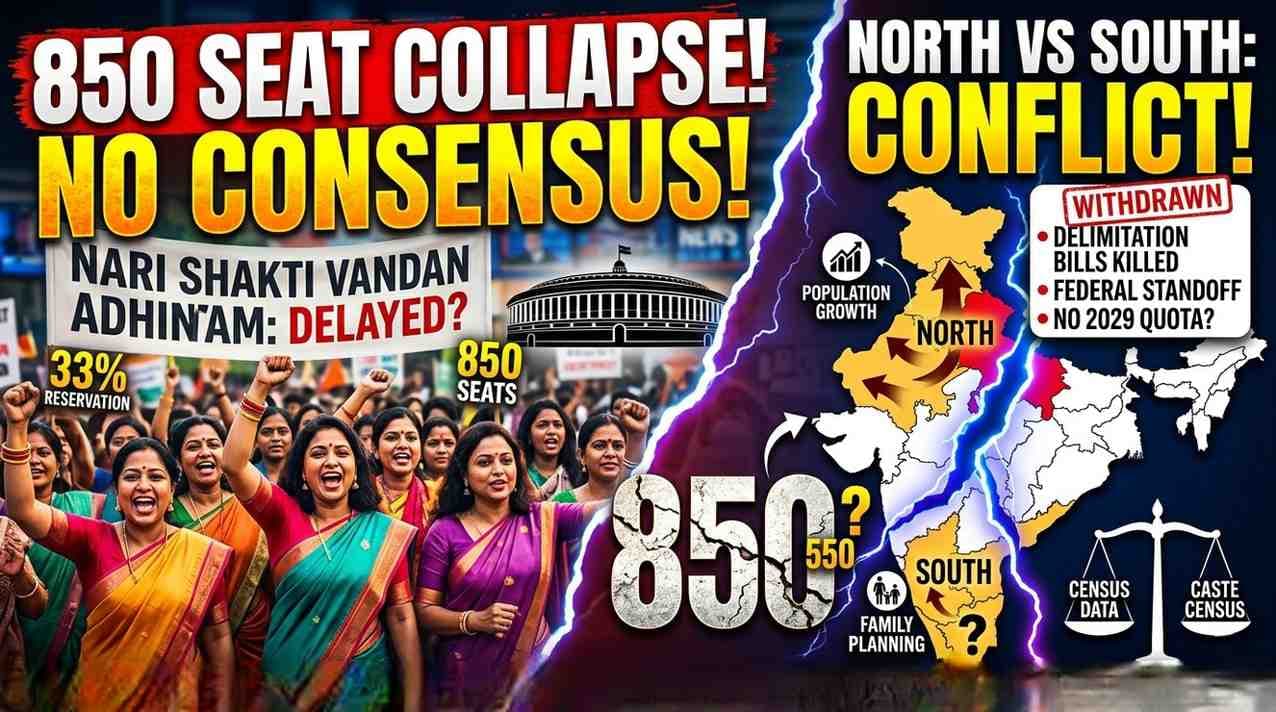
The Union government’s ambitious legislative package aimed at expanding the strength of the Lok Sabha to 850 seats has reportedly faced a major setback, with the Centre withdrawing the linked Delimitation Bills after failing to secure the necessary consensus. The Constitution (One Hundred and Thirty-First Amendment) Bill, 2026, which sought to remove the decades-old freeze on seat readjustment, was the cornerstone of a plan to implement the 33% women's reservation before the 2029 General Elections.
The proposal aimed to raise the ceiling of the Lower House from 550 to 850 (specifically 815 for States and 35 for Union Territories). This massive expansion was presented as a "mathematical necessity" to accommodate the Nari Shakti Vandan Adhiniyam without reducing the number of seats available for male candidates. However, the move triggered a fierce federal standoff, particularly from southern states who argued that a population-based expansion would unfairly penalize them for their successful family planning and population control measures.
Key Reasons for the Impasse:
- The North-South Divide: Southern states, led by Tamil Nadu and Kerala, expressed deep concerns that their political representation in the Union would be diluted. Despite assurances from the Home Ministry that their seats would increase in absolute numbers, the "relative share" of power was expected to shift heavily toward northern states with higher population growth.
- The Census Linkage: Opposition parties questioned the government’s attempt to "de-link" delimitation from the completion of a fresh decadal census. The proposal to use the 2011 Census or "any census Parliament determines" was criticized as a violation of the constitutional spirit of using current data for representation.
- Caste Census Demands: The debate was further complicated by the Opposition's demand for a "Caste Census" to be integrated into the delimitation exercise, a move the Centre has been reluctant to initiate.
The withdrawal of the Delimitation Bill, 2026 and the Union Territories Laws (Amendment) Bill marks a significant rare legislative retreat for the current administration. While the Home Ministry maintained that the "850 seats" figure was a rounded-off upper limit intended to protect regional interests, the lack of a "special majority" required for constitutional amendments made the Bills' passage untenable during the special sitting.
Legal and political analysts suggest that the implementation of women's reservation, which was tied to this delimitation exercise, may now face further delays. Without an expanded House, the rotation of existing seats to meet the 33% quota remains a politically sensitive task that most parties are hesitant to trigger. For now, the "Constitutional freeze" of 1976 remains in place, and the debate over India’s electoral map has been pushed back to the drawing board.