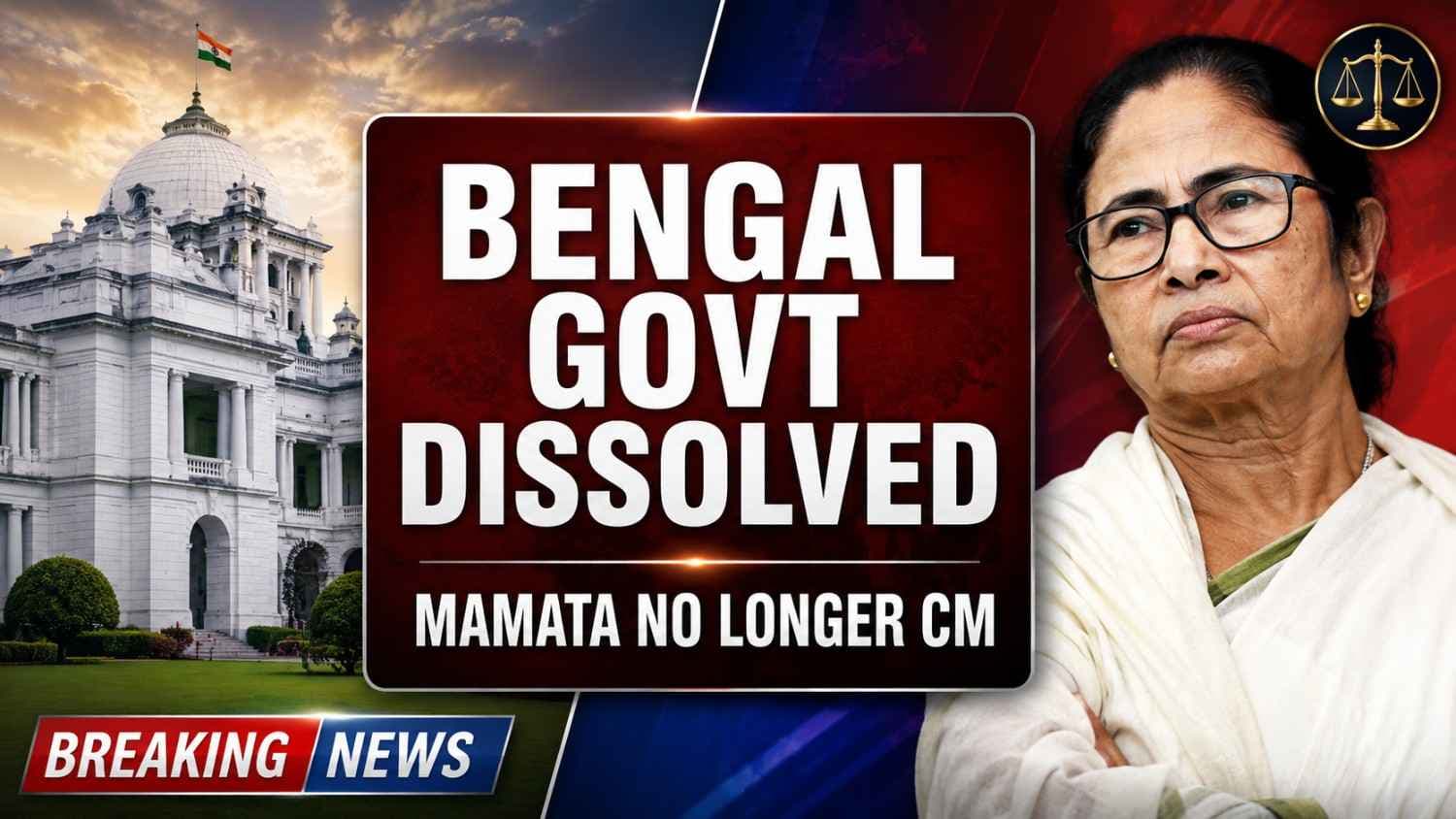
Kolkata: In a historic and dramatic turn of events, the West Bengal Governor, Shri R.N. Ravi, has officially dissolved the West Bengal Legislative Assembly today, May 7, 2026. With this order, the long-standing tenure of Mamata Banerjee as the Chief Minister of West Bengal has come to an end.
The Governor’s decision follows a tense political standoff after the recently concluded 2026 Assembly Elections, where the Trinamool Congress (TMC) suffered a defeat against the Bharatiya Janata Party (BJP). Despite the election results, Mamata Banerjee had refused to tender her resignation, citing a "conspiracy" and a "looted mandate," leading to a potential constitutional deadlock.
The Governor’s Order and Article 174
The official notification from Lok Bhavan stated that the Governor exercised his powers under Article 174(2)(b) of the Constitution of India. This article grants the Governor the authority to dissolve the Legislative Assembly.
The move became necessary as the five year term of the previous assembly, constituted in 2021, expired today. In India’s parliamentary democracy, a government cannot continue in office once its term ends or if it loses the majority in an election. Since the TMC was reduced to 80 seats against the BJP’s 207 seats, the Governor acted to ensure the constitutional machinery did not break down.
Why Mamata Banerjee is No Longer CM
Under the Indian Constitution, the Chief Minister and the Council of Ministers hold office "during the pleasure of the Governor" (Article 164). However, this "pleasure" is tied to the government having a majority in the house.
While Mamata Banerjee earlier declared, "No question of me resigning," legal experts point out that a Chief Minister cannot remain in power after the Assembly term expires and a new majority has been declared by the Election Commission. By dissolving the Assembly, the Governor has formally stripped the outgoing government of its legal status, clearing the way for the formation of a new government.
Context of the 2026 Elections
The 2026 West Bengal Assembly elections were one of the most closely watched contests in recent history. The BJP emerged victorious with a clear majority of 207 seats, while the TMC, which had ruled for 15 years, saw its numbers drop significantly.
The transition, however, has been marred by reports of political unrest and legal challenges. The TMC has already announced its intention to move the courts against the election results and the Governor's recent action.
What Happens Next?
With the Assembly dissolved, the decks are now clear for the Governor to invite the leader of the majority party to form the next government. This dissolution is a standard constitutional process, but the refusal of the outgoing Chief Minister to step down added a layer of complexity that required the Governor’s direct intervention.
The legal community is closely watching how the courts will respond to the TMC's planned petitions. For now, the administrative control of the state transitions into a caretaker phase until a new Chief Minister is sworn in.
This development marks the end of an era in Bengal politics and sets the stage for a new legislative chapter in the state.
Stay tuned to our legal news portal for live updates and expert analysis on the West Bengal constitutional crisis.