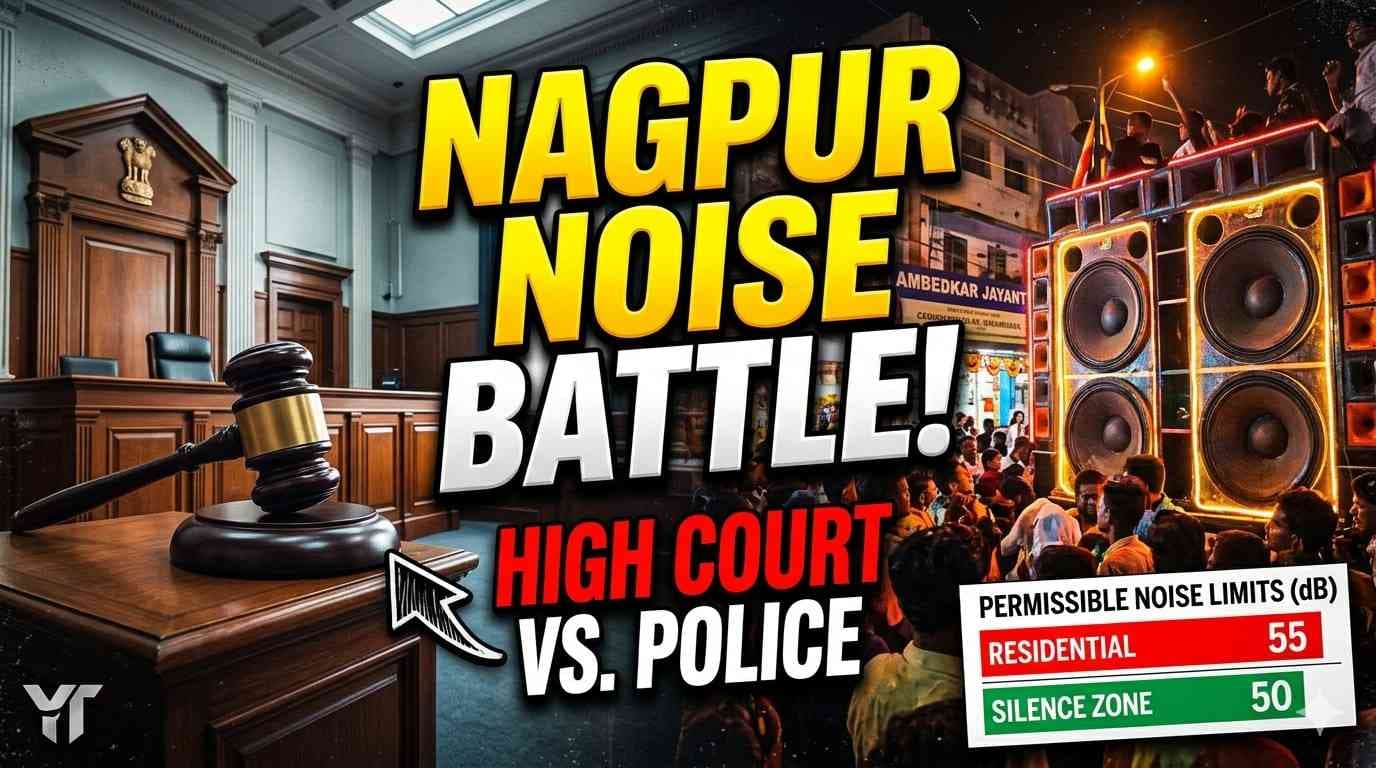
The Nagpur Bench of the Bombay High Court has expressed strong displeasure over the "alarming" levels of noise pollution witnessed during recent public celebrations in Nagpur, specifically citing events related to Ambedkar Jayanti. While hearing a PIL regarding the implementation of the Noise Pollution (Regulation and Control) Rules, 2000, the court observed that despite previous directions, the city's streets were dominated by high-decibel sound systems that caused significant distress to residents, particularly the elderly and patients.
The division bench noted that while festivals and jayantis are an integral part of social and cultural life, they must be celebrated within the "four corners of the law." The court was particularly critical of the use of massive DJ walls and sound amplifiers that far exceeded the permissible decibel limits for residential and silent zones. The justices remarked that such noise is not just a nuisance but a serious health hazard that can lead to permanent hearing loss and cardiovascular stress.
A central point of the court’s inquiry was the perceived "administrative paralysis" in enforcing the law. The bench questioned why the police and the Maharashtra Pollution Control Board (MPCB) failed to seize unauthorized sound equipment or stop the noise in real-time. The court highlighted that a "fear of the law" must be maintained to ensure that public celebrations do not trample upon the fundamental right to a quiet and healthy environment, guaranteed under Article 21 of the Constitution.
During the proceedings, the court took note of reports suggesting that several hospitals and educational institutions in Nagpur were severely impacted by the loud music. The bench emphasized that "Silence Zones"—areas within 100 meters of hospitals and schools—are non-negotiable. The court has now directed the Commissioner of Police and the Municipal Commissioner to submit a detailed report on the number of permissions granted, the monitoring mechanisms used, and the punitive actions taken against violators.
The legal discourse around noise pollution in India has seen a shift toward stricter accountability. The High Court reiterated that the right to celebrate is subject to "reasonable restrictions" and cannot override the right of other citizens to live in peace. The bench also touched upon the responsibility of organizers, noting that honoring a great leader like Dr. B.R. Ambedkar should involve following the very constitutional values and laws he helped create, rather than flouting them.
This intervention by the Bombay High Court serves as a timely reminder as the city prepares for future festivities. It underscores the judiciary's role in balancing cultural expressions with environmental sustainability. For the residents of Nagpur, the court's tough stance offers a glimmer of hope for a more regulated and peaceful public square.
In conclusion, the Bombay High Court’s questioning of the Nagpur authorities is a call for systemic reform in how the state manages public events. As the case moves forward, the focus will be on whether the administration can move beyond "paper circulars" and implement actual "on-ground enforcement" to protect the city from the growing menace of noise pollution.
This chart illustrates the permissible noise limits in different zones (Industrial, Commercial, Residential, and Silence) as per the Noise Pollution Rules, helping you understand the legal thresholds discussed by the High Court.