The matter arose from a criminal revision petition filed by Santosh Kumar challenging an order passed in August 2025 by the Principal Judge, Family Court, Chitrakoot. The Family Court had directed Santosh Kumar to pay Rs 2,000 per month to the woman and Rs 1,000 per month to their minor daughter until she attains majority. The woman asserted that she had solemnised a second marriage with Santosh Kumar through a compromise notarised on 10 June 2006, performed in the presence of witnesses and according to Hindu rites. She stated that they began cohabiting as husband and wife and that a daughter, now approximately eight years old, was born from their union. She further contended that after the child’s birth, Santosh Kumar’s conduct turned abusive, he ceased providing food and financial support despite earning between Rs 18,000 and Rs 20,000 per month as a mason.
During cross‑examination, the woman admitted that she had been married to another man about fifteen years earlier and had two children from that marriage. She also acknowledged that she had not obtained a divorce from her first husband before commencing cohabitation with Santosh Kumar. She conceded that the second marriage was not solemnised in accordance with Hindu rites and rituals. The first husband subsequently died while she was already residing with Santosh Kumar.
The Family Court, after examining the evidence, had granted maintenance to both the woman and the child. Santosh Kumar filed the revision petition contending that the order against him was unsustainable because the woman could not be regarded as his legally wedded wife under Section 125 CrPC.
High Court’s Observations on the Status of the Woman
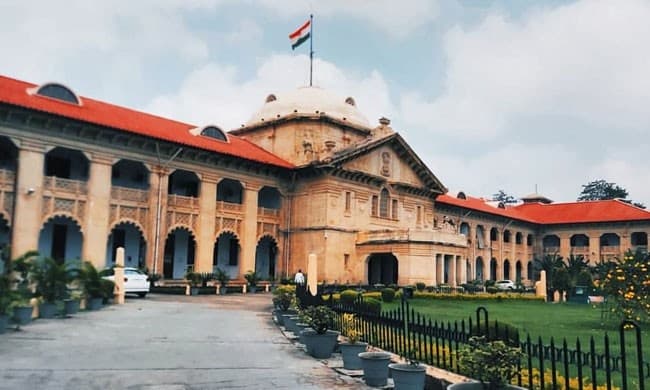
The Allahabad High Court, after perusing the record, noted that the trial court itself had recorded a finding that the woman had failed to prove that her marriage with Santosh Kumar was solemnised as per Hindu rites and rituals. The Court further observed that the woman’s first husband was alive when she started living with Santosh Kumar. Justice Achal Sachdev, delivering the judgment, stated: “From the perusal of evidence on record, it is clear that the applicant no. 1 does not qualify the term ‘legally wedded wife’ of the opposite party, and the trial court has erred in passing the maintenance order in favour of applicant no. 1 (woman).”
The bench explained that Section 125 CrPC entitles a wife to claim maintenance only if she is a legally wedded wife of the person from whom maintenance is sought. The expression “legally wedded wife” presupposes a valid marriage subsisting at the time of the claim. A marriage entered into while the first spouse is still alive is void under Section 5 of the Hindu Marriage Act, 1955, and consequently does not confer the status of a legally wedded wife. The Court held that the woman’s admission that her first husband was alive at the commencement of her relationship with Santosh Kumar, coupled with her inability to prove compliance with Hindu marital rites, rendered the second marriage void for the purposes of Section 125 CrPC.
Protection of the Minor Daughter’s Right to Maintenance
Although the woman’s claim was rejected, the High Court upheld the maintenance awarded to the minor daughter. The Court relied on a DNA report on record which established that Santosh Kumar and the woman are the biological parents of the child. Referring to Section 125(1)(b) CrPC, the bench observed that a father is obligated to maintain his children who are unable to maintain themselves, irrespective of whether the children are legitimate or illegitimate. The judgment clarified that the daughter’s entitlement to maintenance flows directly from the father’s statutory duty and is not contingent on the validity of the parents’ marriage.
Accordingly, the Court partly allowed the criminal revision petition: it set aside the maintenance order in favour of the woman while confirming the order for the daughter’s maintenance. The revisionist remains liable to pay Rs 1,000 per month to the daughter until she attains majority.
Implications of the Judgment
The decision reinforces the principle that maintenance under Section 125 CrPC is contingent upon the existence of a valid marriage at the time of the claim. It signals that parties cannot circumvent the requirement of divorce by entering into a subsequent relationship and then seeking maintenance on the basis of a putative marriage. The judgment also underscores that the welfare of children remains protected irrespective of the marital status of their parents, affirming the legislature’s intent to safeguard minors from destitution.
Legal practitioners may view this ruling as a clarification of the interplay between personal laws governing marriage and the procedural provisions of the Code of Criminal Procedure. It serves as a precedent for future cases where a claimant’s marital status is disputed, reminding courts to scrutinise the validity of the marriage before granting spousal maintenance under Section 125 CrPC.