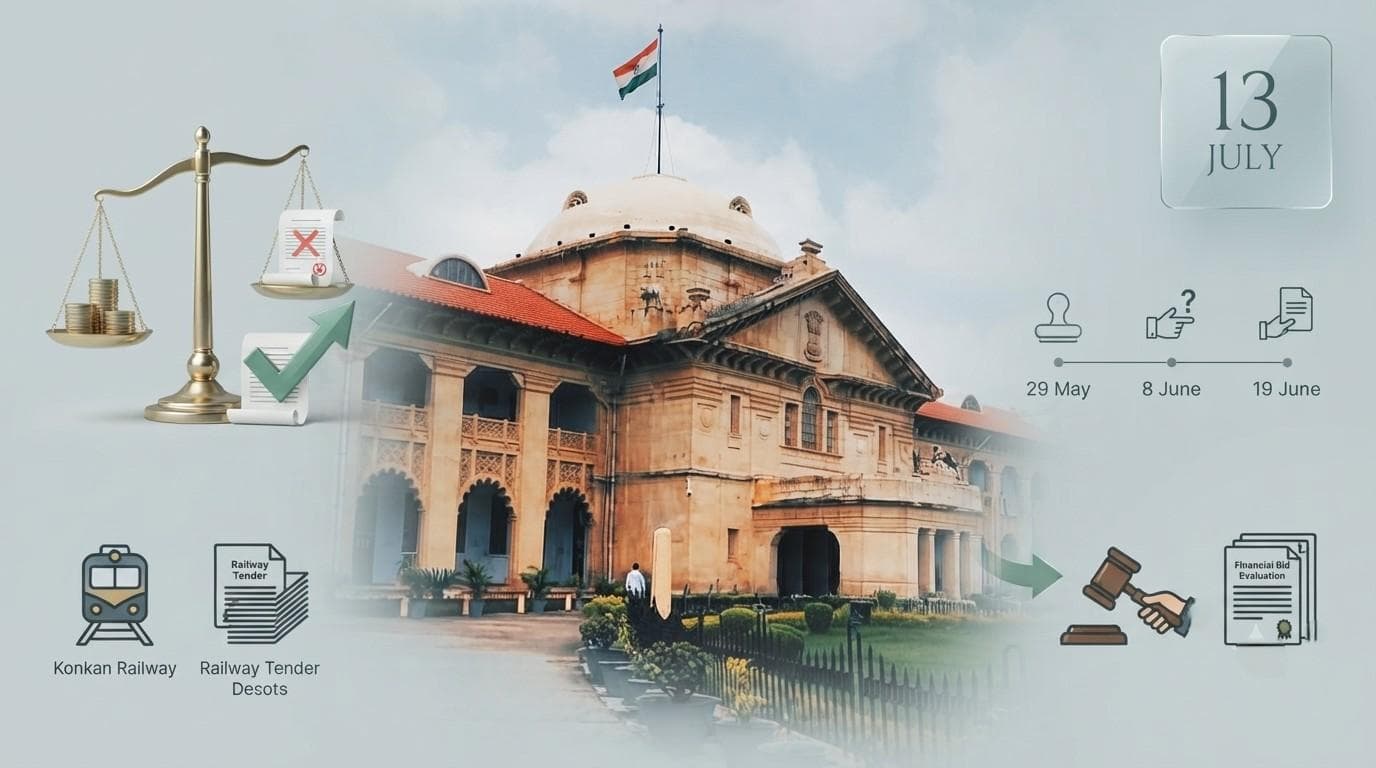
The Varanasi Division of the North Eastern Railway issued a tender for capacity upgradation of electric traction power supply installations on an engineering, procurement and construction basis. The estimated value of the work was Rs 262.12 crores. Konkan Railway Corporation Limited (KRCL) submitted its financial bid, which was the lowest among the participants. The North Eastern Railway (NER) initially rejected the bid on the ground that the bank guarantee accompanying the bid lacked adequate stamp duty.
KRCL approached the Allahabad High Court challenging that rejection. In an order dated 29 May 2026, a Division Bench comprising Justice Shekhar B Saraf and Justice Abdhesh Kumar Chaudhary held that an insufficient stamp duty on a bank guarantee is merely a lacuna and a curable defect. The Court directed NER to allow KRCL to rectify the deficiency and observed that the authorities’ conduct appeared mala fide, as it seemed aimed at eliminating KRCL despite its lowest bid.
Subsequent Rejections and the Present Petition
Following the Court’s direction, KRCL furnished a bank guarantee with the requisite stamp duty. NER, however, returned the guarantee on 8 June 2026, citing a new objection: the beneficiary name mentioned in the guarantee was incorrect. KRCL promptly submitted a fresh guarantee with the correct beneficiary’s name on 19 June 2026. NER again rejected the guarantee, this time on the ground that the submission was belated.
Aggrieved by this fresh rejection, KRCL filed the present petition before the Lucknow Bench of the Allahabad High Court.
Court’s Examination of the Authorities’ Conduct
During the hearing, the Bench noted that NER ought to have raised the issue of the incorrect beneficiary name at the earliest opportunity, preferably during the first round of litigation when the stamp duty objection was addressed. The Court examined the correspondence and found that the defects pointed out by NER – first the stamp duty inadequacy and later the beneficiary name – were both curable.
The Bench observed that the authorities appeared fixated on preventing KRCL’s participation in the tender by raising one ground after another. It stated that all the defects raised by NER were curable and could have been highlighted much earlier. Consequently, the rejection of KRCL’s bid on such grounds amounted to a gross violation of the principles of natural justice and contravened established legal tenets.
Comparison with Another Railway Division
The Court drew a contrast with the approach adopted by the Southern Railway (Chennai), another unit of the same organisation. In March 2026, the Southern Railway had treated an analogous error in the beneficiary name of a bank guarantee furnished by KRCL as a curable defect and had permitted the petitioner to rectify the mistake. The Bench remarked that it was rather amused to see two different standards being applied by two arms of the same state instrumentality, emphasizing that railways, as a state entity, must function uniformly and fairly.
Findings and Operative Directions
Characterising NER’s conduct as arbitrary, whimsical and tainted with mala fide, the Bench held that the authorities ought to have disclosed the inaccuracy in the beneficiary name at the very first instance. It further observed that, as a model employer, the railway authorities cannot indulge in a game of hide and seek with bidders.
Concluding that NER was hell‑bent on ousting the legitimate participation of KRCL in the tendering process, the Court set aside the rejection order dated 8 June 2026. It directed the North Eastern Railway authorities to accept the corrected bank guarantee submitted by KRCL and to evaluate the petitioner’s financial bid within three working days, thereafter proceeding with the tender in accordance with law.
Implications
The decision reinforces the principle that curable defects in tender documents cannot be used as a basis for disqualifying a bidder, especially when the defect could have been rectified earlier. It also serves as a reminder to state instrumentalities to maintain consistency and fairness across their various divisions, lest their actions be construed as an abuse of power.